Toddler Tantrums: Why They Happen and What to Do Before, During and After

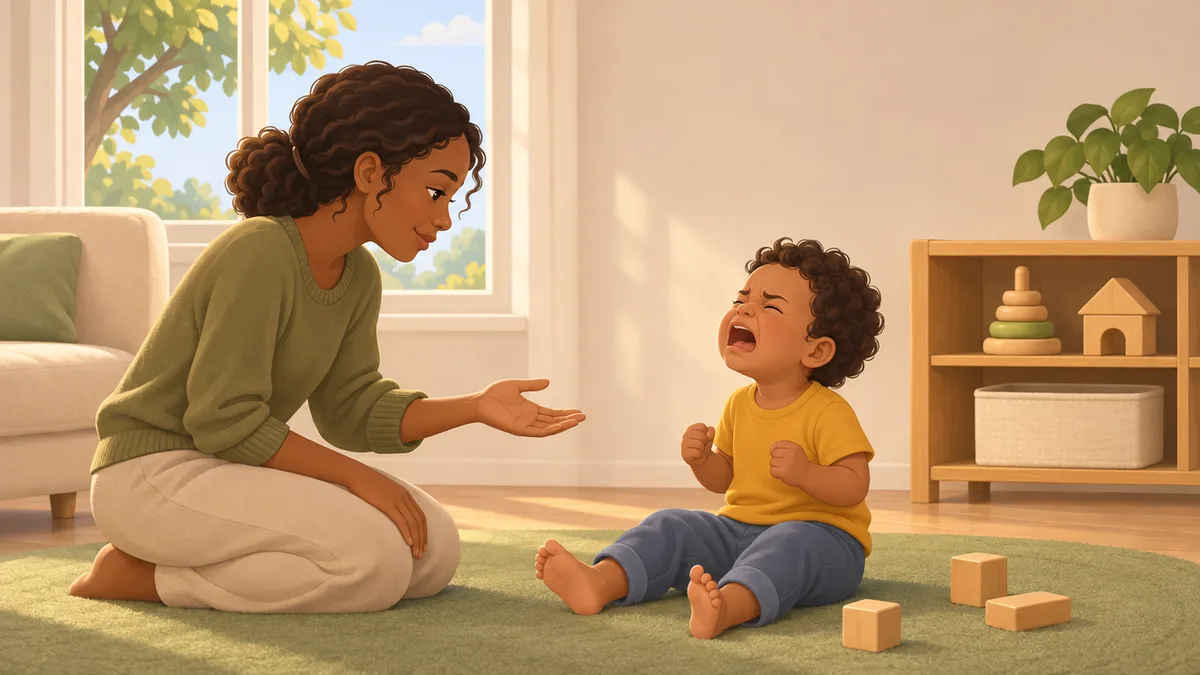
Quick answer: toddler tantrums are a normal part of development. They are most common between ages 1 and 3, usually become less frequent after 3, and are far less common by about age 4 as language and self-control improve. Most tantrums are driven by frustration: a toddler wants independence and has big feelings but not yet the words or skills to handle them, and being tired, hungry or unwell makes everything worse. In the moment, keep your child safe, stay calm, name the feeling in a few words, skip long explanations and do not give in to the demand that started it. Afterward, reconnect with a hug and praise the calming down. Talk to your pediatrician if tantrums are getting longer, more intense or more frequent, if your child often hurts themselves or others, or if you often feel out of control when you respond.
Few things test a parent like a toddler face-down on the supermarket floor because the banana broke. The good news is that tantrums are not a sign of bad parenting or a “difficult” child. They are a phase with a fairly predictable pattern, and the way you respond can make them shorter, less frequent and less stressful for everyone. This guide is organized the way tantrums actually happen: what is behind them, what to do before, during and after, and what to say when your brain is running on empty.
Why toddlers have tantrums
A tantrum can look like whining and crying, screaming, kicking, throwing, hitting or, in some children, holding their breath. Nemours KidsHealth notes that tantrums are equally common in boys and girls and usually happen between ages 1 and 3. A few forces collide in those years:
- A drive for independence. Around age 2, children start forming strong opinions and want to do things themselves, often more than they actually can. Cleveland Clinic describes tantrums as one way toddlers try to exert that independence.
- Language that lags behind feelings. Toddlers usually understand more than they can say, and words for emotions come later still. When they cannot explain what they want, frustration comes out as a meltdown. As they start talking more, tantrums tend to ease.
- Immature self-regulation. The CDC points out that emotions like anger and sadness can feel very intense for young children, and that outbursts are a normal way for them to release that energy and return to calm.
- Basic needs. Tired, hungry, sick or overstimulated children have a much shorter fuse, just like adults.
Not all tantrums are the same
One of the most useful shifts is to ask “what kind of tantrum is this?” before deciding how to respond. Cleveland Clinic and the CDC both describe responding differently depending on what is driving the behavior.
| Type of tantrum | What it looks like | What usually helps |
|---|---|---|
| Needs-driven (tired, hungry, sick, overwhelmed) | Melts down late in the day, before a meal, after a long outing or when unwell | Meet the need: snack, rest, a quiet space, comfort. These are not tantrums to ignore. |
| Frustration (“I can’t do it”) | Puzzle piece will not fit, shoe will not go on, tower falls | Stay close, name the feeling, offer a little help or a simpler step once the peak passes |
| Limit-driven (“I want it”) | Starts after hearing “no” to a toy, a treat or more screen time | Calm, brief empathy without giving in: “You really wanted it. We’re not buying it today.” |
| Attention-seeking (minor, safe behavior) | Whining or fussing that escalates when you are busy or on the phone | Briefly redirect your attention away from the behavior, then return attention and praise as soon as it stops |
| Unsafe (hitting, biting, throwing, running off) | Hurts self, others or property, or puts the child in danger | Stop it immediately and move your child somewhere safe. Never ignore unsafe behavior. |
The CDC is clear that ignoring should be brief and used only for minor, attention-seeking behavior, never when a child is hungry, tired, sick or genuinely distressed, and never for dangerous behavior.
Before: how to prevent some tantrums
You cannot prevent every tantrum, and that is not the goal. But a few habits from the American Academy of Pediatrics (AAP) and KidsHealth reduce how often they happen:
- Catch them being good. Give plenty of specific praise for behavior you want more of: “You waited so patiently for your turn.”
- Offer small choices. “Red cup or blue cup?” works better than “Do you want to drink now?”, which invites a “no.” Give control over things that do not matter much.
- Know your child’s limits. If tantrums spike when your child is hungry, carry a snack. If they spike when tired, protect naps and bedtime, even if it means skipping an errand.
- Keep off-limits things out of sight. Fewer temptations mean fewer battles over “no.”
- Give warnings before transitions. “Two more slides, then we go home” helps many toddlers shift gears.
- Choose your battles. If the request is harmless (mismatched socks, the green spoon), saying yes is not “giving in.”
- Protect sleep. KidsHealth notes that getting enough sleep can greatly reduce tantrums. A predictable bedtime routine is one of the best long-term tools.
During: what to do in the moment
When a tantrum is in full swing, think of your job as keeping everyone safe and staying the calm one, not winning the argument.
1. Check safety first
Move your child away from stairs, streets, hard edges or other children if needed. If they are hitting, biting or throwing, stop the behavior right away. The AAP calls for a zero-tolerance approach to hitting, kicking, biting and throwing.
2. Get calm yourself
Yelling back makes tantrums longer, not shorter. Take a slow breath, lower your voice and, if you can, get down to your child’s eye level. If you feel your own anger rising and your child is safe, it is fine to step a few feet back for a moment.
3. Name the feeling in a few words
“You’re mad. The tower fell.” Cleveland Clinic explains that labeling feelings teaches children the words they will eventually use instead of screaming. The CDC’s emotion coaching approach is built on the same idea: notice, connect, listen and name the emotion.
4. Say less
Toddlers are not rational at the peak of a tantrum, and long explanations will not land. Short, calm phrases and your steady presence matter more than the words.
5. Hold the limit, offer comfort
If the tantrum started because of a “no,” keep the “no.” The NHS notes that giving in, or bribing with sweets, teaches a child that tantrums work. You can still comfort: “I know you’re upset. I’m right here. We’re not buying the cookie.”
6. Wait it out
Many tantrums simply need to run their course. Stay nearby so your child knows you have not left. Some children want a hug; others need a little space first. Some parents find that firmly holding a child helps when the child is more upset than angry, as the NHS describes, but only if you feel calm enough to do it gently.
What to say (and what to skip)
| Instead of | Try |
|---|---|
| “Stop crying right now!” | “You’re really sad. I’m here.” |
| “There’s no reason to be upset.” | “You wanted the blue cup. That’s frustrating.” |
| “Fine, take the phone.” | “The phone is not for now. You can hold the keys or the spoon.” |
| “If you don’t stop, we’re never coming to the park again.” | “When your body is calm, we’ll put shoes on and go.” |
| “Bad boy / bad girl.” | “I won’t let you hit. Hitting hurts.” |
| A long explanation of why candy is unhealthy | “Not today.” Then quiet, steady waiting. |
After: reconnect and teach
The minutes after a tantrum are when real learning happens, because your child can finally listen.
- Reconnect. A hug and a simple “I love you, even when you’re upset” tells your child the relationship is safe. KidsHealth notes that children can feel especially vulnerable after a tantrum.
- Praise the calming down. “You calmed your body. That was hard.”
- Follow through. If the tantrum was about a task, like getting into the car seat, the task still happens once your child is calm.
- Give words for next time. With older toddlers, practice simple phrases or signs for “help,” “mad” or “stop.” Simple baby signs can help children who are not talking much yet.
- Look for patterns. If tantrums cluster before lunch or after daycare pickup, adjust the schedule rather than bracing for the same battle.
Tantrums in public
Stores, restaurants and family gatherings are classic tantrum zones, and embarrassment makes it harder to stay calm. A few things help:
- Keep outings short and plan them after naps and meals.
- Give your child a job, like holding the list or finding the bananas, as the NHS suggests.
- If a tantrum starts, move to a quieter spot (the car, an empty aisle, outside) and handle it the same way you would at home.
- Ignore the looks. Your consistency matters more than strangers’ opinions, and most of them have been there.
Breath-holding spells
Some toddlers hold their breath during a tantrum, sometimes until their lips change color or they briefly pass out. KidsHealth lists breath-holding spells among tantrum behaviors. These episodes are frightening to watch, so if it happens, mention it to your pediatrician so they can explain what to expect and check for anything that needs follow-up. If your child is not breathing normally afterward, call emergency services.
When to talk to your pediatrician
Most tantrums are not a cause for concern and fade with age. Based on guidance from KidsHealth, the AAP and the NHS, check in with your child’s pediatrician if:
- tantrums are becoming more frequent, more intense or longer over time;
- your child often hurts themselves or others, or destroys things during tantrums;
- tantrums are still frequent and intense as your child gets past age 4, when they are usually much less common;
- your child seems unusually disagreeable most of the time and rarely cooperates;
- you have concerns about speech, hearing, vision or development, since these can make tantrums more likely (see our baby milestones guide for what is typical);
- you often feel angry or out of control when responding, or you keep giving in to avoid outbursts;
- tantrums are causing a lot of tension between you and your child or within the family.
Asking for help is not failing. Your pediatrician can rule out health issues and point you to parenting support that fits your family.
Frequently asked questions
At what age do tantrums start?
They can start in the second year of life. The NHS says they usually begin around 18 months, and KidsHealth and the AAP describe them as most common between ages 1 and 3.
When do toddler tantrums stop?
The AAP notes that tantrums tend to get better after age 3, though they do not disappear completely. The NHS says that by age 4 they are far less common.
Should I ignore a tantrum?
Only sometimes. Briefly redirecting your attention can work for minor, safe, attention-seeking behavior, according to the CDC. It is not appropriate when your child is hungry, tired, sick or truly distressed, or when the behavior is unsafe.
Is a time-out OK for a 2-year-old?
KidsHealth describes a short time-out of a few minutes, with a parent nearby, as an option when a toddler repeats an unsafe behavior after being told to stop. For most everyday tantrums, staying close and helping your child calm down (sometimes called “time-in”) works better at this age.
Is my child having too many tantrums?
There is no set number, and children vary a lot by temperament. What matters more is the trend and the intensity. If tantrums are getting worse instead of better, involve harm to self or others, or you are worried, talk to your pediatrician.
Why are tantrums worse at bedtime?
By the end of the day, toddlers are tired and have used up their patience, and bedtime means separating from you and stopping play. A consistent routine, an earlier bedtime when your child seems overtired, and plenty of connection beforehand often help. Nighttime protests can also overlap with separation anxiety.
Sources
- American Academy of Pediatrics (HealthyChildren.org). Top Tips for Surviving Tantrums.
- Centers for Disease Control and Prevention. Tips for Noticing and Naming Emotions.
- Centers for Disease Control and Prevention. Tips for Redirecting Your Attention.
- Nemours KidsHealth. Temper Tantrums.
- NHS (UK). Temper tantrums.
- Cleveland Clinic. How To Deal With (and Maybe Even Prevent) Toddler Tantrums.
This article was researched and written by the BabyU Editorial Team following our Editorial Policy. It is general educational information and does not replace advice from your child’s pediatrician or another qualified professional.