Treasure Basket for Babies: What to Put In It and How to Play Safely

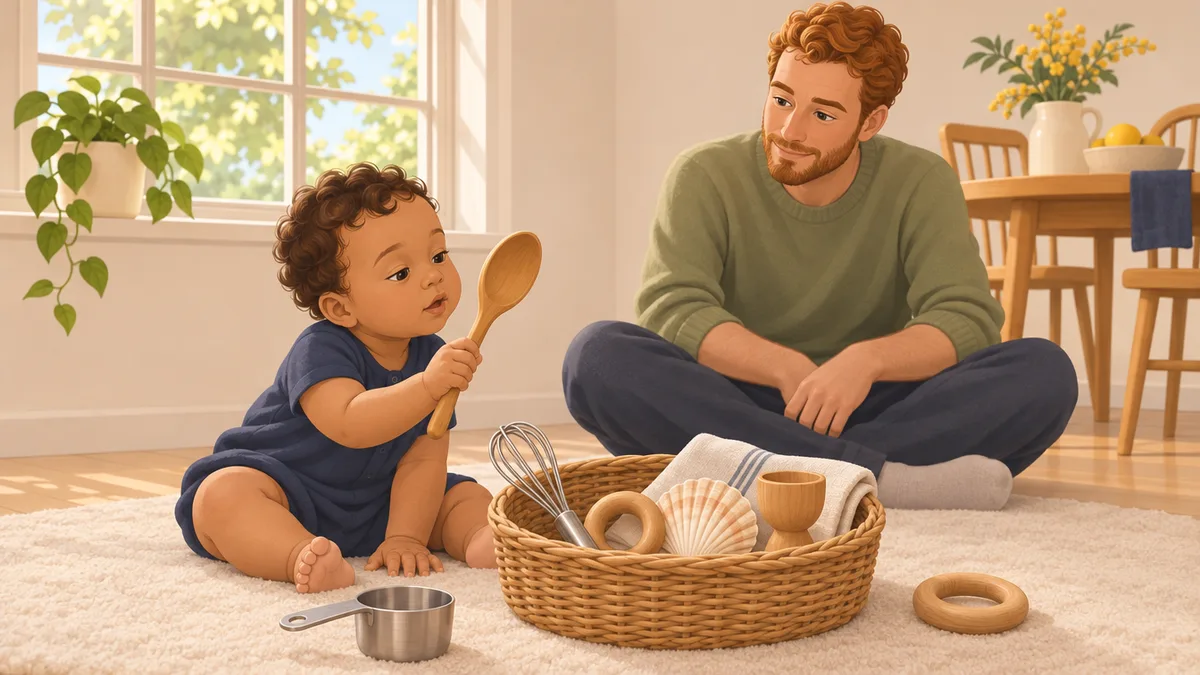
Quick answer: a treasure basket is a low, sturdy basket filled with everyday objects made of different materials (wood, metal, fabric, natural items) that a baby who can sit up explores freely with hands, eyes, ears and mouth. It works best from about 6 months, once your baby sits steadily with or without a little support, until they start crawling away to explore on their own. Choose objects that are too big to swallow, have no sharp edges, splinters, loose parts or batteries, and can be washed. Sit close by and watch, but let your baby choose what to pick up and what to do with it. Always supervise, check every item before and after each session, and swap a few objects regularly to keep it interesting.
Many baby toys do one thing: press a button, hear a sound. A treasure basket flips that around. The objects don’t do anything on their own, so your baby has to find out what they can do. Is the spoon heavy or light? Does the whisk jingle? Is the shell cold? This guide explains where the idea comes from, what to put in the basket (and what to leave out), how to run a session, and how to adapt it as your baby grows.
What is a treasure basket?
The treasure basket was developed decades ago by Elinor Goldschmied, described in UK early years guidance as an educational psychologist who championed babies learning through their own investigation of natural and household objects. Early years services in the UK and elsewhere still use it today.
A North Yorkshire County Council toolkit for early years settings describes it simply: a collection of everyday objects chosen to stimulate the different senses, offered to babies who are not yet mobile, from around 6 months until they start crawling. Babies learn from it by looking, sucking, touching, licking, banging, picking up, dropping, shaking and moving objects from hand to mouth.
The basket sits in the middle of a bigger idea: babies are active learners. Instead of an adult showing them what a toy is “for,” the baby leads and the adult supports.
Why treasure basket play is worth trying
- Rich sensory input. Real objects vary in weight, temperature, texture, sound and smell in a way most plastic toys do not.
- Hand skills. Grasping a wooden ring, passing a spoon from hand to hand and letting go of a cup all build the fine motor control that later leads to the pincer grasp.
- Choice and focus. Your baby decides what to pick up and how long to stay with it. Guidance from early years organizations notes that babies can concentrate for surprisingly long stretches when the choice is theirs.
- Early language. When you name what your baby is exploring (“cold spoon,” “soft cloth”), you connect words to real experiences.
- Low cost. Most items are already in your kitchen, bathroom or linen cupboard.
Treasure baskets are a play idea, not a treatment or a test. They are one good option among many, alongside floor time, books, songs and everyday chat.
When to start, and when babies outgrow it
| Stage | Typical age | How the basket fits |
|---|---|---|
| Sitting with support | Around 4 to 6 months | Short sessions with cushions around your baby, or with your baby leaning on the basket edge. Offer 3 or 4 objects at a time. |
| Sitting steadily | Around 6 to 9 months | The classic treasure basket stage. Fill the basket generously and let your baby rummage. |
| Crawling and pulling up | Around 8 to 12 months | Many babies leave the basket to explore the room. Keep it out as a “base,” or move on to containers they can fill and empty. |
| Toddlers | About 12 months and up | Heuristic play: bigger collections of safe objects and containers to fill, stack, sort and tip out. |
Ages are approximate. Go by what your baby can do, not by the calendar. Our guide to when babies sit up explains supported and independent sitting in more detail.
What to put in a treasure basket
Aim for variety: different materials, weights, shapes, sounds and textures. The North Yorkshire toolkit and New Zealand’s Tākai parenting program both suggest everyday objects like the ones below. Choose only things you are completely comfortable seeing in your baby’s mouth. If in doubt, leave it out.
| Material | Ideas | What your baby discovers |
|---|---|---|
| Wood | Large wooden spoon, wooden ring (like a big curtain ring or napkin ring), wooden egg cup, small wooden bowl | Warmth, smoothness, a dull “knock” when banged |
| Metal | Small whisk, stainless steel measuring cup, large teaspoon, tin lid with smooth rolled edges | Cold, shiny, reflective, ringing sounds |
| Fabric | Washcloth, linen napkin, a square of velvet or corduroy, a silk scarf cut short | Soft, crumpled, peekaboo surprises |
| Natural items | A large, smooth scallop shell, a natural sponge, a loofah, a large smooth piece of driftwood | Rough versus smooth, light versus heavy, unusual shapes |
| Rubber and silicone | Silicone spatula, a sink plug without chain, a silicone muffin cup | Squishy, bendy, chewable |
| Paper and cardboard | A sturdy cardboard tube, a small cardboard box | Crinkly, light, easy to grab (replace once it gets soggy) |
Choosing the basket itself
Early years guidance recommends a basket that is low, wide and strong enough for your baby to lean on without tipping over, with a flat base and no sharp points. A natural wicker basket is the traditional choice. Check it for broken strands or splinters, and replace it if it starts to unravel. A sturdy low wooden box or a shallow fabric basket also works.
What to leave out
Babies explore with their mouths, so safety rules every choice. The American Academy of Pediatrics (AAP), on its HealthyChildren.org site, explains that babies and toddlers are at the highest risk of choking because they put things in their mouths, and that small round objects, balloons and pieces of toys cause the most choking deaths.
- Anything small enough to swallow. In the United States, the Consumer Product Safety Commission (CPSC) uses a “small parts cylinder,” sized to approximate the fully expanded throat of a child under 3, to test toys. The Tākai program offers a simple home check: if an item fits inside a paper towel tube, it is too small for a baby. Also avoid objects that can be squeezed to fit entirely into a mouth.
- Button and coin batteries, magnets and coins. The AAP warns that button batteries can cause internal burns if swallowed. Never include battery-powered gadgets, remote controls or anything with a battery compartment.
- Balloons, even uninflated or popped.
- Things that can break into small pieces: glass, ceramics, thin plastic, dried pine cones, small pebbles, feathers, beaded items or brushes with loose bristles.
- Cords, ribbons, chains and long strings, which can wrap around a neck or finger.
- Sharp, pointed or heavy objects that could hurt if dropped on a foot or swung into a face.
- Anything with chemicals or finishes you are unsure about, including painted or varnished items of unknown origin, and plants or plant parts that may be toxic.
- Food that can come apart in the mouth once your baby has teeth, such as a whole lemon or apple whose peel can be bitten off.
A treasure basket is never a babysitter. An adult should be right there, watching, the whole time, and older siblings should not add their own small toys to the basket.
How to run a treasure basket session
- Pick a calm moment. Choose a time when your baby is fed, rested and alert, not right before a nap. The North Yorkshire toolkit suggests planning a specific session rather than using the basket to fill time at the end of the day.
- Set up the space. Clear a quiet patch of floor on a rug or play mat. If your baby still needs support, surround them with firm cushions in case they topple.
- Place the basket within easy reach, at your baby’s side or in front of them, so they can lean in and rummage.
- Sit close, then step back. Stay near enough to step in instantly, but don’t direct the play. UK early years guidance calls this “watch and respond”: smile, nod, accept an object your baby offers you, but let them lead.
- Name, don’t teach. A few quiet words help (“That’s the shell. Bumpy!”). Avoid turning it into a quiz.
- Follow your baby’s lead on timing. Some sessions last a few minutes, others much longer. Stop when your baby loses interest or gets tired.
- Clean and check. After each session, wash or wipe items, look for cracks, splinters or loose pieces, and remove anything damaged.
What you might see
- Mouthing almost everything. This is normal and is one of the main ways babies learn about objects.
- Banging two objects together, then listening.
- Passing an object from hand to hand.
- Dropping things over and over to see what happens.
- Long, quiet staring at one object, followed by sudden interest in another.
- Pulling out a cloth to find what is underneath, an early cousin of object permanence games.
Keeping it fresh
The Tākai program notes that a baby may be fascinated by an object for a while and then ignore it once they have found out all they need to know. That’s your cue to swap. You don’t need many items: rotating a handful every few days keeps the basket new. The same principle works for all toys, as we explain in our guide to toy rotation.
Theme baskets can add variety once your baby is used to the basic version:
- Kitchen basket: wooden spoon, whisk, silicone spatula, measuring cup, small pot lid with rolled edges.
- Bath basket: natural sponge, loofah, washcloth, a sink plug, a large shell.
- Fabric basket: squares of different fabrics, a short scarf, a knitted coaster.
- Shiny basket: stainless steel cup, large spoon, a small unbreakable baby mirror.
From treasure basket to heuristic play
Once your baby crawls and walks, they usually want to do more with objects: fill, empty, stack, line up and carry. This is often called heuristic play, a next step also associated with Elinor Goldschmied. Offer a few safe containers (tins with smooth edges, boxes, baskets) and larger collections of objects to put in and take out. For more ideas by age, see our guide to sensory play for babies and toddlers.
When to talk to your pediatrician
Treasure basket play is not a developmental test, and babies differ a lot in how interested they are in any single activity. Still, mention it at your next visit if you notice that your baby:
- Shows little interest in looking at or reaching for objects by around 6 months.
- Doesn’t bring objects to the mouth or pass them between hands as the months go on.
- Uses only one hand consistently and seems to ignore the other side.
- Can’t sit with support by around 9 months, or has lost skills they used to have.
Trust your instincts. If anything about your baby’s development worries you, a check-in is always reasonable.
In an emergency, such as a baby who is choking and cannot cough, cry or breathe, call your local emergency number immediately. Taking an infant CPR and first aid course, as the AAP recommends, prepares you for these moments.
Frequently asked questions
What age is a treasure basket for?
It is designed mainly for babies who can sit, roughly from 6 months until they crawl. Younger babies can enjoy a few items with support; older babies often move on to filling and emptying containers.
How many items should go in a treasure basket?
There is no magic number. Early years guides suggest filling it generously so your baby has plenty to choose from, but start with fewer items if your baby seems overwhelmed.
Is a treasure basket Montessori?
Not strictly. It comes from Elinor Goldschmied’s work rather than from Maria Montessori, but it shares Montessori ideas such as real materials, a calm prepared space and letting the child lead.
Is it OK that my baby puts everything in their mouth?
Yes, mouthing is a normal way babies explore. That is exactly why every object must be too big to swallow, unbreakable, free of loose parts and clean.
Can I leave my baby alone with the basket for a minute?
No. Treasure basket play should always be supervised by an adult within arm’s reach.
How often should I offer it?
As often as your baby enjoys it. Many families bring it out a few times a week and rotate items to keep it interesting.
Sources
- North Yorkshire County Council, Quality Improvement Toolkits. Treasure Baskets (PDF).
- Tākai (New Zealand Ministry of Social Development parenting program). Treasure basket.
- American Academy of Pediatrics, HealthyChildren.org. Choking Prevention for Babies & Children.
- U.S. Consumer Product Safety Commission. Small Parts Ban and Choking Hazard Labeling.
- NHS. Baby and toddler play ideas.
This article was researched and written by the BabyU Editorial Team following our Editorial Policy. It is general educational information and does not replace advice from your child’s pediatrician or another qualified professional.