Sensory Play by Age: 30 Ideas for Babies, 1- and 2-Year-Olds

Sensory play does not have to mean a tub full of rice. A baby studying your face, a 1-year-old filling a cup and a 2-year-old washing a toy are all using sight, sound, touch and movement to learn what their bodies and objects can do.
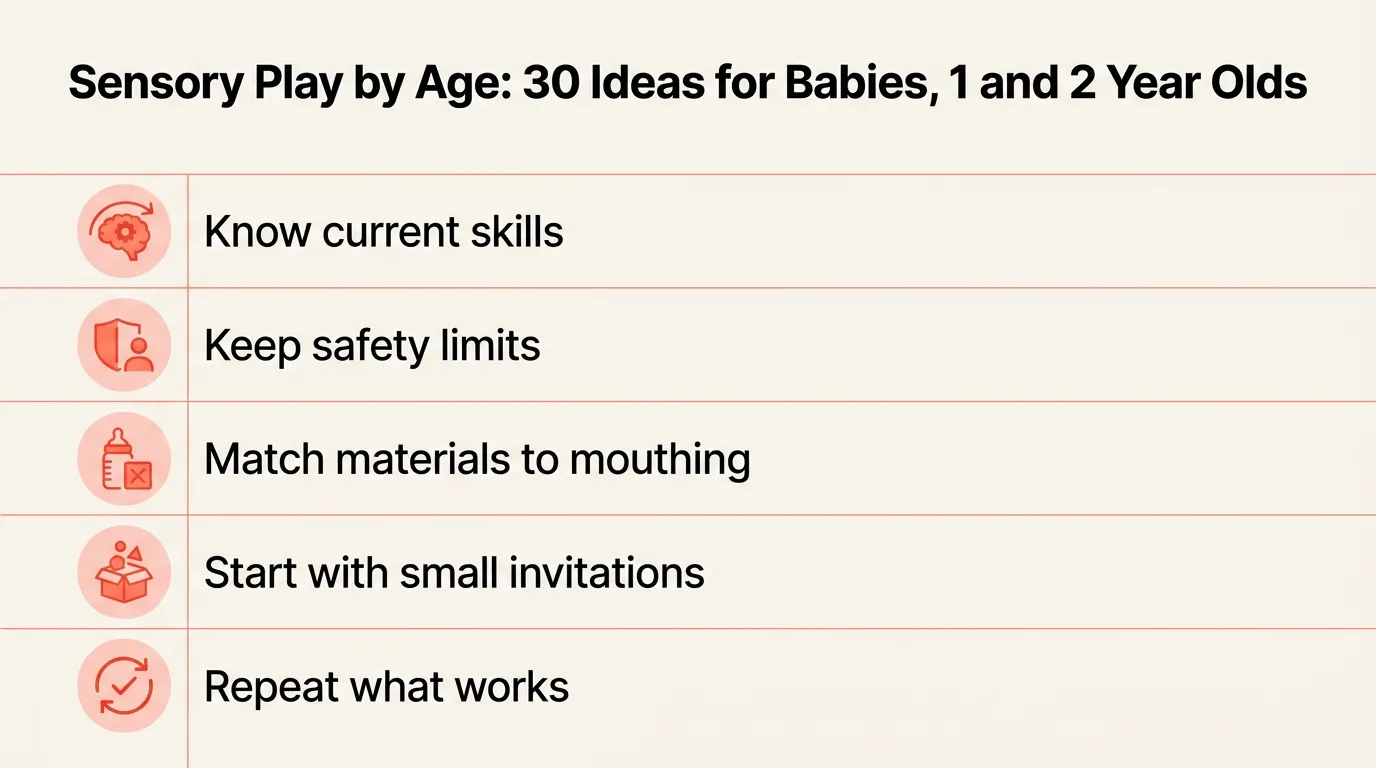
The useful question is not “What activity belongs to this birthday?” It is “What can this child safely do today?” Age gives you a starting point. Current skills, mouthing, mobility, allergies, sensory preferences and the adult’s ability to stay close decide whether the activity fits.
Below are 30 ideas split into babies, 1-year-olds and 2-year-olds. Each one includes the materials, likely mess and a simple invitation. None is a developmental test, treatment or promise of a particular outcome.
Use milestones as clues, not deadlines
The CDC describes milestones as things most children (75% or more) can do by a given age. Its checklists help families notice development, but they do not replace validated developmental screening. That distinction matters here: an activity can meet a child where they are, but it cannot diagnose a delay or make a milestone happen on schedule.
| Broad stage | Exploration you may notice | Useful play direction |
|---|---|---|
| Birth to about 6 months | Looking at faces, responding to voices, reaching, bringing safe objects to the mouth | Brief face-to-face play, soft sound, supervised tummy time and simple grasping |
| About 6 to 12 months | Moving objects between hands, banging two objects, sitting, looking for a dropped item | Two-object comparison, cause and effect, hiding and finding, supported water play |
| About 12 to 24 months | Putting objects into containers, carrying, dumping, walking and copying daily actions | Large-object fill-and-empty play, washing, pushing, pulling and movement |
| About 24 to 36 months | Using two toys together, trying lids or controls, running and beginning richer pretend play | Simple sequences, sorting, tools, art and familiar pretend scenes |
These examples align with current 6-month, 9-month, 1-year and 2-year CDC pages. If a child has lost a skill, is not meeting one or more milestones or you have another developmental concern, share it with the child’s doctor and ask about screening. Do not respond by drilling the activity more often.
Six safety limits that apply at every age
- Small parts stay out of under-3 play. The CPSC treats accessible small parts in products intended for children under 3 as choking, aspiration and ingestion hazards. Skip beads, buttons, dry beans, rice, coins, pom-poms, small magnets and any object that can detach when the child mouths materials.
- Water means arm’s-reach supervision. Give it your full attention and empty every tub, bucket and bowl immediately after play. Shallow is easier to manage, but it is not supervision-free.
- Water beads are excluded. Current CPSC guidance tells caregivers not to allow children to play with them and urges their removal from environments with children.
- “Non-toxic” does not mean edible. Follow art-product age labels, prevent ingestion and wash hands. Use only familiar foods during an ordinary supervised meal if taste is part of the experience.
- Check allergies and skin reactions. Read ingredient labels for dough, paint, food, soap and natural material. Stop if a child develops irritation or an allergy is suspected.
- Stay responsive. Turning away, stiffening, crying, frantic dumping, repeated throwing or repeated mouthing are reasons to pause, simplify or stop.
Do not use essential oils, strongly scented mixtures, borax slime, button batteries, magnets, balloons or unknown craft chemicals in these setups. Keep loose plastic bags out of reach; if paint is sealed in a bag, the bag must be taped flat and removed at the first tear or leak.
10 sensory play ideas for babies
For young babies, the caregiver is the activity. Keep looking, listening and touch brief, slow and easy to stop. HealthyChildren.org recommends tummy time only while the baby is awake and watched; it suggests short 3- to 5-minute periods two or three times a day when starting. Ask the baby’s pediatrician for individual guidance if the baby was premature or has reflux or special health needs.
- Face and voice tracking. Materials: you. Mess: none. Hold the calm, alert baby comfortably, move your face slowly from one side to the other and speak. Pause when their gaze moves away rather than trying to win it back.
- Sound turn-taking. Materials: your voice. Mess: none. Copy one coo or babble, then wait. Let the exchange end naturally. This is quieter and more responsive than playing a stream of recorded “sensory” sounds.
- Tummy-time face view. Materials: firm floor area and caregiver. Mess: none. During supervised awake tummy time, lower your face to the baby’s level. Start with a short period and stop when fatigue or distress appears.
- Baby-safe mirror look. Materials: purpose-made shatter-resistant baby mirror. Mess: none. Place it within view during floor play and describe the reflection. Do not substitute household glass.
- One-cloth touch. Materials: clean intact washcloth. Mess: none. Let the baby grasp or pat it while you name “soft,” “warm” or “cool.” Remove it if threads loosen, and never leave loose cloth in a sleep space.
- Soft rattle, then silence. Materials: age-labeled rattle. Mess: none. Make one gentle sound to the side and wait. Keep the toy away from the face and stop when the baby startles or disengages.
- Two-object bang. Materials: two large, lightweight, age-appropriate toys. Mess: low. For a baby who can sit and hold both safely, model one soft tap, then let them explore. Avoid heavy kitchen tools.
- Drop-and-return game. Materials: one large washable toy and a clean floor mat. Mess: low. Return the toy when the baby drops it, then pause. The repetition is the game; there is no need to add a basket of objects.
- Supported water patting. Materials: stable shallow bowl, small amount of water and towel. Mess: medium. For a baby who sits steadily with the support they need, help them pat the surface while you remain within arm’s reach. Empty it immediately.
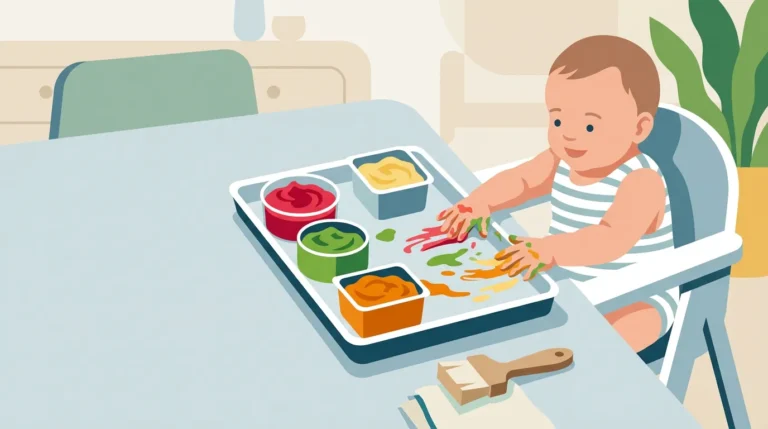
- Food texture at mealtime. Materials: a small amount of a familiar, safely prepared food already offered to that baby. Mess: medium. Let the baby touch and smear it in appropriate feeding seating. This is part of a supervised meal, not a separate tray of unfamiliar ingredients.
10 sensory play ideas for 1-year-olds
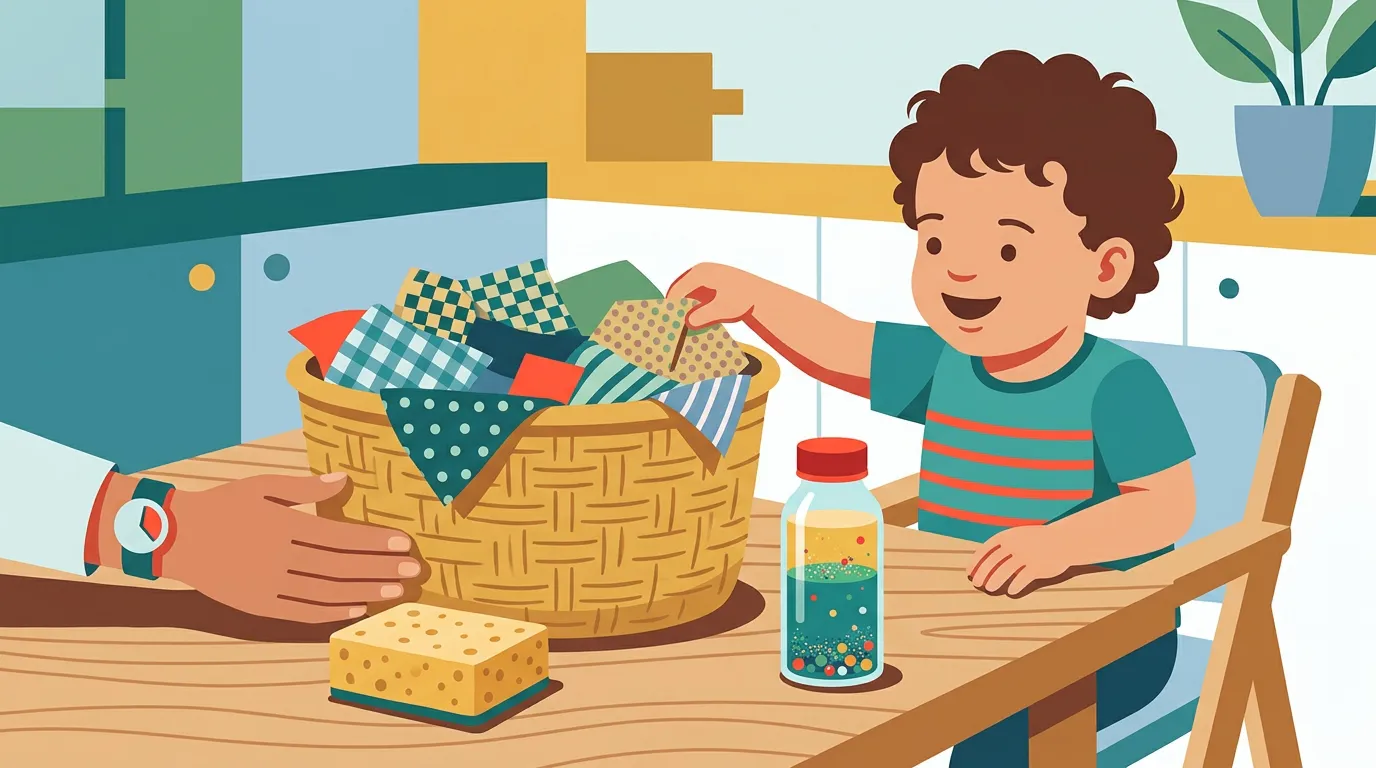
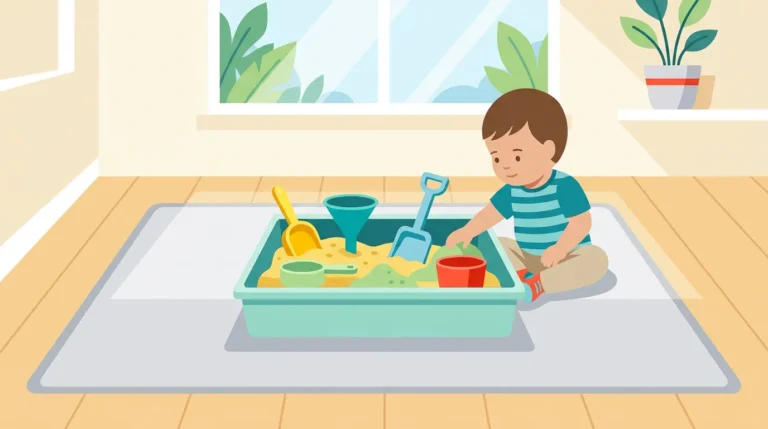
Many 1-year-olds still mouth play materials even after they begin walking and using containers. These ideas rely on large, washable objects rather than rice, beans, pasta, pom-poms or loose craft pieces.
- Large-object texture basket. Setup: 3 minutes. Mess: low. Put an intact washcloth, large silicone spatula, large wooden spoon and textured board book in a basket. Offer only one-piece objects that can withstand mouthing.
- Washcloth pull box. Setup: 5 minutes. Mess: low. Place three washcloths in a clean open-top box and leave one edge visible. Invite “pull it out,” then let the child stuff them back without correcting the method.
- Block drop. Setup: 2 minutes. Mess: low. Offer three large age-labeled blocks and a wide plastic bowl. Dropping, carrying and emptying support container play without a loose filler.
- Cardboard tunnel. Setup: 5 minutes. Mess: low. Open both ends of a large clean box. Remove staples, loose tape and labels; retire it when chewed, torn or unstable.
- Water cup transfer. Setup: 5 minutes. Mess: medium. Put a little water and two large cups in a stable tub on a towel. Stay within arm’s reach and accept filling, tipping or simply patting.
- Sponge toy wash. Setup: 5 minutes. Mess: medium. Offer one whole sponge, one large washable toy and shallow water. Remove a sponge that starts to tear.
- Water painting. Setup: 3 minutes. Mess: low. Give the child a wide brush and a cup with a small amount of water on a dark outdoor surface or plastic tray. Watch marks appear and disappear.
- Sealed rolling bottle. Setup: adult-made in advance. Mess: low unless it fails. Roll a sturdy, inspected sensory bottle back and forth rather than handing over a thin homemade bottle for chewing. Follow the full sensory bottle sealing and leak-test guide.
- Stop-and-go movement. Setup: 1 minute. Mess: none. Sing or play a familiar song, move together, pause, then begin again. Keep volume comfortable and let the child ignore the “stop” cue.
- Barefoot texture route. Setup: 5 minutes. Mess: low. Secure a towel, bath mat and fleece blanket flat on a clear floor. Let the child sit, crawl or step; remove raised edges that could trip them.
10 sensory play ideas for 2-year-olds
At 2, some children are ready to use tools and combine two actions. Mouthing and throwing can still happen, so introduce small or hard material only when the individual child can use it safely and the product’s age guidance allows it.
- Dough and large tools. Setup: 4 minutes. Mess: low. Pair age-labeled modeling dough with one roller and one chunky stamp. Check allergens, prevent eating and return the dough to its container before it dries.
- Three-tool painting. Setup: 7 minutes. Mess: high. Tape large paper down and offer a wide brush, whole sponge and roller with washable age-labeled paint. Ask, “Which mark will this make?”
- Color-water combine. Setup: 5 minutes. Mess: medium. Use two cups with a little colored water and one empty cup. Begin with only two colors and supervise within arm’s reach.
- Wash, rinse, dry. Setup: 7 minutes. Mess: medium. Provide one toy, a wash bowl, an empty rinse bowl and towel. Model the three-step sequence once, then let the child change the order.
- Laundry texture sort. Setup: 3 minutes. Mess: low. Put socks, washcloths and a small towel beside two baskets. Sort by soft/rough, light/dark or “mine/yours,” or simply carry the laundry.
- Outdoor mud mixing. Setup: 5 minutes. Mess: high. Use clean soil from an appropriate play area, water, a large bowl and scoop. Prevent eating and wash hands after play; skip where soil contamination is possible.
- Whole-herb smell choice. Setup: 3 minutes. Mess: low. An adult holds familiar mint, basil or a cut lemon at a comfortable distance. Ask “more or all done?” Do not apply plants or oils to skin, and check allergies.
- Flashlight shadow wall. Setup: 2 minutes. Mess: none. Shine a flashlight at a blank wall and move hands or a large toy through the beam. Never shine it into eyes.
- Quiet and loud comparison. Setup: 3 minutes. Mess: low. Compare a soft fabric bag tapped with the hand and an age-labeled drum. Let the child choose the volume; stop if the sound becomes uncomfortable.
- Large-shape search. Setup: 5 minutes. Mess: low. Hide three large shapes under washcloths in an empty bin. Invite “Can you find the circle?” and accept uncovering without naming as meaningful play.
For fine-motor activities beyond sensory play, see 20 fine motor activities for 1- and 2-year-olds. For climbing, rolling and whole-body movement, use the separate gross motor activities guide.
How to present an activity without taking over
- Set out one idea while the child is rested and you can supervise without a phone or competing task.
- Demonstrate one action at most: squeeze the sponge, drop one block or make one brush mark.
- Describe what the child does: “The water moved,” or “You found the rough cloth.” Avoid turning every moment into a color or counting quiz.
- Add one variation only after the original action holds interest.
- End when the child signals “finished,” the setup becomes unsafe or your attention must move elsewhere.
There is no required session length. A planning window of five minutes is enough for a first attempt, but the child may finish sooner or continue longer. Engagement and safety—not a timer—decide when to stop.
Adapt when touch is unwelcome
Never press a child’s hands or feet into a material. Head Start recommends following children’s cues and offering tools, gloves or another route into messy play. Try this progression:
- watch an adult use the material;
- touch with a wide brush or spoon;
- press a sealed paint bag that is taped flat;
- touch a familiar dry material;
- stop and revisit another day.
Sensory preference is not misbehavior. If reactions to everyday sound, touch, food, movement or clothing frequently interfere with eating, sleep, hygiene, school or family life, raise the pattern with the child’s pediatrician. A DIY activity list is not a substitute for individual assessment. The AAP has also cautioned that evidence for sensory integration therapy is limited and inconclusive; any therapeutic trial should have clear, observable goals and clinical guidance.
Build a small weekly rotation
Keep one no-mess idea, one water or art idea and one movement idea available. Repeat them before adding more. For example:
- No mess: texture basket on Monday and Thursday.
- Wet: sponge wash when an adult can stay within arm’s reach.
- Movement: cardboard tunnel or stop-and-go song.
Change one element at a time: a new large tool, a different location or one extra object. Repetition lets you notice preferences and new actions without buying a constant stream of supplies.
Sources and safety references
Last source review: July 26, 2026. Milestone pages support developmental monitoring but do not replace screening or individual medical advice.
- CDC: Milestones by 1 Year and Milestones by 2 Years
- American Academy of Pediatrics: Back to Sleep, Tummy to Play
- CPSC: Small Parts Ban and Choking Hazard Labeling
- American Academy of Pediatrics: Water Safety and Young Children
- Head Start: Messy Play
Frequently asked questions
What sensory play is best for a 1-year-old who mouths everything?
Use large, intact, washable objects: washcloths, a silicone cup, a whole sponge, large blocks and sturdy board books. An empty bin can still support filling, hiding and carrying. Skip rice, beans, pasta, beads, pom-poms and small toys.
How long should sensory play last?
Only as long as the child is safely and comfortably engaged. Start with one simple action and allow a few minutes. Stop sooner for turning away, distress, repeated mouthing, throwing or frantic dumping. There is no project to finish.
Does my child need sensory play every day?
No special sensory activity is required every day. Dressing, bathing, eating, walking outdoors, singing and ordinary floor play already contain rich sensory experiences. A repeatable routine is more useful than pressure to produce a new tray daily.
What if my toddler refuses messy play?
Do not force contact. Let the child watch, use a brush or spoon, choose a dry material or stop. Offer the experience again without pressure on another day. Persistent reactions that disrupt daily activities are worth discussing with the child’s clinician.
Are sensory bins appropriate for babies?
Loose-filled bins are usually not the best starting point for babies because mouthing is expected. Use face-to-face play, supervised tummy time, one safe cloth, large age-labeled toys or a small amount of water with arm’s-reach supervision. The sensory bin building guide explains how filler choice changes for older, non-mouthing children.