Pincer Grasp in Babies: How It Develops and Activities That Help

Quick answer: the pincer grasp is the ability to pick up a small object between the tip of the thumb and the index finger. It usually comes after a few earlier stages: whole-hand grabbing, then “raking” small things toward the body with the fingers, then a clumsier thumb-and-finger pinch. The CDC lists “uses fingers to rake food towards himself” among the things most babies do by 9 months and “picks things up between thumb and pointer finger, like small bits of food” among the things most babies do by 1 year. You can’t rush it, but you can give your baby plenty of safe chances to practice, mostly at mealtimes and with simple, large toys. Supervise closely, because the same skill that lets a baby pick up a soft pea-sized piece of banana also lets them pick up a coin or a button battery.
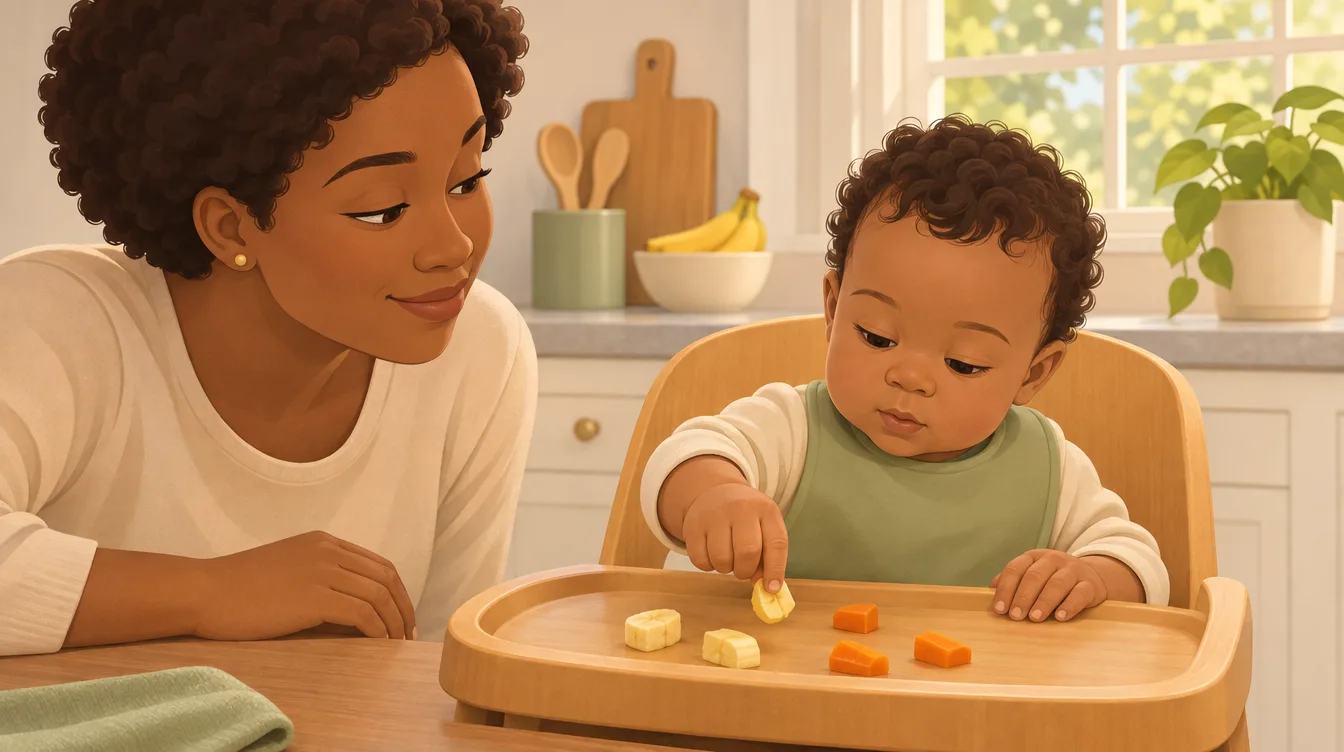
Watching a baby chase a single crumb across a high-chair tray can be surprisingly gripping. That small, determined pinch is one of the clearest signs of how fast fine motor skills develop in the first year. This guide explains what the pincer grasp is, the stages that usually come before it, simple ways to practice at home, the safety rules that matter most, and when it makes sense to bring it up with your pediatrician.
What is the pincer grasp?
The pincer grasp is a fine motor skill: the coordinated use of the small muscles of the hand and fingers together with the eyes. Instead of closing the whole hand around an object, the baby isolates the thumb and the index finger and brings their pads or tips together to hold something small.
It matters because it opens up a lot of everyday independence. A baby who can pinch can feed themselves small pieces of soft food, turn chunky board-book pages, pull a sock off, drop a block into a cup and, later on, hold a crayon and work buttons and zippers. It is also a sign that hand, eye and attention are working together, which is why it shows up on developmental checklists.
The stages that lead to a pincer grasp
Babies don’t jump straight to a neat pinch. The skill builds in a fairly predictable order, although the timing of each step varies a lot from one baby to another. The CDC milestone lists describe what most babies (75% or more) can do by a given age, so many babies get there earlier and some a little later.
| Stage | What it looks like | What helps |
|---|---|---|
| Whole-hand (palmar) grasp | The baby closes all fingers around an object and holds it against the palm. Letting go is still hard. | Easy-to-hold rattles and soft toys during tummy time and floor play |
| Passing and banging | Moves a toy from one hand to the other, bangs two objects together. The CDC lists both by about 9 months. | Two blocks, two cups, a wooden spoon and a pot |
| Raking grasp | Sweeps small things toward the body using all the fingers like a rake. The CDC lists raking food by about 9 months. | Soft finger foods on a tray, larger loose parts on a mat |
| Early (inferior) pincer | Uses the pad of the thumb against the side or pad of the index finger. Often still rests the forearm on the tray for support. | Self-feeding practice, chunky board books, large pegs |
| Neat (fine) pincer | Picks up small things between the tip of the thumb and the tip of the index finger, without resting the arm. The CDC lists this by about 1 year. | Container play, simple puzzles with big knobs, self-feeding |
Around the same time, babies also learn to let go on purpose. That is why “putting something in a container, like a block in a cup” appears on the CDC 1-year list next to the pincer grasp. Picking up and releasing are two halves of the same skill, and many of the best activities practice both.
How to help your baby practice
The single most useful thing is time with real, safe objects and food, with you close by. You don’t need special equipment. Fine motor skills grow from many short, everyday repetitions rather than from formal lessons.
At mealtimes
- Offer soft finger foods once your baby is eating solids. Ripe banana, well-cooked carrot or sweet potato, and soft avocado cut into small pieces give the hands a reason to work. The AAP advises cutting food for infants and young children into pieces no larger than half an inch.
- Put just a few pieces on the tray. A crowded tray encourages raking with the whole hand. Two or three pieces at a time invite a more careful pinch.
- Let them try a cup with a small amount of water. The CDC suggests letting babies practice feeding themselves with their fingers and using a cup with a little water, with you sitting next to them.
- Expect mess. Dropping food over the edge is part of learning to release. Try not to turn every meal into a cleanup lesson.
During play
- Drop-in containers. A large plastic jar or a tissue box with chunky blocks or wide wooden rings (too big to fit in the mouth) to drop in and dump out. The CDC suggests dumping blocks from a container and putting them back in together.
- Board books. Thick cardboard pages are great pinch-and-turn practice. Books with flaps add an extra challenge around the first birthday. See our guide to reading to babies for ways to make book time more interactive.
- Knob puzzles. Simple wooden puzzles with large knobs, two or three pieces only. Chunky knobs are easier than tiny pegs at first.
- Peekaboo with a cloth. Covering a toy with a light cloth so your baby pulls it off combines grasp practice with object permanence.
- Peel-off tape. A strip of painter’s tape on a tray or the floor that your baby can peel off. Stay right there and remove the pieces once peeled so they don’t end up in the mouth.
- Taste-safe painting. Finger painting with a food-based paint gets the fingers moving independently. Our taste-safe baby paint guide has options and a safer setup.
For older babies and young toddlers
Once the pincer grasp is reliable, the same skill develops into more precise hand work: stacking two or three blocks, fitting large shapes into a shape sorter, using crayons, and picking up toys to put them away. Our list of fine motor activities for 1- and 2-year-olds picks up where this guide ends.
A simple practice routine
| When | Activity | Time |
|---|---|---|
| Breakfast or lunch | Three or four soft finger-food pieces on the tray | As long as the meal lasts |
| Morning play | Drop-in container with large blocks or wide rings | 5 to 10 minutes |
| Afternoon | Board book with thick pages or flaps | A few minutes, as long as interest lasts |
| Anytime | Peekaboo with a light cloth over a toy | A few rounds |
Follow your baby’s interest. If they push something away or get frustrated, switch to something else and try again another day. A small selection of toys often holds attention better than a full basket; our toy rotation guide shows an easy way to set that up.
Safety: the pincer grasp is also a choking-hazard skill
The moment a baby can pick up something small, anything small within reach becomes a risk. According to the AAP, choking is a leading cause of death for infants and young children, and most children who die from choking are under age 5. Small round objects such as balloons, balls, marbles, pieces of toys and foods cause the most choking deaths.
Around the house
- Get down to floor level and check under furniture and between couch cushions for coins, small toy parts, pen caps and batteries.
- Keep button and coin batteries locked away. The AAP notes they can also cause internal burns if swallowed.
- Keep balloons away. The AAP points out that balloons are a choking risk for children up to 8 years old.
- Avoid toys with small or detachable parts and toys that can be squeezed to fit entirely into a child’s mouth, and follow the age labels on toy packaging.
- Watch out for small items left by older siblings.
At the table
- Your baby should always be sitting up while eating, ideally in a high chair, and never eating while lying down, crawling or walking. The CDC also advises against eating in the car or stroller.
- Stay with your baby for the whole meal and keep mealtimes calm.
- Avoid or modify high-risk foods. The AAP and CDC lists include whole grapes, cherry tomatoes and berries that haven’t been cut, raw carrot or apple pieces, nuts and seeds, popcorn, hot dogs and sausages, chunks of cheese or meat, spoonfuls of nut butter, marshmallows and hard or gummy candy.
- Cut round foods into small pieces and cook firm vegetables until soft.
Consider taking an infant CPR and first-aid class, which the AAP recommends, so you know what to do if your baby does choke.
When to talk to your pediatrician
There is a wide range of normal, and babies born prematurely are usually assessed by their corrected age. Still, it’s worth bringing up with your child’s doctor if:
- your baby isn’t raking small objects or moving toys from hand to hand by around 9 months;
- your baby isn’t picking up small things between thumb and pointer finger by around 12 months;
- your baby seems to use only one hand, or one side of the body seems weaker or stiffer than the other;
- the hands stay tightly fisted most of the time;
- your baby has lost a skill they used to have;
- you have any other concern about how your baby moves, plays or communicates.
The CDC’s message is simple: you know your child best, so don’t wait. If something worries you, ask about developmental screening. In the US, you can also contact your state’s early intervention program directly.
Frequently asked questions
At what age do babies develop the pincer grasp?
Most babies are raking food toward themselves by about 9 months and picking up small things between thumb and pointer finger by about 1 year, according to the CDC. Many get there earlier, and the early, clumsier version often appears a few weeks before the neat fingertip pinch.
Is baby-led weaning required to develop the pincer grasp?
No. Babies develop the pincer grasp whether they start solids with purées, finger foods or a mix. What helps is regular, supervised chances to handle soft finger foods and safe objects once they are developmentally ready.
My baby can pinch but keeps putting everything in their mouth. Is that normal?
Yes. Mouthing is a normal way for babies to explore. It is the reason supervision and choking-hazard checks matter so much during this stage.
Are there toys that “teach” the pincer grasp?
Simple, open-ended items work as well as specialty toys: board books, large knob puzzles, containers with chunky blocks and soft finger foods. If you’re shopping, our guide on how to choose Montessori toys explains what to look for.
Should I worry if my baby prefers one hand?
Babies often reach with whichever hand is closer. A strong, consistent preference for one hand in the first year, or seeming not to use one side, is worth mentioning to your pediatrician.
Sources
- Centers for Disease Control and Prevention. Milestones by 9 Months.
- Centers for Disease Control and Prevention. Milestones by 1 Year.
- American Academy of Pediatrics (HealthyChildren.org). Choking Prevention for Babies & Children.
- Centers for Disease Control and Prevention. Choking Hazards.
- American Academy of Pediatrics (HealthyChildren.org). Movement Milestones in Babies 8 to 12 Months Old.
This article was researched and written by the BabyU Editorial Team following our Editorial Policy. It is general educational information and does not replace advice from your child’s pediatrician or another qualified professional.