Tummy Time by Age: How Much, When to Start and What to Try

Quick answer: Tummy time can start in the first days at home, while your baby is awake and someone is watching. Begin with two or three short sessions a day of about 3 to 5 minutes, and build up to a total of 15 to 30 minutes a day by around 7 weeks to 2 months, as recommended by the American Academy of Pediatrics (AAP) and the NIH Safe to Sleep campaign. The World Health Organization suggests at least 30 minutes of tummy time spread across the day for babies who are not yet crawling. After that, keep offering more floor time on the tummy until your baby moves around on their own. For sleep, your baby always goes on their back.
Advice on tummy time often stops at “do more of it.” This guide goes further. It covers what a session can look like at each age, what skills you may start to see, positions that help when your baby protests, and the safety rules that matter most.
What tummy time is and why it matters
Tummy time means placing your baby on their stomach while they are awake and supervised. The AAP describes it as the “tummy to play” half of its message: “back to sleep, tummy to play.” Babies sleep on their backs, so the awake hours are their main chance to practice lifting the head, pushing through the arms and shifting weight. These are the building blocks for rolling, sitting and crawling.
The NIH Safe to Sleep campaign is clear that tummy time does not directly reduce the risk of SIDS. It is about development, not sleep safety. It also helps with head shape. The AAP notes that babies who spend a lot of time on their backs and get too little tummy time are more likely to develop a flattened head, and it names extra supervised tummy time as one of the simple prevention steps.
Tummy time by age: a practical overview
The table below combines the official targets with what sessions often look like in real life. Every baby develops at their own pace, so treat the “skills you may see” column as a range, not a test.
| Age | Daily target | What a session can look like | Skills you may see |
|---|---|---|---|
| First days to 1 month | 2–3 sessions of about 3–5 minutes, or shorter if needed | Mostly chest-to-chest or across your lap; short floor tries | Briefly lifts or turns the head to clear the nose |
| 1–2 months | Build toward 15–30 minutes total by about 7 weeks to 2 months | Several mini-sessions on a firm floor surface, with your face at eye level | Lifts the head for a few seconds; turns it to both sides |
| 3–4 months | At least 30 minutes total, spread through the day (WHO) | Longer floor sessions with a toy or baby-safe mirror in view | Pushes up onto elbows and forearms; tracks toys and faces |
| 5–6 months | More floor time; many guides suggest working toward about an hour a day | Toys placed slightly out of reach to encourage reaching and pivoting | Pushes up on straighter arms, reaches for toys, starts rolling |
| 6 months until crawling | As much awake floor play as your baby enjoys | Free movement on the floor; tummy time blends into everyday play | Pivots, rolls both ways, may start belly-crawling or creeping |
The CDC lists “pushes up onto elbows/forearms when on tummy” as a milestone most babies reach by 4 months. The 5- and 6-month skills above follow the progression described by Pathways.org and Cleveland Clinic. Cleveland Clinic suggests working up to 60 to 90 minutes a day after 6 months, until your baby crawls.
How to do tummy time, step by step
1. Pick the right moment
The AAP suggests trying tummy time after a diaper change or when your baby wakes from a nap, when they tend to be alert and calm. Many babies are more comfortable when a session does not come right after a big feed. A full tummy and pressure on it can lead to spit-up and fussing.
2. Choose a firm, flat surface
The floor, on a clean blanket or a firm play mat, is the best everyday spot. Avoid adult beds, sofas, beanbags and thick cushions. Soft surfaces make it harder for your baby to push up and can block the nose and mouth.
3. Get down to their level
Babies work harder when there is something worth looking at. Lie on the floor facing your baby, talk, sing or make faces. Your face is usually more interesting than any toy, especially in the first weeks.
4. Keep it short and end before tears
One minute of happy effort beats five minutes of crying. When your baby starts to tire, with the head dropping or the fussing getting louder, roll them onto their back or pick them up, and try again later. Several mini-sessions add up to the daily total just as well as one long one.
5. Add one small challenge as your baby grows
Once your baby holds their head up more steadily, move a toy slowly from side to side, place it a little to one side, or put it just out of reach. Small changes like these encourage turning, reaching and weight-shifting without overwhelming them.
Tummy time positions that count
Floor time is the end goal, but it is not the only way to do tummy time. These positions are especially useful for newborns, during recovery from birth, or for babies who protest the floor.
- Chest-to-chest: Recline on a sofa or bed with your baby on your chest, tummy down. Your baby will try to lift the head to see your face. Stay awake and keep a hand on your baby. If either of you starts to doze off, move your baby to their own safe sleep space on their back.
- Lap tummy time: Sit down and lay your baby across your thighs, tummy down, with one hand on their back. Gentle rocking or patting can help settle them.
- Tummy-down carry: Carry your baby face down along your forearm, with your hand supporting the chest and your other hand on the back. This is a good option while walking around the house.
- Rolled towel support: On the floor, place a small rolled towel under your baby’s chest, with the arms in front of it. The slight lift makes it easier to raise the head. Use it only during supervised play and remove it afterward.
What to put in front of your baby
You do not need special equipment. Simple, safe things work well, as long as they are too large to choke on and free of loose parts:
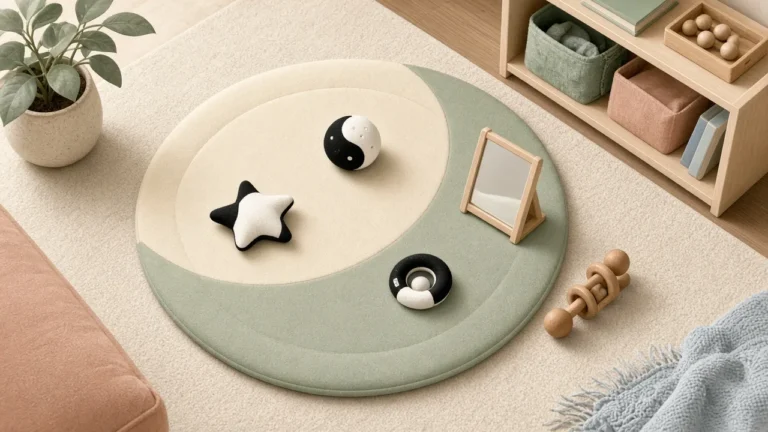
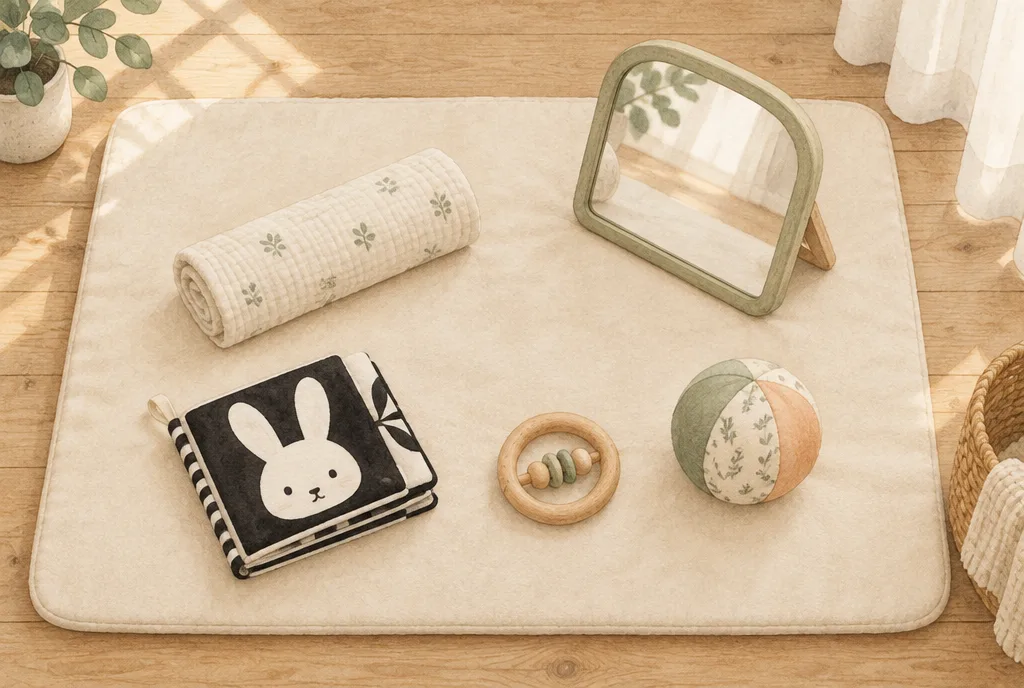
- A shatter-resistant baby mirror placed on the floor
- A high-contrast cloth or board book standing open
- A soft rattle or a fabric ball within view
- A sealed sensory bottle rolled slowly in front of them. Our DIY sensory bottles guide explains how to seal them and test for leaks.
- Siblings or other adults lying down at eye level, always with an adult in charge
For more ideas on simple sensory moments in the first year, see sensory play by age for babies and toddlers. When your baby gets older and starts grasping well, Montessori toys for 1-year-olds shows how to choose a few open-ended toys that are worth the space.
When your baby hates tummy time
Protest is common, especially in the first weeks. Lifting a heavy head is hard work. The AAP notes that some babies do not like the position at first and that putting yourself or a toy within reach can help. Try these adjustments before giving up for the day:
| What you notice | What to try |
|---|---|
| Cries within seconds on the floor | Switch to chest-to-chest or lap tummy time, then try the floor again for very short stretches |
| Face plants and gets frustrated | Add a small rolled towel under the chest; get your face at their eye level |
| Fussy and spits up | Wait longer after feeds; try after a diaper change instead |
| Bored after a minute | Change the view: a mirror, a new spot in the room, or a sibling on the floor |
| Always turns the head to the same side | Place toys and your face on the less-preferred side, and mention it to your pediatrician |
Consistency matters more than session length. Several short, positive sessions a day help most babies get used to the position over time.
Safety rules for tummy time
- Awake and watched, every time. Tummy time is only for babies who are awake, with an adult right there and paying attention.
- Back to sleep, always. The NIH Safe to Sleep campaign recommends placing babies on their backs for every sleep, naps included, until age 1. If your baby falls asleep during tummy time, gently move them onto their back in a safe sleep space: a firm, flat mattress in a crib or bassinet with no pillows, bumpers or loose bedding.
- Once your baby rolls both ways on their own, Safe to Sleep says you can leave them in the position they choose after placing them on their back to sleep.
- Floor, not furniture. Avoid beds, sofas and other raised or soft surfaces where a baby could roll off or sink in.
- Watch pets and young children. A baby on the floor is at the level of curious dogs, cats and toddlers. An adult needs to stay within arm’s reach.
- Nursing pillows and props are for awake play only. Never leave a baby propped on a pillow or cushion unattended, and never let them sleep on one.
- Check toys for choking hazards. Anything that fits through a toilet paper tube is too small. Learn more in our guide to setting up a safer play space.
Tummy time and flat head: what parents should know
According to the AAP, a flat area on the back of the head (deformational brachycephaly) is often seen in babies who spend a lot of time on their backs without enough tummy time. A flat spot on one side (deformational plagiocephaly) is often linked to a favorite head position or tight neck muscles (torticollis). The AAP describes these positional changes as cosmetic, without effects on brain growth. Most do not need surgery, and simple changes help when they are caught early.
Those changes include:
- More supervised tummy time each day, working up to about an hour in several short sessions, as described on HealthyChildren.org
- Less time in car seats (outside the car), bouncers, swings and other carriers, which press on the back of the head. The WHO also recommends that infants not be restrained for more than one hour at a time.
- Switching the side you use for feeding and holding, and changing which end of the crib your baby’s head faces, while still placing them on their back
The AAP suggests checking your baby’s head shape after bath time, when the hair is wet. The back of the head should look evenly round, and the ears should line up.
When to call the pediatrician
Talk to your baby’s doctor if you notice any of the following:
- Your baby always keeps the head tilted or turned to one side, or has trouble turning it both ways
- A flat spot, uneven ears or forehead, or a head shape that worries you
- Your baby seems very stiff or very floppy, or uses one side of the body much more than the other
- Your baby is not lifting the head during tummy time by around 3 to 4 months, or is not pushing up on the forearms by around 4 months
- Your baby loses a skill they already had
- Tummy time seems painful, or comes with breathing trouble, repeated forceful vomiting or unusual distress. Stop the session and call.
Babies born prematurely, babies in the NICU, and babies with reflux, feeding tubes or other medical needs may need an adjusted plan, so ask their care team. The CDC’s milestone pages also encourage parents to “act early,” which means sharing concerns with the doctor and asking about developmental screening instead of waiting.
How tummy time fits into the rest of the day
Tummy time works best as part of a balanced day of floor play, cuddles, reading and rest, not as a separate workout. The WHO guidelines for infants emphasize interactive floor-based play several times a day, with no screen time, and reading and storytelling with a caregiver when the baby is resting. As your baby starts rolling, sitting and crawling, tummy time naturally turns into exploring. By then, a safe floor space and a few simple toys matter more than a timer. For the next stage, our list of at-home activities for 1-year-olds picks up where floor play leaves off.
Frequently asked questions
When should I start tummy time?
The AAP says you can start the day your baby comes home from the hospital, and Safe to Sleep notes that most babies can start a day or two after birth. Begin with very short sessions. If the umbilical cord stump is still attached, chest-to-chest or lap positions may feel more comfortable at first.
How long should tummy time be for a newborn?
Aim for two or three sessions a day of about 3 to 5 minutes each, and stop sooner if your baby is tired or upset. Build up gradually as they get stronger.
How much tummy time does a 2-month-old need?
By about 2 months, pediatric guidance points to 15 to 30 minutes of total tummy time a day, split into several sessions. The WHO suggests at least 30 minutes across the day for babies who are not yet mobile.
Does tummy time on my chest count?
Yes. Chest-to-chest and lap positions count, especially in the early weeks. Over time, try to move more of the total to a firm floor surface, where your baby can push up and move more freely.
Can my baby sleep on their tummy if they fall asleep during tummy time?
No. Move them onto their back in a safe sleep space. Back sleeping is recommended for every sleep until age 1. Once your baby can roll both ways on their own, you can leave them in the position they roll into.
When can I stop doing tummy time?
There is no single cutoff date. Once your baby crawls and spends lots of awake time moving on the floor, planned tummy time becomes ordinary play. Keep giving them plenty of safe floor time.
Sources
- American Academy of Pediatrics, HealthyChildren.org: Back to Sleep, Tummy to Play
- American Academy of Pediatrics, HealthyChildren.org: Positional Skull Deformities and Torticollis
- NIH Safe to Sleep campaign: Benefits of Tummy Time
- NIH Safe to Sleep campaign: Ways to Reduce Baby’s Risk
- World Health Organization: To grow up healthy, children need to sit less and play more
- CDC, Learn the Signs. Act Early.: Milestones by 4 Months
- Cleveland Clinic: When To Start Tummy Time and How To Do It Safely
- Pathways.org: Tummy Time: Essential Guide for Parents
This article is for general information and does not replace advice from your child’s pediatrician.