Montessori Toys for 1 Year Old: What’s Worth Buying

A 1 year old is working on several things at once: shaky steps or full walking, a real pincer grasp, dropping and retrieving things on purpose, copying what you do. Montessori toys for 1 year old are built around that stretch, and the stretch is short. A toy that held a 12 month old for a month can sit untouched by 15 months, and nobody selling it will tell you that.
That’s the gap in most advice on montessori toys for 1 year olds: the same eight or nine items, all called worth buying. Nobody says how long a toy will hold interest, or what that costs per month. Every pick below gets a usable window and a cost per month, and four popular categories get rated a skip.
How these montessori toys for 1 year old were judged
Every toy here first passed the six-question test in our guide on how to choose Montessori toys: does the child act on it or does it act on them, does it do one thing, is there built-in feedback, is it real rather than a plastic imitation, is it sized for their hands now, and can they manage it without help. A toy that failed two or more never made the list.
Passing that test only proves the toy is well designed, not that it’s worth buying at this age, which depends on how long it gets used. So every pick also gets a usable window and a rough cost per month: typical price divided by that window. Treat it as a guide, not a precise figure.
The comparison table at a glance
Rough current US price ranges, not quotes for a specific product. Full reasoning is below the table.
| Toy type | What it develops | Typical price range | Usable window | Rough cost per month | Verdict |
|---|---|---|---|---|---|
| Object permanence box, single ball and tray | object permanence, cause and effect | $15 to $30 | 12 to 15 months | $5 to $10 | Buy |
| Posting box, one shape | grasp and release, concentration | $12 to $25 | 12 to 15 months | $4 to $8 | Buy |
| Weighted push wagon, adjustable resistance | walking confidence, gross motor | $40 to $90 | 11 to 16 months | $8 to $18 | Buy used |
| Plain nesting or stacking cups | size discrimination, fine motor | $10 to $20 | 12 to 20 months | $1 to $2 | Buy |
| Wooden shape sorter, 3 or more shapes | shape matching, problem solving | $18 to $35 | 15 to 22 months | $3 to $5 | Buy |
| Chunky knob puzzle, single | pincer grasp, matching | $12 to $25 | 15 to 20 months | $2 to $5 | Buy |
| Low two-step indoor climber | gross motor, risk judgment | $60 to $150 | 15 to 30 months | $3 to $8 | Borrow |
| Plain stacking ring tower, no rainbow | size sequencing, fine motor | $12 to $25 | 12 to 20 months | $1.50 to $3 | Buy |
| Pull toy with a cord, 18 months and up | walking rhythm, cause and effect | $12 to $25 | 18 to 26 months | $2 to $4 | Buy |
| Peg puzzle, 4 to 6 pieces | pincer grasp, matching | $12 to $22 | 18 to 26 months | $2 to $4 | Buy |
| Simple ball ramp, large balls | cause and effect, gross motor | $20 to $45 | 18 to 26 months | $3 to $7 | Buy |
| Starter pretend cookware, 2 to 3 pieces | imitation, sequencing | $15 to $30 | 18 to 28 months | $2 to $5 | Buy |
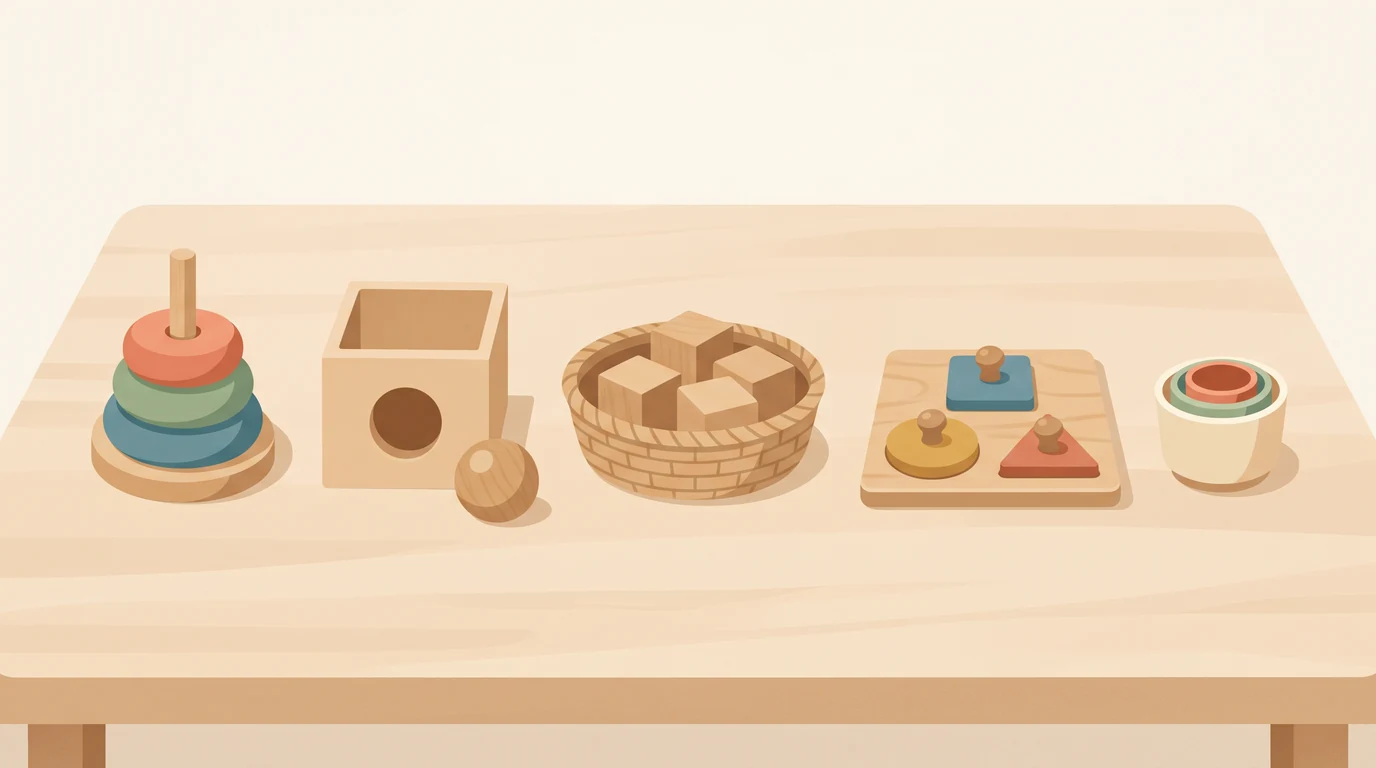
Best picks for 12 to 15 months
Object permanence box with a single ball and a tray
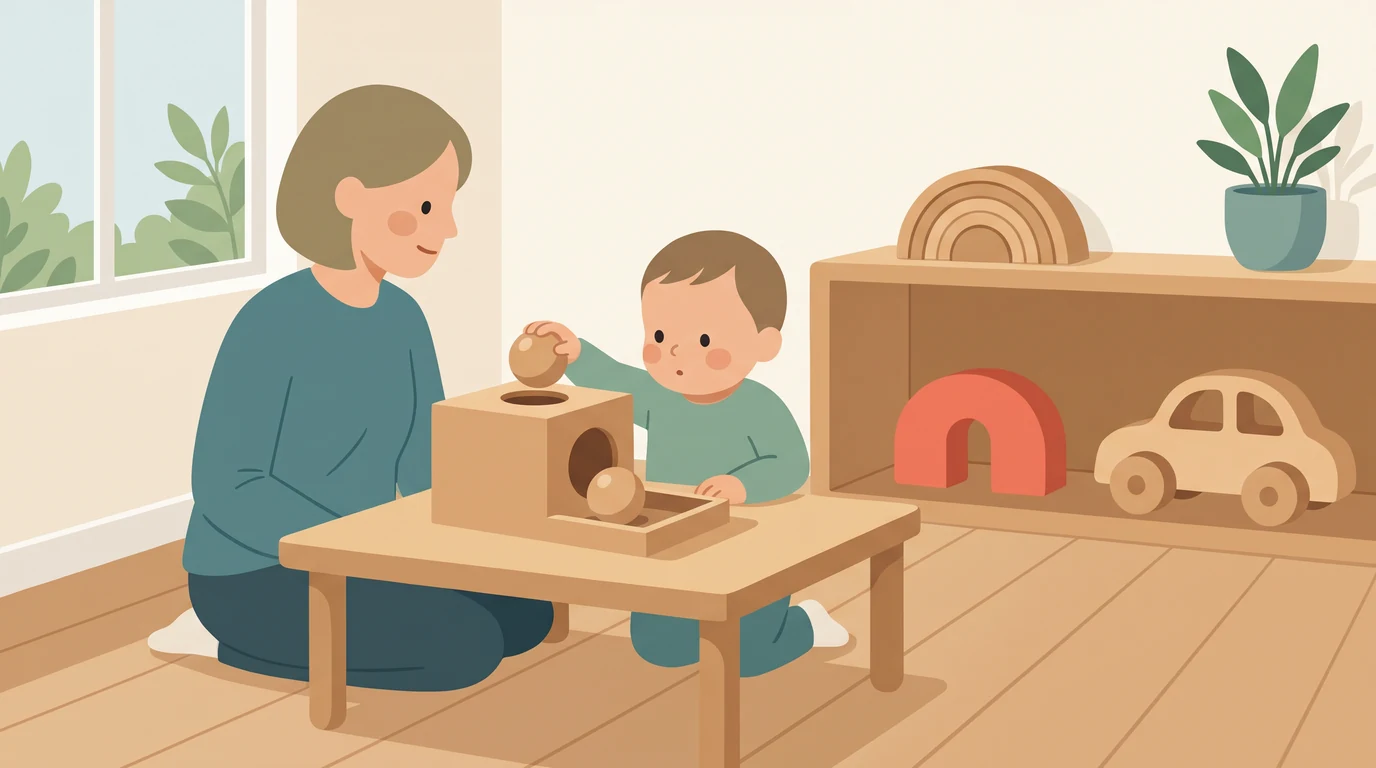
A wooden box with a hole: a ball drops in and rolls onto a tray in view, teaching that it still exists once it disappears. Choose a ball too large for the CPSC small parts cylinder, about 1.25 inches. Usable window: roughly 12 to 15 months, shorter if peekaboo already taught object permanence. Skip it once your child searches drawers for hidden things unprompted.
Posting box with one shape
A box with one slot cut for a single shape, usually a coin-sized disc, so the child practices releasing an object on purpose. The disc should be too large for the small parts cylinder. See more in our fine motor skills activities guide. Usable window: roughly 12 to 15 months. Skip it if your child already posts mail or stacks blocks.
Weighted push wagon with adjustable resistance
A sturdy wagon the child pushes while learning to walk, with adjustable resistance so it doesn’t roll away too fast. Look for a wide wheelbase and a bar height matched to their grip. Usable window: roughly 11 to 16 months, shorter if walking starts confidently before purchase. Skip it if your child has walked steadily for over a month.
Plain nesting or stacking cups
A set of cups or bowls in graduated sizes that nest and stack, with no attached game or sound. Choose plain over ones printed with numbers or letters. Usable window: roughly 12 to 20 months, one of the longest here since it works for bath, sand, and stacking alike. Close to the best value on this page.
Best picks for 15 to 18 months
Wooden shape sorter with three or more shapes
A box or ball with several differently shaped holes, each matched to one wooden piece, so the child judges orientation as well as shape. Holes should only admit their matching piece; oversized holes give no real feedback. Usable window: roughly 15 to 22 months. Skip it if a single-shape posting box is already easy.
Chunky knob puzzle, a single board
A wooden board with two to four large pieces, each with a raised knob and a matching cutout. Knobs should fit a full pincer grip, and pieces should sit flush when correct, so the fit itself is the feedback. Usable window: roughly 15 to 20 months. Skip it if your child still mostly mouths the pieces.
Low, wide two-step climber
A short, stable set of two steps and a platform, low enough that a fall lands at shin height, not head height. Always supervise climbing equipment on carpet or a padded mat, never a hard floor. Usable window: roughly 15 to 30 months, one of the longest here, so borrow or buy it secondhand. Skip it with no safe landing surface nearby.
Plain stacking ring tower
A post with rings of decreasing size to thread on in order, without rainbow coloring that turns the task into color matching instead of size judgment. Usable window: roughly 12 to 20 months, first for stacking any order, later by size. Skip it if you already have a rainbow stacker.
Best picks for 18 to 24 months
Pull toy with a cord
A simple toy on wheels, pulled behind a walking child by a cord. A cord that’s too long or loose is a strangulation risk. Cords on toys for children under 18 months must stay under 12 inches; pull toys with longer cords are meant for around 19 months and up. Usable window: roughly 18 to 26 months. Skip it before your child walks steadily.
Peg puzzle with 4 to 6 pieces
A step up from the knob puzzle: more pieces, smaller knobs, a finer pincer grip needed per piece. Pieces should stay above the small parts size. Usable window: roughly 18 to 26 months. Skip it if a two-piece knob puzzle still gives trouble.
Simple ball ramp with large balls
A short wooden ramp or tower a ball rolls or drops through, with a clear result every time. Balls should be too large for the small parts cylinder. Usable window: roughly 18 to 26 months. Skip a version using small marbles instead of large balls.
Starter pretend cookware, 2 to 3 pieces
A small pot, a spoon, and a cup rather than a full playset, so the child imitates a real sequence: stir, pour, serve. Choose wood or unbreakable metal over molded plastic, and stop at two or three pieces. Usable window: roughly 18 to 28 months, growing more useful closer to 2 years. Skip it if your child shows no interest yet in stirring or pouring.
Widely recommended and not worth it at this age
These four show up on nearly every competing list, and none are bad toys. The issue is timing and price against what a 12 to 24 month old does with them.
The large wooden climbing triangle, bought at 12 months
A large climbing triangle typically runs $130 to $350, and it’s a genuinely good piece of equipment once a child climbs with purpose, usually closer to 18 months than 12. Bought right at the first birthday, it often sits half used for months while a child is still learning to stand and walk, putting $20 to $30 a month against very little climbing in this age range. The equipment isn’t the issue; buying it six months before most children are ready for it is.
The full-size play kitchen, bought before 18 months
Full-size wooden play kitchens typically run $70 to $250 and up. A child under 18 months mostly opens and closes the doors and mouths the accessories; the multi-step pretend play a kitchen is built for usually starts closer to 2 years. Bought at 12 months, a kitchen can sit as furniture for a year before it’s used as designed. A starter cookware set at a tenth of the price covers the same skill meanwhile, and the kitchen can wait.
The multi-piece Montessori subscription box
These typically run $30 to $50 a month for several small activities bundled together, some duplicating what a child already owns, some used once and abandoned. Over a year that’s $360 to $600 for a mix you didn’t choose, against picking two or three well matched items yourself for a fraction of the cost. If the novelty and unboxing itself is the appeal, that’s a real reason to keep one. As a value strategy, it rarely beats choosing your own.
The expensive rainbow stacker as a first toy
A well made rainbow stacker typically runs $25 to $45. It’s a genuinely versatile toy over a long stretch of childhood, but the skill it teaches, nesting and arranging pieces by size, is closer to an 18 to 30 month skill than a 12 month one. Given to a 1 year old as a first toy, it usually gets banged, chewed, and knocked over like any other wooden object. A $15 set of plain stacking cups does the same job for the first several months, and the rainbow stacker is worth buying later, once that skill is actually in reach.
What you already own that does the same job
At least six things already in most houses match a paid pick above one to one. Several pair well with our sensory play for 1 year olds guide.
- Instead of an object permanence box: a tissue box with a scarf pulled through, or a box with a coin slot and a ping pong ball to drop in.
- Instead of a posting box: a yogurt tub with a slit cut in the lid and milk caps too large for the small parts limit.
- Instead of a weighted push wagon: a cardboard box or laundry basket with a few books inside for weight, pushed across carpet.
- Instead of nesting cups: mismatched plastic food containers and lids, straight from the kitchen cupboard.
- Instead of a shape sorter: a muffin tin and oversized pom poms or balls, sorted one per cup.
- Instead of a knob puzzle: a set of measuring cups nested inside each other in size order.
- Instead of a two-step climber: a stable step stool already in the house, supervised, or sturdy couch cushions on the floor.
- Instead of a pull toy: a large soft ball to kick or roll while walking, building the same coordination without a cord.
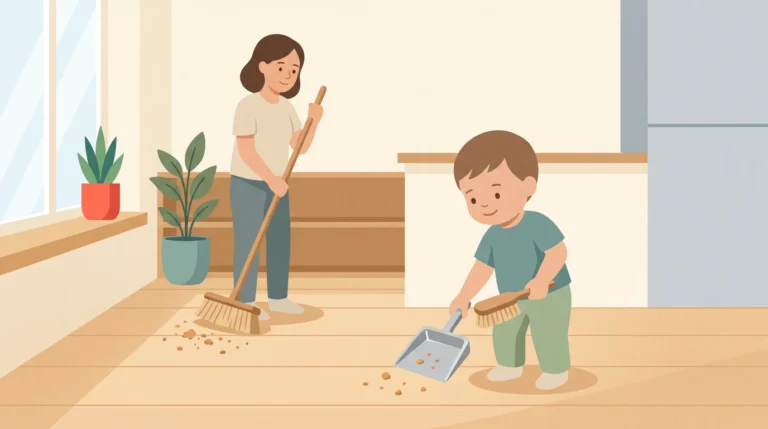
- Instead of starter cookware: a real unbreakable bowl, a wooden spoon, and a small pot, supervised at the table you cook at.
Buying used without buying a problem
Secondhand wooden toys are often the best value on this page, but check a few things first. Search the item and seller on the CPSC’s recall database at cpsc.gov before paying; recalls apply to secondhand sales too. Run a finger over every edge for splinters, and check painted pieces for chips rather than assume an older toy meets current lead paint limits. Count pieces against the listing photo; a shape sorter missing two shapes is a different toy than the one you bought. If a piece has a magnet, confirm it’s sealed in with none loose; swallowed magnets are a serious, sometimes fatal hazard, so a toy with a loose magnet gets thrown out, not passed on.
When a good toy gets ignored
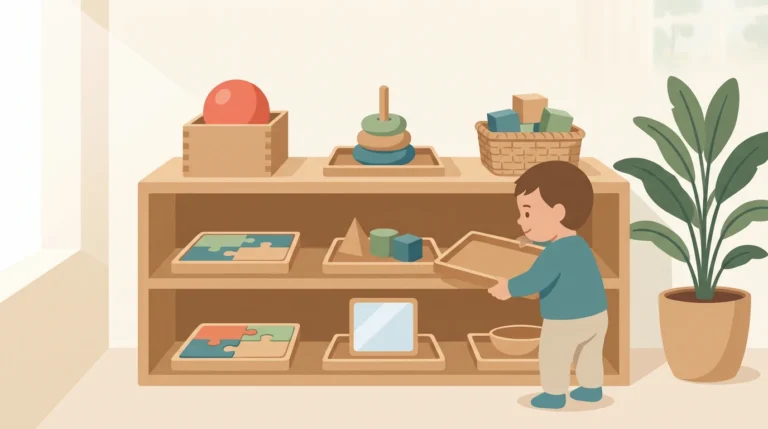
A toy that passed every test above can still sit untouched, and that’s not always a sign you chose badly. Start with presentation: a toy on a low, open shelf with nothing else competing gets picked up far more than the same toy in a bin with twenty others. Our guide on how to set up a toddler playroom covers shelf height and item count.
If presentation isn’t the issue, put the toy away for four to six weeks, then reintroduce it as if new. Interest crowded out by novelty usually comes back. If it still gets no attention, consider whether it’s too advanced rather than uninteresting: a child who ignores a shape sorter but happily bangs the pieces together is telling you the task is out of reach, not that shapes bore them. Put it away longer and try again in a month. See our activities for 1 year olds guide meanwhile.
Frequently asked questions
How many toys does a 1 year old need?
Far fewer than most shelves suggest. Six to ten toys, rotated a few at a time on a low shelf, get more genuine use than thirty in a bin.
Are montessori toys worth the money?
Some are, some genuinely aren’t. A toy that isolates one skill, gives honest feedback, and fits their hands now tends to earn its price even at a short window. A toy bought mainly for the label rarely does.
What is a good montessori first birthday gift?
An object permanence box, a posting box, or plain nesting cups: cheap enough that a short window doesn’t sting, and matched to what a child is working on right at 12 months, not six months from now.
Do montessori toys have to be wooden?
No. Wood is common because it’s durable and gives honest feedback, but the real test is how the toy behaves, not what it’s made from. A well designed plastic shape sorter beats a wooden toy that only rattles.
What age should I start buying montessori toys?
There’s no single starting age. For a 1 year old, start with object permanence, posting, and simple stacking, then move toward matching and sorting as pincer grasp and patience develop, usually from around 15 months.
Is it safe to buy secondhand montessori toys?
Usually, and it’s often the best value on this page, but check the CPSC recall database, inspect for splinters and chipped paint, count pieces, and confirm any magnets are sealed in. See the buying used section above for the full checklist.
Sources and notes
Safety guidance here draws on the Consumer Product Safety Commission’s small parts standard, its warnings on ingestion dangers from small high powered magnets, its toy safety rules on cord length, and its public recall search tool. Price ranges were checked against current US retailer listings and will drift over time; treat them as a starting point, not a quote. Developmental milestones referenced reflect widely published pediatric guidance for the 12 to 24 month range.
Sources checked on October 25, 2026. Primary references: