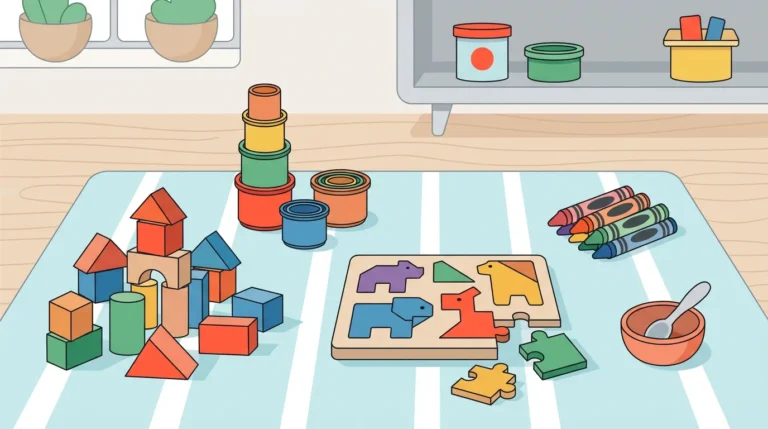
How to Set Up a Toddler Playroom: Safer Ideas for Any Space

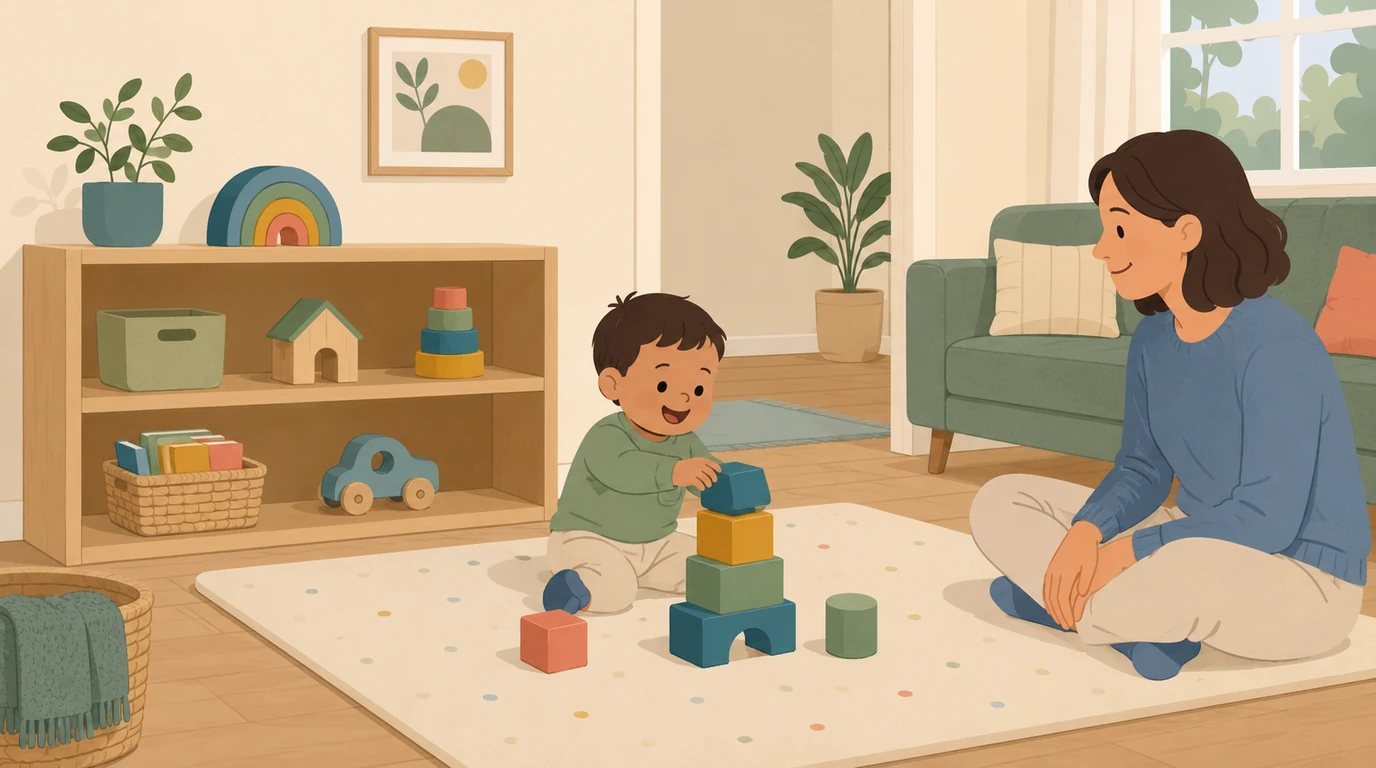
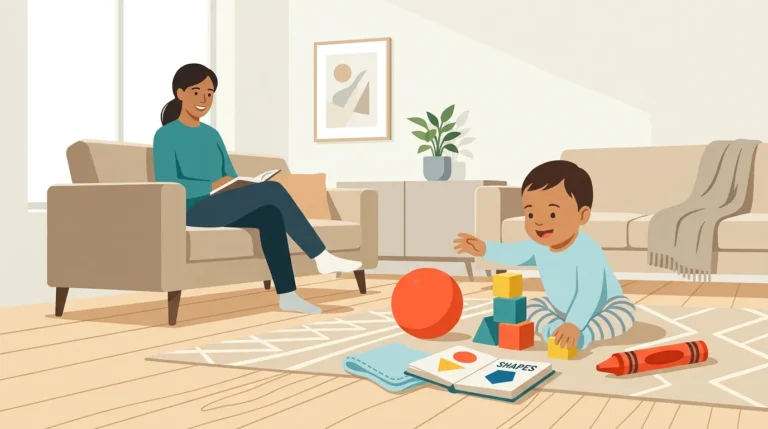
A toddler playroom does not need to be a separate room, follow a decorating theme or contain a wall of new toys. It needs to give a child somewhere to move and explore while an adult can see, reach and respond. In a small home, that may be one living-room corner and a basket that disappears after bedtime.
This guide starts with hazards and sightlines before moving to shelves, storage and toy rotation. It also separates child-accessible materials from supplies that require adult control. No room arrangement makes a baby or toddler safe without active supervision, and childproofing needs to change as crawling, pulling to stand, climbing and problem-solving change.
Choose the smallest setup that solves the real problem
Before shopping, name what is not working. Toys may be blocking a walkway, art supplies may be mixed with everyday toys, or the child may keep leaving the play area because it is too far from the adult. The answer is often a clearer boundary or less material, not more furniture.
| Setup | Works well when | Minimum useful pieces | Main limitation |
|---|---|---|---|
| Portable play basket | The home has no permanent play corner or several rooms are used during the day | One adult-carried basket, a clear floor area and three to five play choices | Needs a consistent storage location that the child cannot access unsupervised |
| Living-room play corner | The child wants to stay near family activity and an adult needs a direct sightline | A washable floor boundary, one anchored low shelf or lidless bin and a book basket | Shared walkways and adult electronics must be screened carefully |
| Shared bedroom zone | Floor play can remain clearly separate from the sleep space | A small mat, a few quiet materials and storage away from the crib or bed | Toys, cords and soft items must not migrate into an infant sleep space |
| Dedicated playroom | An adult will still remain close enough to supervise and the room can be secured as a whole | Clear movement space, two or three activity zones and anchored storage | A door or baby monitor is not a substitute for direct supervision |
If you are choosing between a bigger room and a smaller area beside the adult, visibility usually deserves more weight than square footage. Head Start’s guidance on active supervision recommends arranging furniture so adults can observe children and keep clear paths to where they are playing.
Run a 20-minute safety audit before buying anything
Do the first inspection from the child’s height. Crawl or sit on the floor and look for reachable cords, peeling finishes, sharp edges, small objects and furniture that invites climbing. Then stand and check what could fall from above. This is a screening exercise, not a certification that the room is hazard-free.
| Area | What to check | Action before the room opens |
|---|---|---|
| Furniture and television | Bookcases, cube units, dressers, televisions or appliances that can tip when pulled or climbed | Anchor them according to the manufacturer’s instructions using hardware appropriate for the wall; keep toys and remotes off the top |
| Windows and doors | Blind cords, curtain ties, low windows, accessible locks, door pinch points and furniture that provides a route to a window | Use cordless window coverings where young children are present and move climbable furniture away from windows |
| Electricity and cords | Loose charger cables, lamps that can be pulled down, damaged outlets, power strips and baby-monitor cords | Remove unnecessary electronics; route necessary cords completely out of reach and use childproofing products that fit the home |
| Floor and movement path | Loose rugs, hard objects in a fall zone, unstable foam tiles, splinters, pet items and a blocked route to the adult | Create a flat, dry, unobstructed path and repair or remove damaged flooring and equipment |
| Toys and household objects | Loose magnets, button batteries, balloons, coins, beads, broken pieces, long strings and items intended for older siblings | Remove them from the play zone; place older-child materials in locked or truly inaccessible storage |
| Containers | Heavy lids, locking trunks, sharp basket fibers, finger traps and bins large enough for a child to climb inside | Prefer light, lidless child-accessible storage; keep large or lidded containers under adult control |
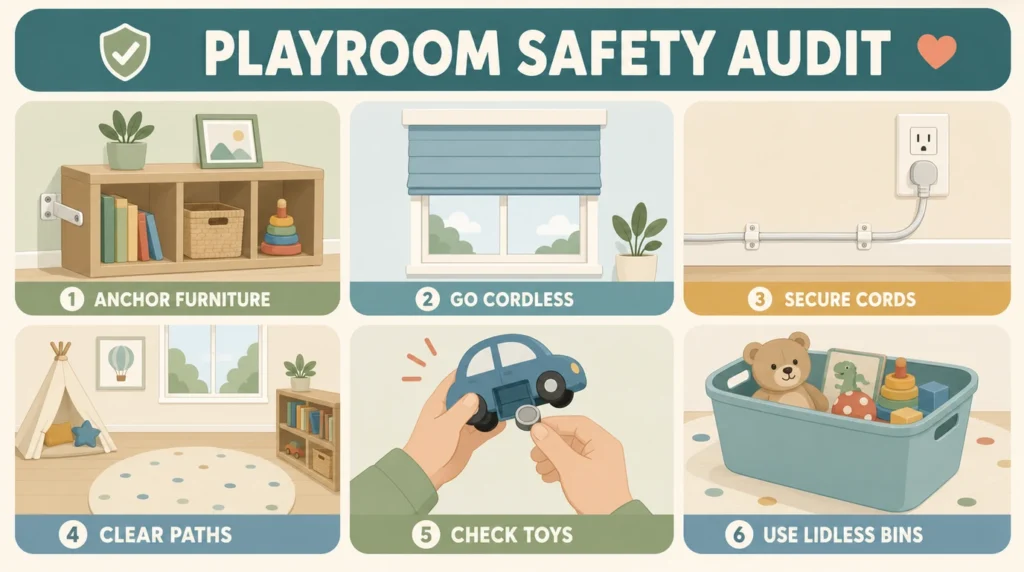
The U.S. Consumer Product Safety Commission’s Anchor It campaign warns that children may climb furniture and recommends securing top-heavy furniture and televisions. Installation matters: use the instructions supplied with the furniture and anchoring device, and obtain help from the manufacturer, landlord or a qualified installer when the wall or hardware is uncertain.
For windows, CPSC says the safest option in homes with young children is cordless window coverings. Moving a shelf away from a window does not make an accessible cord harmless. It only removes one climbing route.
Check the room again when the child gains a skill
A setup that worked for a sitter may fail as soon as that child crawls. Pulling to stand changes which shelves can tip. Climbing changes what “out of reach” means. Opening a latch changes which cabinets count as closed. Repeat the audit after a new mobility skill, a furniture change, a move, a holiday with new toys or a visit from an older child.
Build four useful zones, not a miniature classroom
Zones are actions, not furniture collections. A single mat can be a building zone in the morning and a movement zone later. In a small space, mark a zone with one basket, a washable mat or the side of an anchored shelf rather than adding a room divider.
1. Clear movement space
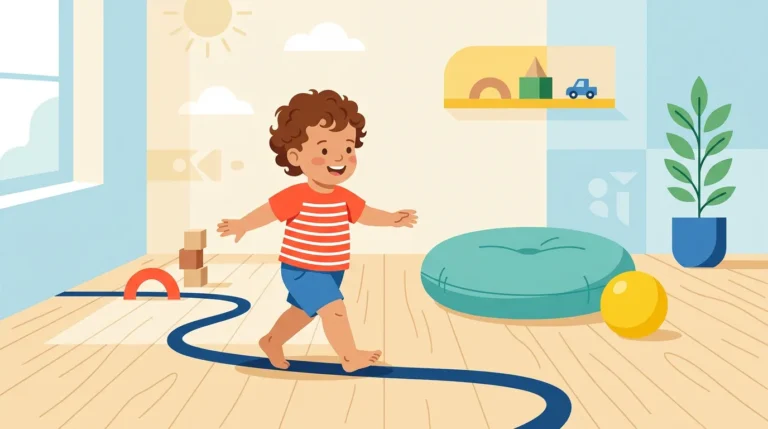
Leave enough open floor for the child’s current movement: rolling and reaching for a baby, cruising along a secured support for a new walker, or carrying and pushing appropriate objects for a toddler. Keep loose toys out of the path. Large indoor climbing equipment is not a requirement, and it can introduce fall, entrapment and installation questions that a clear floor does not.
For planned movement games that use ordinary household space, choose from these gross motor activities for 2-year-olds. Match every activity to the child and room rather than leaving equipment available by default.
2. Quiet connection space
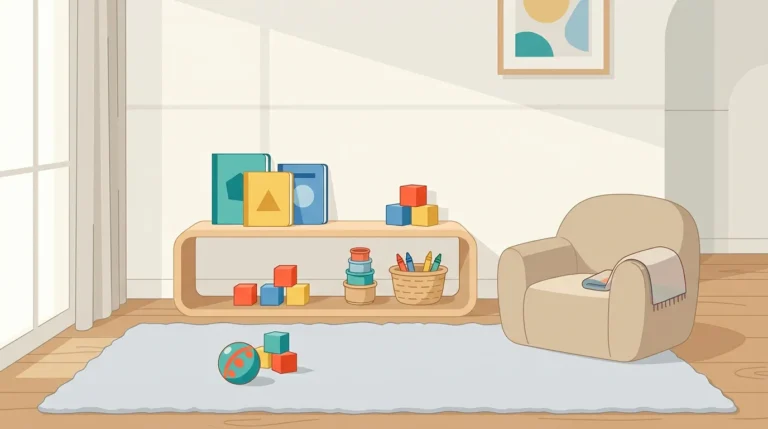
A small book basket beside a place where an adult can sit is enough. Put book covers facing forward only if the display is stable and does not require a tall unanchored unit. Two board books that a child can reach are more useful than a decorative shelf that blocks the adult’s view.
3. Open-ended play space
Offer materials that support more than one action: sturdy blocks, nesting cups, a ball, large animal figures, fabric pieces or simple pretend-play objects that fit the child’s age. Head Start describes blocks and ordinary household objects as open-ended materials and notes that interesting play does not require expensive products.
4. Adult-controlled activity storage
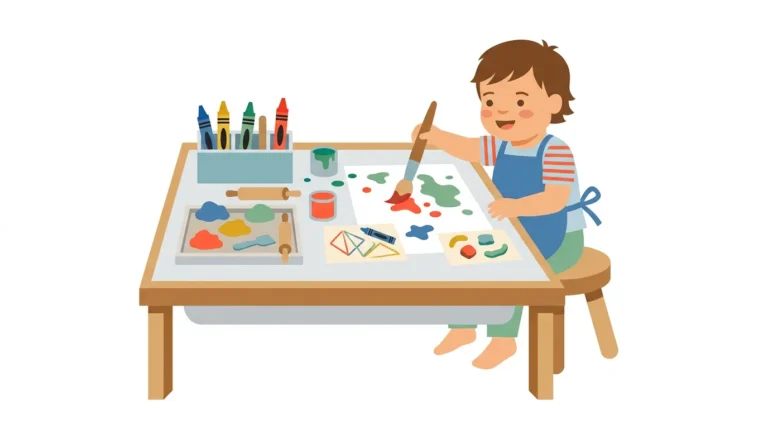
Paint, glue, sensory fillers, scissors, small loose parts and spare batteries do not belong on an open toddler shelf. Store them in a locked cabinet or another location the child cannot reach, and bring out only the material needed for one supervised activity. Use the art and craft guide for 1- and 2-year-olds when you want a contained project rather than permanent free access to supplies.
Compare toy storage by access, not appearance
Storage has two jobs that sometimes conflict: allowing the child to choose and preventing access to hazards. Use different storage for those jobs. Everyday, age-appropriate toys can be visible. Materials that require an adult should be locked or genuinely inaccessible.
| Storage type | Best use | Child access | Important trade-off |
|---|---|---|---|
| Low open shelf | A small selection of sturdy toys and books | Independent selection | The shelf must be stable and anchored when required; too many displayed items create visual and cleanup load |
| Light lidless bin | Large blocks, balls or soft toys | Easy access and simple cleanup | Deep bins hide pieces and encourage dumping; inspect woven fibers and handles |
| Closed drawer or cabinet | Rotation stock and adult-prepared activities | Depends on the latch and the child’s skills | A toddler may learn a latch; hazardous supplies need locked storage, not a visual boundary |
| Rolling cart | Adult-controlled art or sensory sessions | Only while an adult presents it | It can roll, tip or provide climbing steps; store it secured and inaccessible between sessions |
| Hinged toy chest | Usually avoid for child-accessible everyday storage | Tempting to climb into | Lids can fall, trap fingers or create entrapment concerns; a lidless alternative is simpler |
| High shelf | Light adult supplies only when the shelf and wall system are properly installed | Not intended for the child | “High” changes when a child climbs, and heavy objects can fall; locked storage is better for serious hazards |
CPSC safety materials note that toy-chest lids can fall and trap or injure children. If a home already has a toy chest, check its current manufacturer instructions and recall status. Do not assume an old hinge or aftermarket support still works because the lid stayed open once.
Choose a small toy set with a buying scorecard
A product does not become necessary because it is marketed as developmental, sensory or Montessori. The American Academy of Pediatrics explains that no specific toy is required for a milestone. Start with what the child already uses, then buy only to fill a clear gap.
A balanced starting shelf might contain one item from four or five of these groups:
- Build and combine: large blocks, nesting cups or a simple shape container.
- Move: a soft ball, sturdy push item labeled for the child’s stage, or scarves for supervised movement.
- Pretend: a doll, large figures, play food or a few safe household objects.
- Language: two to four board books, family photos in a durable album or simple picture cards.
- Make and notice: paper and age-labeled crayons for a supervised toddler, or a sealed sensory item that is inspected before every use.
- Comfort and music: one washable comfort toy or a simple instrument without detachable pieces.
Use this scorecard before adding a product:
- Age and stage: Does the label fit the youngest child who can reach it, not only the child receiving it?
- Failure test: What becomes accessible if the item is dropped, chewed, pulled or opened?
- Battery and magnet check: Does it contain a button battery, coin cell or high-powered magnet? Is the battery compartment secured with a screw or tool as required?
- Cleaning: Can the item be inspected and cleaned using the manufacturer’s directions?
- Play range: Can the child use it in several ways, or does it perform one fixed routine?
- Storage footprint: Where will every piece live when the toy is not being used?
- Recall check: Is the model listed in the CPSC recalls and product safety warnings database?
Be especially conservative with electronic toys, loose remotes and novelty lights. CPSC advises keeping products with accessible button or coin batteries away from children and checking that battery compartments are secured. High-powered magnets can cause severe internal injury when more than one is swallowed. Neither belongs in an unsupervised toy basket.
Match access to the youngest child in the home
Mobile babies
Prioritize a clean, firm floor area, direct adult reach and a few large, intact objects. Babies explore with their mouths, so inspect seams, labels and detachable pieces. Keep the baby’s floor zone away from the path of ride-on toys, older children and pets. A play mat is a boundary for organization, not a protective barrier.
Children 12 to 23 months
Expect pulling, carrying, dropping, pushing and attempts to climb. Recheck every storage unit and cord. Offer four to six clear choices rather than filling a deep bin. The at-home activities for 1-year-olds can help you select materials based on the child’s current movement and attention, without treating age as a deadline.
Two-year-olds
Make room for transporting objects, pretend play and simple art with an adult. Use picture labels only if they make cleanup easier; labels are not required for the room to work. If the goal is reducing default screen use, the screen-free activity guide includes options arranged by mess and adult involvement.
Mixed-age siblings
Design for the youngest child who can enter the space. Older-child pieces should not sit in an open bin just because the baby “usually” stays on the other side of the room. Use a separate table session with direct supervision, then count and store every small piece before the younger child returns.
Use a small rotation instead of displaying everything
Toy rotation is storage management, not a developmental prescription. It does not need a strict weekly schedule or matching wooden bins. Head Start suggests offering a few choices and rotating materials from time to time so children have both familiar and new options.
Try this four-group system:
- Keep out: four to eight well-used items across different kinds of play.
- Store: intact, age-appropriate toys that are temporarily out of view.
- Repair or verify: toys with a loose seam, missing instruction, questionable battery cover or unknown recall status.
- Pass on or discard: outgrown, recalled, broken or incomplete items. Follow recall remedies and local disposal rules rather than donating a hazard.
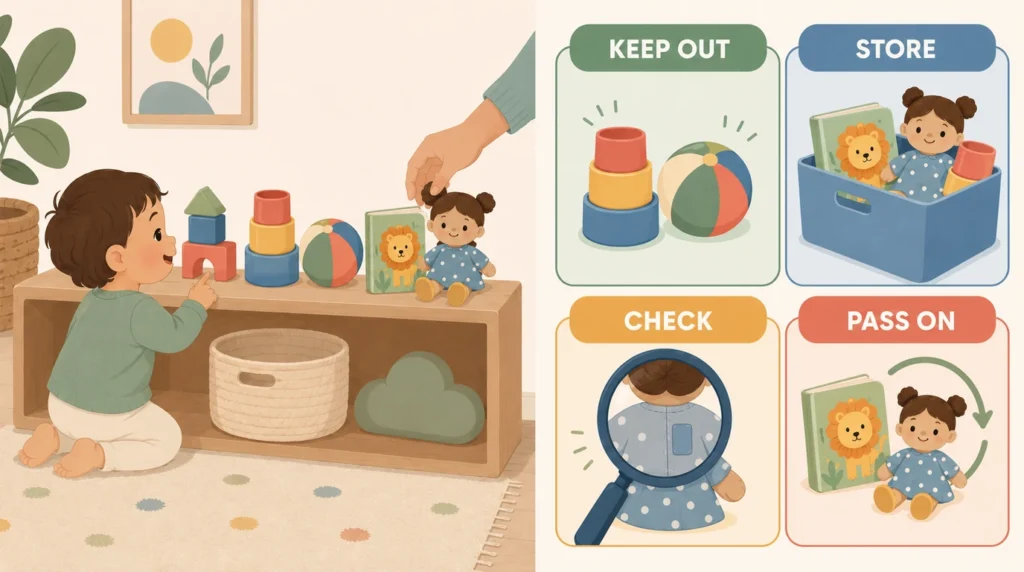
Rotate because the child’s use has changed, not because the calendar says Monday. Keep a favorite item available. Exchange one or two items at a time, then watch what the child carries, combines, ignores or repeatedly asks an adult to retrieve. Those observations are more useful than copying another family’s shelf.
Three realistic layouts for small homes
A living-room corner
Place the play area where the supervising adult naturally spends time, but outside the main route between doors, kitchen and seating. Use a washable mat as a visual boundary and one anchored low unit against a wall. Keep adult drinks, remotes, chargers and bags elsewhere. At the end of the day, move the visible toys into one lidless bin or a closed adult-controlled cabinet.
A play zone in a one-bedroom home
Use one portable basket for current toys and a separate locked location for rotation stock and activity supplies. Choose a floor area that can be cleared completely for sleep or household movement. If a crib is in the same room, keep toys, pillows, cords and storage outside the sleep space and follow current safe-sleep guidance for the child.
A shared space for a baby and toddler
Create a baby floor area outside the toddler’s traffic path, then select toddler materials that are also safe around the baby. Schedule small-piece or messy activities only when the baby is elsewhere with another responsible adult. This is more reliable than asking a toddler to keep every item on one side of a line.
Spend in the right order
Safety work comes before decoration. Costs vary by home, country and installation needs, so the sequence below is more useful than a universal shopping total.
| Priority | Spend first on | Delay or skip |
|---|---|---|
| 1. Remove serious hazards | Correct anchors, cordless window coverings, repairs and locked storage appropriate to the home | Wall art, themed bins and decorative shelving |
| 2. Create a usable floor area | Repairing a damaged surface or adding a simple washable boundary if needed | Large foam installations and indoor play structures |
| 3. Control materials | One stable storage solution and a separate locked location for adult supplies | A matching container for every toy category |
| 4. Fill a real play gap | One durable, age-appropriate material the child does not already have | Subscription boxes and products purchased only for a milestone claim |
A zero-new-toy setup is possible when the home already has a safe floor area, appropriate storage and a few suitable household materials. Head Start recommends home materials that are safe, durable, washable and open-ended. A measuring cup, sturdy container and washable cloth can support more play than a battery toy with one button.
Set up the first version in 30 minutes
- Minutes 0–5: Draw the room or corner. Mark doors, windows, adult seating, outlets and the main walking route.
- Minutes 5–10: Remove loose small objects, cords, bags, pet items and damaged toys. List repairs or anchoring that must happen before use.
- Minutes 10–15: Choose one clear floor zone that the adult can see and reach without stepping over furniture.
- Minutes 15–20: Select four to six age-appropriate play choices already in the home.
- Minutes 20–25: Place child-accessible materials in one stable shelf or lidless bin. Move everything else to adult-controlled storage.
- Minutes 25–30: Sit at the child’s height, scan again and decide where the adult will be during play.
Do not rush anchoring, electrical work, window changes or repairs to fit the timer. The 30-minute plan creates a first layout and a work list. The play area opens only after the safety work is complete.
Maintain the room with a short reset
- After play: count multipart toys, remove mouthed items for cleaning and return adult-controlled supplies to locked storage.
- Once a week: inspect seams, battery covers, cords, anchors, bin edges and floor surfaces. Confirm that sightlines and walkways still work.
- When a new toy arrives: read its full label and instructions, record the model if useful, remove packaging immediately and decide what leaves the visible shelf.
- Regularly: check recalls and act on the stated remedy. Do not sell or donate a recalled product.
- After a new skill: repeat the room audit. A new climber creates a new room.
Frequently asked questions
Does a toddler need a dedicated playroom?
No. A supervised corner with clear floor space, a few appropriate materials and controlled storage can provide the same basic functions. A dedicated room is useful only when its location, furniture and supervision plan work for the household.
How many toys should be available at once?
There is no official ideal number. Start with four to eight clear choices across different kinds of play, then adjust. A child using everything purposefully may not need a change. Repeated dumping, blocked floor space or difficulty finding pieces may be signs that less should be visible.
Are open shelves safe for toddlers?
They can be useful, but “low” does not mean tip-proof. Evaluate the complete unit, follow its instructions and anchor it when required. Do not place heavy objects on top or use furniture as a room divider unless it is designed and secured for that use.
What should stay out of an open toy basket?
Keep out button and coin batteries, high-powered magnets, balloons, water beads, coins, beads, broken toys, long cords, medication, cleaning products and materials intended for older children. Art and sensory supplies should remain under adult control and be selected for one supervised activity.
Can a baby and toddler share the same playroom?
Yes, when the environment is designed for the youngest child who can access it. Small toddler materials require a separate supervised session and complete cleanup before the baby returns. Give the baby a floor area outside the toddler’s movement route.
What is the best first purchase for a small play space?
There is no universal product. First identify the problem. If toys block the floor, one stable lidless bin may help. If supplies are accessible, locked storage matters more. If furniture can tip or window cords are reachable, correct those hazards before buying any play material.
Sources and safety references
Sources last checked July 27, 2026. U.S. product rules and recall resources are linked where applicable; families elsewhere should also follow local regulations, product labels and recall authorities.
- U.S. Consumer Product Safety Commission: Childproofing Your Home
- CPSC: Anchor It
- CPSC: Window Covering Cords
- CPSC: Small Parts for Toys and Children’s Products
- CPSC: Button Cell and Coin Batteries
- CPSC: Magnets
- American Academy of Pediatrics: How to Buy Safe Toys
- Head Start: Active Supervision
- Head Start: Environment as Curriculum for Infants and Toddlers
- Head Start: Using Materials Found in the Home
This article provides general educational information, not an inspection of a particular home or product. Follow current manufacturer instructions and seek qualified local help for anchoring, electrical work, window coverings or other installation questions.