How to Choose Montessori Toys: A Test You Can Run in the Store

The word “Montessori” printed on a box does not tell you what is inside it. The term is not trademarked, so any manufacturer can put it on a busy board, a plastic shape sorter, or a stacking toy that plays a tune, whether or not the toy has anything to do with Maria Montessori’s work. If you are trying to work out how to choose Montessori toys worth the money, you need a test you can run yourself, not another list of things to buy.
That test is six short questions. Ask them about the item in front of you and you get an honest pass or fail, including on the expensive ones. Some of what is already in your kitchen passes every question. Some of what is marketed as Montessori for toddlers should go back on the shelf. This article gives you the test, applies it to ten toy categories, and covers what to do when a passing toy still gets ignored.
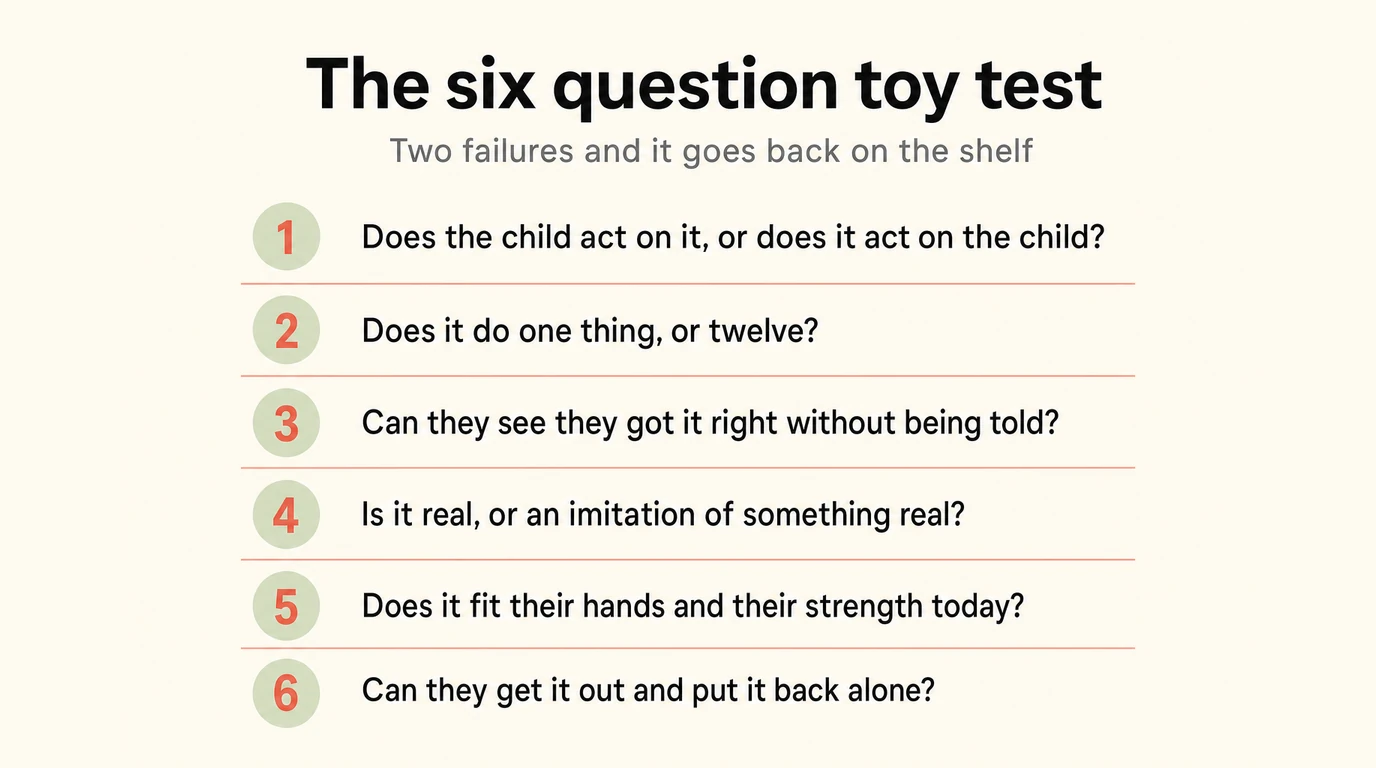
How to choose Montessori toys: a six-question test
Each question takes about ten seconds to answer honestly. If a toy fails two or more, put it back, regardless of the price or the label.
1. Does the child act on the toy, or does the toy act on them?
This is the single most important question, usually answered by whether the toy needs a battery. A toy piano that plays a full song on any key press performs for the child. A hammering bench where the peg only moves when the child swings the mallet puts the child in charge. Pass: nesting cups the child stacks and knocks down at their own pace. Fail: a light-up shape box that praises the child no matter which shape went in.
2. Does it do one thing, or twelve?
Montessori materials isolate a single skill so a child can practice it without other variables in the way. Rings that vary only in size teach size judgment. The same rings in six colors let a child succeed by matching color instead, an easier skill that dilutes the point. Pass: a wooden sorter with three shapes. Fail: an activity cube with a phone, gears, a mirror and a xylophone bolted to one box.
3. Is there a built-in way to see they got it right, without you telling them?
Montessori training calls this control of error, the difference between a toy that teaches and one that just occupies. A knobbed puzzle piece either sits flush or it does not; the fit is the feedback, no adult required. Pass: a sorter where the wrong hole will not accept the piece. Fail: a sorter with oversized holes where every shape fits every opening, so the child gets no information from trying.
4. Is it real, or a plastic imitation of something real?
Under three, Montessori practice favors real, functional objects over toy versions of them, on the idea that a child learns more from an object that behaves the way the real thing behaves. A small wicker basket carries things the way a basket should. A molded plastic one printed to look like wicker does not, and it usually also fails question 2 with a face and rattle on the handle. Pass: a short, sturdy glass used for water at the table. Fail: a sippy cup shaped like an elephant with a spinning wheel in the base.
5. Is it the right size and weight for their hands and their strength right now?
A puzzle knob needs to fit an 18-month-old’s pincer grip, not a 4-year-old’s whole hand. A push wagon needs enough real weight to give honest resistance without tipping over. A household safety rule belongs here too: for any child under 3, a piece counts as a choking hazard if it fits completely inside a cylinder 2.25 inches deep and 1.25 inches across, the official small parts standard. A toilet paper tube is a close, slightly larger stand-in: if a piece slides through one, treat it as a choking risk, whatever the label says about age range. For more ideas that build this hand skill safely, see our fine motor skills activities for 1 to 2 year olds. Pass: chunky wooden beads threaded by a 2-year-old’s whole hand. Fail: a “Montessori” kit with beads smaller than a pea, sold for a 1-year-old.
6. Is it beautiful enough to be left out on a shelf, and can they get it and put it back without help?
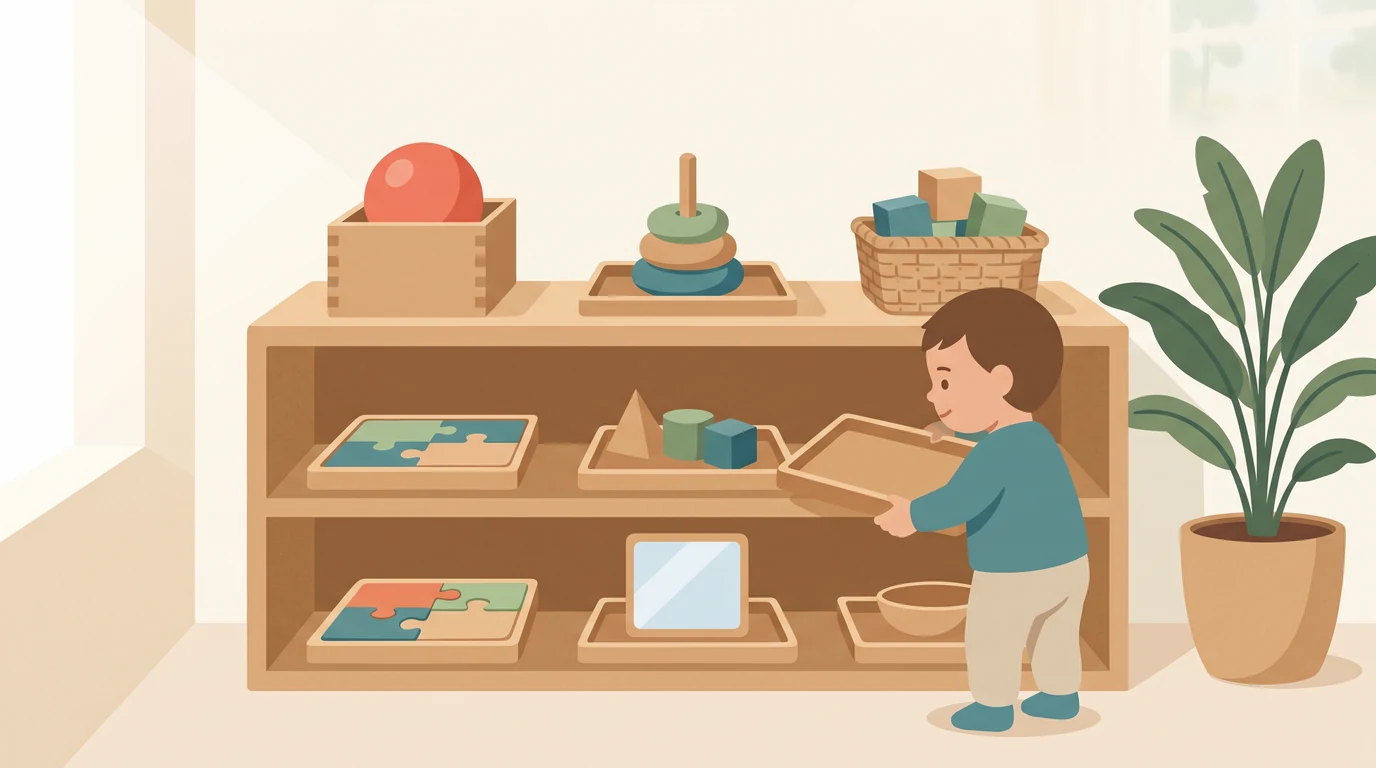
This is the order and independence half of the test, and it rules out almost everything sold in one oversized bin. A wooden rainbow on a low tray is something a toddler can carry to a mat, use, and return, without help. Two hundred mixed plastic blocks dumped in a toy chest fail this question even if every block would pass the first five, because nothing about the presentation lets a child manage them alone. Pass: one activity per basket, on a shelf at the child’s height. Fail: a toy box.
Applying the test to ten toys you will actually see in a store
Here is the same test applied at the category level, so you have an answer ready before you are standing in the aisle.
| Toy category | Passes | Fails | What to look for instead |
|---|---|---|---|
| Wooden shape sorter | One shape per hole, no sound, no lights | A “sensory” version with light-up buttons or a tune on success | A sorter where the wrong hole visibly refuses the piece |
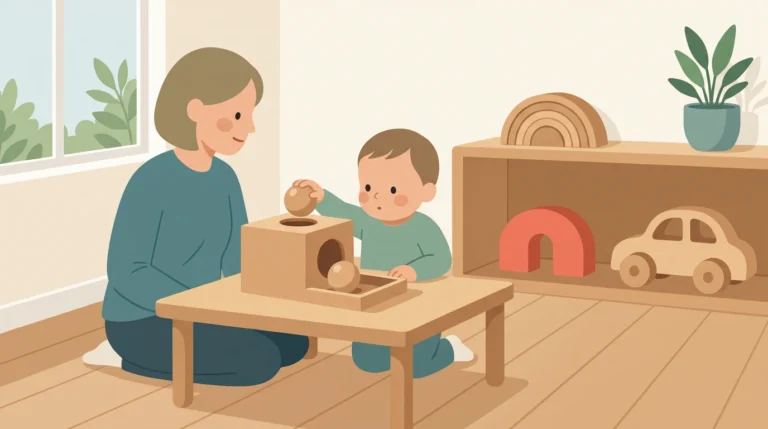
| Object permanence box | A wooden ball dropped through one hole, disappears, reappears below, silent | Versions that announce colors or play music | Plain wood, one opening, no batteries |
| Busy board | Rare: one real latch mounted alone | A dozen unrelated latches, dials and lights, no single skill | Supervised access to your own cabinet latch |
| Stacking rings | Same-color wooden rings that differ only in size | Multi-colored rings a child can sort by color instead of size | One color, graduated size only |
| Push wagon | Solid wood or metal, heavy enough for real resistance, no long cord | Light plastic with a long pull cord, especially with beads that could form a loop | Real weight, no cord or one under the length limit covered below |
| Plastic activity centre (stand-up panel with a phone, mirror, spinners and gears) | Almost never | Fails 1, 2 and 4 at once: performs, does a dozen things, imitates real objects badly | A real spinner or gear toy bought alone, or skip the category |
| Subscription toy box | Depends on the contents, not the packaging | Fails as a bundle if you trust it to have vetted each item | Apply the six questions as items arrive |
| Play kitchen | Toddler height, plain wood, real small pans a child can lift | Oversized plastic with recorded sizzling sounds and a beeping microwave | A step stool at your real counter |
| Musical toy | A small real instrument the child strikes to produce a sound they controlled | An electronic keyboard that plays a full song from one button | An instrument, not a music player |
| Ride-on | Wooden or metal, propelled and steered by the child’s own body | Battery-powered with a parent-held remote control | Feet on the ground, hands on the actual wheel |
The push wagon row needs one more detail. Cords longer than 12 inches on toys for children under 3 are treated as a strangulation risk under the toy safety standard, and pull toys with beads that could tangle into a loop fall under the same rule. If a cord is close to that length, cut it down or choose a version without one.
One more hazard does not fit into a single row: loose magnets. Some sensory and building toys marketed at toddlers include small magnetic beads or balls. If a child swallows more than one, the magnets can attract each other through the stomach and intestinal walls, causing injury that often needs surgery. Skip any toy with loose magnetic pieces for a child under 3, no matter how it is marketed.
How brands use the word Montessori
Montessori is not a protected trademark the way a brand name is. Maria Montessori died in 1952, and decades later almost any toy company can print the word on a box or a listing title without asking anyone’s permission. That is not illegal. It does mean the word carries none of the guarantee a parent assumes when they see it in a search for the best Montessori toys.
Three patterns turn up constantly under the label. A busy board covered in unrelated latches, zippers and lights, sold as sensory development, fails question 2 the moment you count the actions crammed onto one panel. A plastic shape sorter that plays a tune on success fails question 3 by replacing the child’s own feedback with the toy’s applause. And a rainbow arc stacker sold as developmental with no control of error at all lets an 18-month-old and a 3-year-old use it the same way, with neither getting feedback about doing anything differently.
Paying more does not change the pattern. A wooden busy board with a dozen latches still fails question 2, just at three times the price.
What you already own that passes the test
Most of what clears all six questions is already in your kitchen or costs a fraction of the marketed equivalent:
- A small real jug for pouring water or dry rice
- A basket with handles, for carrying things from one room to another
- An unbreakable mirror mounted at floor level
- A low, open shelf they can reach without help
- A set of metal measuring cups
- A nail brush and a small basin, for washing hands or vegetables
A boxed “Montessori pouring set”, a jug, a tray and two cups with a label on the box, typically runs $25 to $40 online. A ceramic creamer jug from a secondhand shop, paired with two bowls you already own, passes the same six questions for under $5, and it is real, which a plastic jug printed to look like ceramic is not.
The same logic applies to shelving. Search for the best Montessori bookshelf and most results are purpose-built units running well past $100. A front-facing shelf just needs to display a few board books cover-out, low enough for a child to choose one and put it back. A picture ledge from a hardware store, mounted at toddler height, does that job for less. For the rest of the room around it, see our guide to setting up a toddler playroom.
How many toys should actually be out at once
Most Montessori-trained guides land in a similar range: 5 to 8 activities visible on the shelf for a toddler between 1 and 3, closer to 3 or 4 for a baby under 12 months who is still learning to choose at all. The number is not arbitrary. Fewer choices mean a child can see the whole shelf at a glance, choose without being overwhelmed, and finish what they started instead of reaching for the next bright object in a pile.
Keep everything else in a closet bin, and swap it in every couple of weeks or when interest drops, rather than replacing the whole shelf at once.
What changes as they grow
0 to 12 months. The test mostly points toward looking, reaching and grasping: an unbreakable mirror, a rattle with real texture contrast, plain wood or fabric objects sized for a fist rather than fingers. Almost nothing needs to be bought new. For more low-prep options at this stage, see our sensory bin ideas.
12 to 24 months. Pouring, nesting, threading and early sorting take over as the pincer grip develops and walking frees their hands. This is where fine motor practice earns its keep; see our activities for 1-year-olds for more of what fits this window.
2 to 3 years. This is also the age where outdoor Montessori toys earn their keep: a child-sized wheelbarrow, a real trowel, a low balance beam. The same six questions apply outside; does the wheelbarrow move real mulch, or does it get pushed around empty because it is too flimsy to hold weight. Separate, more detailed roundups of Montessori toys for 1-year-olds and for 2-year-olds are coming soon, and this test is the criteria they will be judged against.
When a good toy gets ignored
A toy can pass all six questions and still sit untouched. Before assuming the toy or the child is the problem, check the presentation. Too many items on the shelf hide the one you want noticed. A basket with unrelated objects mixed together, instead of one activity per tray, makes it harder to see what the toy is for. Turn it so the working side faces out, put one thing per container, and give it its own space.
If the presentation is already right and it is still ignored after a few weeks, that is information, not a verdict on your child. A toy untouched for eight weeks usually means it is not the right skill at the right moment. Put it away and bring it back in a month or two.
Frequently asked questions
Are Montessori toys worth it?
The principle is worth applying: one skill at a time, real materials, built-in feedback. Paying a premium for the label is a separate question, and often it is not worth it, since a household object applying the same principle usually costs less.
Do Montessori toys have to be wooden?
No. Wood is common because it is real and quiet, which helps it pass questions 1 and 4. A cloth basket, a metal cup or a ceramic bowl passes just as well. Material is not the requirement; how the object behaves is.
Is a busy board Montessori?
Most fail on question 2. A board with ten or more unrelated latches and switches asks a child to do too many things on one object, with no isolated skill to practice. A single real latch, mounted alone, comes closer to the principle.
What are the best Montessori toys for outdoor play?
The same six questions apply outdoors. Real, child-sized tools tend to win: a wheelbarrow that moves dirt, a trowel that digs, a watering can sized for small hands. Battery-powered ride-ons and plastic playhouses with sound effects fail the same way indoor toys do.
Do I need a special Montessori bookshelf?
No. You need something front-facing and low enough for a child to reach alone. A purpose-built unit is one way to get that. A mounted picture ledge does the same job for less.
How is this different from a list of the best Montessori toys?
A list tells you what to buy from one store’s catalog. A test travels with you to any store or listing, including ones that do not exist yet, and it tells you when the honest answer is not to buy anything.
Sources and notes
The six-question test draws on core Montessori principles, including isolation of a single quality, control of error, and the preference for real over imitation objects, as described in Maria Montessori’s own work and as taught by Montessori teacher training organizations. It does not quote or cite any specific text or page number. The small parts guidance reflects the Consumer Product Safety Commission’s small parts standard, which defines the test cylinder used to judge choking risk for children under 3. The cord length point reflects the strangulation provisions of the toy safety standard used to test toys sold in the United States. The note on magnets reflects the Commission’s published warnings on magnet ingestion. Parents with a specific safety question should check the item’s packaging and, where needed, consult their pediatrician or the American Academy of Pediatrics’ HealthyChildren.org.
Sources checked on October 25, 2026. Primary references: