When Do Babies Crawl? Typical Ages, Crawling Styles and How to Help


Quick answer: Most babies start crawling somewhere between 7 and 10 months, according to the American Academy of Pediatrics (AAP). The normal range is wider than that. In the World Health Organization’s motor development study, healthy babies began hands-and-knees crawling anywhere from about 5 to 13.5 months, and roughly 4% never crawled on hands and knees at all. That is why the CDC no longer lists crawling as a milestone. What matters more is that your baby finds some way to move, uses both sides of the body evenly and keeps building toward sitting, pulling up and walking.
Crawling is the milestone people ask about most, often at family dinners. This guide explains what is typical, the different ways babies get around, the signs that crawling is close, simple ways to help at home and the signals worth raising with your pediatrician.
When do babies crawl? The real age range
The AAP describes crawling as a skill “usually mastered between seven and ten months.” Many babies spend a few weeks before that rocking on their hands and knees, and some push themselves backward at first, because their arms are stronger than their legs.
The widest view comes from the WHO Multicentre Growth Reference Study, which followed 816 healthy children in Ghana, India, Norway, Oman and the USA. Its “window of achievement” for hands-and-knees crawling runs from 5.2 to 13.5 months (the 1st to 99th percentile). Crawling was also the one milestone that did not follow a fixed order: babies picked it up before, during or after other skills such as standing with help. And 35 of the 816 children (4.3%) skipped hands-and-knees crawling entirely.
Why crawling is no longer on the CDC checklist
In 2022, the CDC and the AAP updated the “Learn the Signs. Act Early.” milestone checklists. The new lists show skills that at least 75% of children have by a given age, rather than the halfway point. Crawling was removed from the 9-month list because there was little data on when 75% of babies reach it, and because some typically developing children never crawl. The current CDC movement milestones for 9 months are getting to a sitting position alone, sitting without support, moving things from one hand to the other and raking food toward themselves with the fingers.
So a 9-month-old who is not crawling yet is not, on that fact alone, “behind.” The bigger picture is what counts.
Babies born early: use corrected age
If your baby was born preterm, the AAP recommends using corrected age for milestones during the first 2 years. Take your baby’s age in weeks and subtract the number of weeks they were born early. A baby born 8 weeks early who is now 10 months old has a corrected age of about 8 months, and that is the age to compare with.
Crawling at a glance
| Topic | What the sources say | Source |
|---|---|---|
| Typical age to crawl | About 7 to 10 months | AAP (HealthyChildren.org) |
| Full normal window, hands and knees | 5.2 to 13.5 months | WHO Motor Development Study |
| Babies who skip hands-and-knees crawling | 4.3% of the WHO study sample | WHO Motor Development Study |
| On the CDC milestone checklist? | No, removed in 2022 | CDC / AAP (Pediatrics, 2022) |
| Belly crawling often appears | Around 7 to 8 months | Cleveland Clinic |
| Classic crawl often appears | Around 9 to 10 months | Cleveland Clinic |
| Preterm babies | Compare using corrected age until age 2 | AAP (HealthyChildren.org) |
Crawling styles: there is more than one “right” way
The AAP lists several crawling styles, and all of them can be part of normal development. Many babies try two or three before settling on a favorite.
| Style | What it looks like | Good to know |
|---|---|---|
| Classic (cross) crawl | Weight on hands and knees; one arm and the opposite knee move together | Takes coordination and core strength; often follows belly crawling |
| Belly or commando crawl | Belly stays on the floor while arms pull and legs push | Often a baby’s first real attempt at getting somewhere |
| Bear crawl | Arms and legs straight, bottom up, moving on hands and feet | Less common; sometimes shows up on the way to walking |
| Bottom scooting | Sitting up and pushing forward with the arms or legs | Counts as independent movement, even if it is not technically crawling |
| Crab crawl | Moving backward or sideways using the hands | Backward movement is common at first |
| Rolling | Log-rolling from one spot to the next | A smart way to travel before crawling clicks |
The AAP’s rule of thumb: as long as your baby coordinates both sides of the body and uses each arm and leg about equally, the style itself is not a concern. The goal is exploration and getting stronger for walking.
Signs your baby is getting ready to crawl
Crawling usually builds on earlier floor skills. You may notice some of these in the weeks or months before:
- Strong tummy time. Pushing up onto forearms and, later, onto straight arms. The CDC lists “pushes up with straight arms when on tummy” as a 6-month milestone.
- Pivoting. Turning in a circle on the tummy to reach a toy.
- Rolling both ways and using rolls to change location.
- Sitting steadily and leaning forward to reach, then catching themselves with their hands.
- Getting from tummy to sitting (or back down) on their own.
- Rocking back and forth on hands and knees, or sliding backward by accident.
- Frustrated reaching. Clear interest in things that are just out of reach.
None of these is a test with a deadline. They simply show the body is collecting the strength and balance crawling needs.
How to help your baby crawl (without pushing)
You do not need special equipment. What babies need most is time on a safe floor, a reason to move and someone nearby.
1. Protect daily floor time
Floor play is where crawling is practiced. Cleveland Clinic notes that babies who spend long stretches in swings, seats and carriers get fewer chances to build crawling skills. Short, frequent sessions on a firm, flat surface work better than one long one. If your baby is younger, our guide to tummy time by age shows how to build up those first sessions.
2. Put interesting things just out of reach
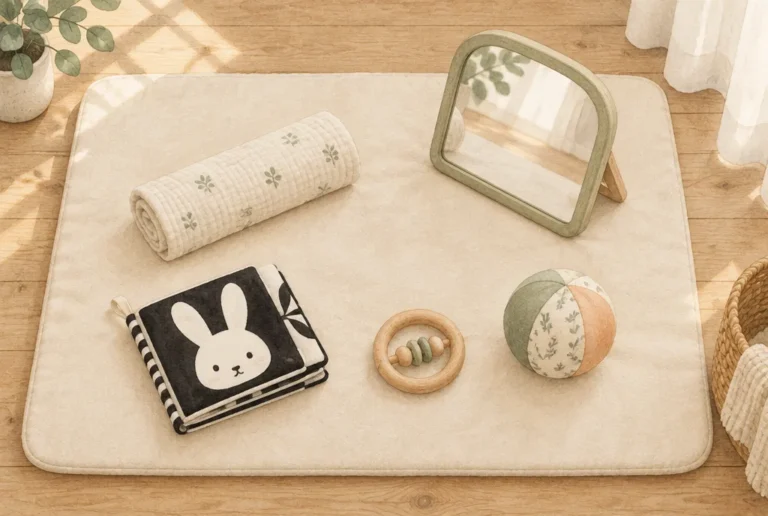
Both the CDC and the AAP suggest placing a toy a little beyond your baby’s reach on a play mat and cheering when they get to it, whether they crawl, scoot or roll. Rotate a few simple objects: a soft ball that rolls slowly, a rattle, a baby-safe mirror or a board book stood up on its side. For more ideas matched to age, see our list of sensory play ideas for babies and toddlers.
3. Get down on the floor yourself
Your face is often the most motivating “toy” in the room. Lie down at eye level, a little out of arm’s reach, and invite your baby to come to you. Peekaboo from behind a cushion turns practice into a game.
4. Build a gentle obstacle course
Once your baby is moving, the AAP suggests mini obstacle courses with pillows, sofa cushions and sturdy boxes. Crawling over a low cushion or around a box adds strength and problem-solving. Stay right there the whole time: a baby who slips between pillows or under a box may not be able to get out and could be at risk of suffocation.
5. Dress for traction
Bare knees and feet, or soft clothing that does not slide, can make it easier to push off. Very slippery floors or bulky outfits can make early attempts harder. This is practical advice rather than a rule, so adjust to your home and the season.
6. Skip the baby walker
Wheeled baby walkers do not teach babies to walk. The AAP says they can reduce the desire to walk and calls them a serious hazard: babies in walkers can tip over, fall down stairs and reach dangerous places. The AAP strongly urges parents not to use them. A stationary activity center without wheels is a safer option for short periods, but floor time is still the main event. If you are weighing gear, our honest look at whether activity tables are worth it may help.
Safety checklist for a newly mobile baby
Crawling changes your home overnight. A baby who could not reach the outlet yesterday may be there today. Before or right after the first crawl:
- Get down to their level. Crawl through main rooms and look for what you can see and grab from the floor.
- Clear small objects. Check under sofas and beds for coins, balloon pieces and anything that could be swallowed. The AAP singles out button batteries as especially dangerous.
- Gate the stairs at the top and bottom, and keep them gated even after your baby learns to crawl down backward.
- Anchor furniture your baby may pull up on, and check that it has no sharp edges.
- Lock away medicines, chemicals and cleaning products. In the US, save the Poison Help Line number, 800-222-1222, in your phone, as the CDC recommends.
- Move diaper changes to the floor if your baby flips and twists on the changing table, and never leave them alone up high.
- Supervise all floor play, especially around cushions, pillows and boxes.
For a room-by-room setup that grows with your child, see how to set up a safer playroom.
What comes after crawling
Many babies start pulling up to stand soon after they learn to crawl, and some do it before they ever crawl. The CDC’s 12-month checklist includes pulling up to stand and walking while holding onto furniture (“cruising”). Many babies take their first independent steps around their first birthday, although earlier and later are both normal. It is also normal for a new walker to drop back to crawling when they want to go fast. When your baby is on the move, our guide to activities for 1-year-olds has plenty of ways to keep that energy busy.
One tip from the AAP: babies who learn to pull up often do not yet know how to get down. If your baby cries while standing at the crib rail or sofa, gently show them how to bend their knees and lower themselves.
When to talk to your pediatrician
A baby who skips crawling but sits, rolls, scoots and later pulls up is usually doing fine. Bring it up at the next well-baby visit, or call sooner, if you notice any of these:
- Your baby is not sitting on their own by about 9 months (the AAP advises telling your pediatrician).
- Your baby uses one side of the body much more than the other, for example dragging one leg or always pushing with the same arm.
- Their body seems very stiff or very floppy when they try to move.
- They show little interest in moving or exploring, or do not bear weight on their legs when you hold them standing.
- They are not reaching other movement milestones, such as pushing up on straight arms during tummy time, rolling or sitting.
- They have lost a skill they used to have.
- You simply feel that something is not right. The CDC’s advice is “don’t wait”: share your concerns and ask about developmental screening.
In the US, the CDC also suggests calling your state or territory’s early intervention program to find out whether your child can get services; the numbers are listed at cdc.gov/FindEI.
Frequently asked questions
Can a baby crawl at 5 or 6 months?
Yes. It is less common, but the WHO window for hands-and-knees crawling starts at about 5 months. Early crawling is not a sign of anything special, and late crawling is not a sign of a problem. Early movers do need home safety steps sooner.
Is it normal for my baby to crawl backward?
Very normal. The AAP explains that arms are often stronger than legs at first, so babies push themselves backward before they figure out how to go forward.
My baby is 10 months old and not crawling. Should I worry?
Not on that fact alone. Look at the bigger picture: is your baby sitting, rolling, moving in some way, using both sides evenly and interested in the world? If yes, keep offering floor time. If you see any of the warning signs above, or you are unsure, ask your pediatrician.
What if my baby skips crawling and goes straight to walking?
Some babies do. In the WHO study, about 4% of healthy children never crawled on hands and knees. The AAP says that what matters is that a baby explores and builds strength for walking, not the exact route they take.
Does commando crawling count as crawling?
Yes. Belly crawling is one of the crawling styles the AAP describes, and it is often the first one babies use. Many move on to hands and knees later; some keep belly crawling until they walk.
Do babies need knee pads or crawling shoes?
No special gear is needed. Soft, non-slippery clothing on a clean, safe floor is enough. When your child starts walking outside, the AAP recommends flexible, comfortable shoes with non-skid soles.
The bottom line
Most babies crawl between 7 and 10 months, but the healthy range runs from about 5 to more than 13 months, and some babies never crawl in the classic way. Give your baby plenty of safe floor time, a reason to move and a childproofed space. Watch the overall pattern, not a single date, and talk to your pediatrician if anything worries you.
This article is for general information and does not replace advice from your child’s healthcare provider.
Sources
- American Academy of Pediatrics (HealthyChildren.org): Movement Milestones in Babies 8 to 12 Months Old
- American Academy of Pediatrics (HealthyChildren.org): Crawling Styles
- American Academy of Pediatrics (HealthyChildren.org): Corrected Age for Preemies
- American Academy of Pediatrics (HealthyChildren.org): Baby Walkers: A Dangerous Choice
- CDC, Learn the Signs. Act Early.: Milestones by 6 Months
- CDC, Learn the Signs. Act Early.: Milestones by 9 Months
- CDC, Learn the Signs. Act Early.: Milestones by 1 Year
- Zubler JM, et al. Evidence-Informed Milestones for Developmental Surveillance Tools. Pediatrics, 2022 (CDC Stacks).
- World Health Organization: Motor development milestones
- WHO Multicentre Growth Reference Study Group. WHO Motor Development Study: windows of achievement for six gross motor development milestones. Acta Paediatrica, 2006 (PubMed).
- Cleveland Clinic: When Do Babies Start To Crawl? And Why Is It Important?