When Do Babies Roll Over? Typical Ages, Stages and How to Help


Quick answer: most babies start rolling over somewhere between about 4 and 6 months, and many roll from tummy to back before they roll from back to tummy. The American Academy of Pediatrics (AAP) says babies work on rolling both ways during the 4 to 7 month stretch, and the CDC lists rolling from tummy to back as a milestone most babies reach by 6 months. Some babies try as early as 2 months, which is why the AAP says to stop swaddling as soon as your baby shows signs of trying to roll. The best way to help is plenty of supervised tummy time and floor play. Keep putting your baby down on their back for every sleep; once they can roll both ways on their own, you don’t need to flip them back.
Rolling over is one of the first big “whole body” skills your baby learns. It takes neck strength, a strong upper back, arms that can push, and a bit of courage. It is also the milestone that changes a lot of everyday routines overnight: the changing table, the sofa, the swaddle and the crib all need a second look. This guide covers the typical ages, the stages that come before a roll, simple ways to practice, safe sleep once rolling starts, and when it is worth checking in with your pediatrician.
When do babies roll over?
There is a range, not a single date. Here is how the main sources describe it:
- The AAP describes the 4 to 7 month period as the time when babies work on rolling over both ways, with many able to roll in both directions by the end of that window.
- The CDC’s developmental milestone checklist lists “rolls from tummy to back” among the skills most babies show by 6 months.
- The AAP’s swaddling guidance notes that some babies start working on rolling as early as 2 months, and its safe sleep guide says rolling usually happens around 3 to 4 months but can happen earlier.
In other words, an early roll at 2 or 3 months and a later one closer to 6 months can both be normal. Premature babies are usually measured by their corrected age, which is their age counted from their due date rather than their birth date.
Tummy to back or back to tummy first?
According to the AAP, most babies roll from tummy to back first. That direction is a bit easier because a baby on their tummy can push up on their arms, shift their weight and let gravity help them tip over. Rolling from back to tummy takes more core strength and coordination. That said, the AAP is clear that doing it in the reverse order is perfectly normal too.
Rolling over timeline by stage
Rolling builds on a set of smaller skills. Ages are approximate and every baby moves through these at their own pace.
| Approximate age | What you might see | Why it matters for rolling |
|---|---|---|
| 0 to 2 months | Lifts head briefly during tummy time, turns head side to side | Starts building neck and upper back strength |
| 2 to 4 months | Pushes up on forearms, holds head steadier, may tip from tummy to side by accident | Early weight shifting, which is the first ingredient of a roll |
| 4 to 5 months | Pushes up on straight arms, arches back, rocks, kicks and “swims” on tummy | The AAP notes these skills usually appear around 5 months and are needed for rolling and crawling |
| 4 to 6 months | Rolls from tummy to back, often first by surprise | First full roll, usually in this direction |
| 5 to 7 months | Rolls from back to tummy, reaches for toys while on side | Rolling both ways, which also changes safe sleep steps |
| 6 months and up | Rolls on purpose to get somewhere, pivots on tummy | Rolling becomes a way to move, a step toward sitting and crawling |
Signs your baby is getting ready to roll
- Lifting their head and chest high during tummy time
- Pushing up on straight arms
- Rocking side to side on their tummy or back
- Kicking hard and twisting their hips when lying on their back
- Rolling onto their side to reach a toy or look at you
- Grabbing their feet while lying on their back, which shows growing core strength
Once you see these, rolling can happen any day, often when you least expect it. Treat every raised surface as a place your baby can roll off from this point on.
How to help your baby roll over
You can’t hurry a milestone, but you can give your baby lots of chances to practice. These ideas are simple and need almost no equipment.
1. Make tummy time a daily habit
Tummy time builds the neck, shoulder and arm strength that rolling depends on. The Safe to Sleep campaign from the U.S. National Institutes of Health recommends supervised tummy time every day while your baby is awake, starting with short sessions in the first days and building up as your baby grows. For age-by-age amounts and ideas, see our guide to tummy time by age.
2. Give them floor time
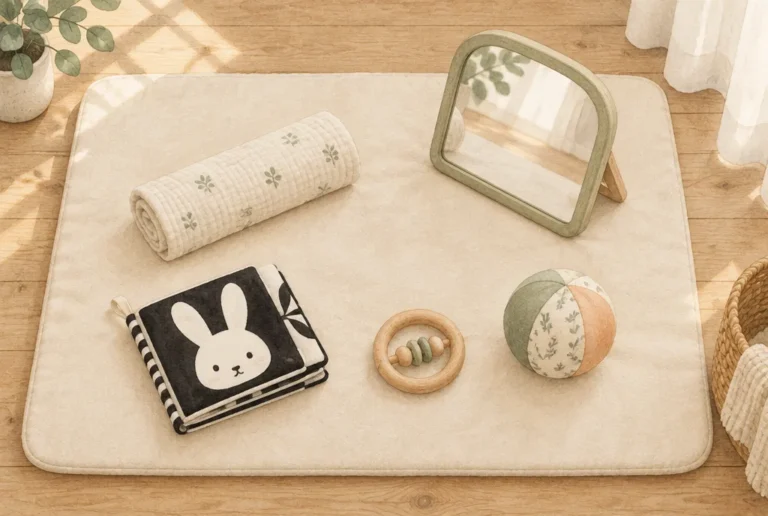
A firm, flat surface like a play mat on the floor is the best place to practice. Bouncers, swings and seats are handy for short breaks, but babies can’t push, twist or roll in them. Spreading out on the floor gives them room to experiment.
3. Use toys as a target
Place a favorite toy just out of reach to one side while your baby lies on their back or tummy. Reaching across the body for it is often what tips a baby onto their side and, eventually, all the way over. Bright, high-contrast toys or a baby-safe mirror work well.
4. Practice “side-lying” play
Gently lay your baby on their side, supported by your hand on their back, and play face to face for a minute. It lets them feel the in-between position and builds the muscles on each side of the trunk. Switch sides each time.
5. Show them the movement
With your baby on their back, slowly bend one knee and bring it across their body so their hips turn, then let them finish the turn of the shoulders themselves. Move slowly and stop if they fuss. The goal is to let them feel the motion, not to roll them over.
6. Cheer, then back off
Babies love an audience. Get down at their eye level, talk, smile and celebrate the attempts. Then give them space to try on their own; struggling a little is part of how they learn.
Rolling over and safe sleep
Rolling is exciting, but it changes the rules in the crib. Here is what the AAP’s safe sleep guidance says:
- Always place your baby on their back to sleep, for naps and at night, until their first birthday.
- Once your baby can roll both ways (back to tummy and tummy to back) comfortably, you don’t need to keep turning them back over if they roll during sleep.
- Keep the crib bare. No blankets, pillows, stuffed toys or bumper pads. A baby who rolls could end up face-down against one of these, which could block their breathing.
- Use a firm, flat sleep surface with only a fitted sheet.
When to stop swaddling
The AAP says to stop swaddling as soon as your baby shows any signs of trying to roll over. The risk of suffocation is higher if a swaddled baby rolls onto their tummy, because their arms are pinned and they can’t push up or turn their head easily. The same goes for wearable blankets or sleep sacks that wrap the arms and chest. A sleep sack that leaves the arms free and lets your baby move can still be used. Weighted swaddles and weighted sleep sacks are not recommended.
| Situation | What to do |
|---|---|
| Baby is starting to rock or try to roll | Stop swaddling and switch to an arms-free sleep sack |
| Baby rolls tummy to back only | Keep placing on back; if they end up on their tummy and can’t roll back, turn them onto their back |
| Baby rolls both ways easily | Place on back to start; you can leave them in the position they choose |
| Baby falls asleep in a car seat, swing or stroller | Move them to a firm, flat sleep surface on their back as soon as possible |
Rolling over and home safety
The first roll often happens in a place you didn’t plan for. A few habits help:
- Never leave your baby alone on a bed, sofa or changing table, even for a second. Keep one hand on them while changing diapers.
- Do floor play on the floor. A play mat on the floor is safer than a bed or sofa.
- Clear the area around the play mat of cords, small objects and anything that could fall.
- Start childproofing early. Rolling is usually followed by pivoting and then crawling, so it is a good time to check outlets, cords and furniture that could tip.
What comes after rolling
Rolling is a building block for the next motor skills. The strength your baby gains while pushing up and twisting helps them sit with support, then sit on their own, pivot on their tummy and eventually crawl. You can read what to expect next in our guides on when babies sit up and when babies crawl. Rolling also opens up new ways to play, like reaching for a toy you’ve hidden under a cloth, which ties into object permanence games.
When to talk to your pediatrician
Babies develop at different speeds, and a few weeks’ difference is rarely a concern. Still, it is a good idea to bring it up with your pediatrician if:
- your baby isn’t rolling at all, in either direction, by about 6 months;
- your baby seems very stiff or very floppy, or has trouble holding their head up by around 4 months;
- your baby always rolls or reaches with one side only, or keeps their head turned to one side;
- your baby used to roll and has stopped, or has lost other skills they had;
- you simply have a feeling that something is off. Your instinct is worth sharing.
Your pediatrician checks motor skills at well-child visits and can tell you whether things are on track or whether an evaluation, such as with a physical therapist, might help. Early support works best, so there is no need to “wait and see” if you are worried.
Frequently asked questions
Is it normal for a 3-month-old to roll over?
Yes. Some babies roll from tummy to back around 3 months, and the AAP notes some start working on rolling as early as 2 months. Early rolls are often accidental. Either way, it is your cue to stop swaddling and to never leave your baby alone on a raised surface.
My baby rolls onto their tummy at night and wakes up upset. What should I do?
If your baby can roll to their tummy but can’t roll back yet, gently turn them onto their back. Lots of daytime practice usually helps them master rolling back within a few weeks. Once they roll both ways easily, the AAP says you don’t need to keep repositioning them.
Can I use a positioner or wedge to keep my baby on their back?
No. The AAP advises against sleep positioners, wedges and similar products. A firm, flat crib with only a fitted sheet is the safest option.
My baby rolled once and hasn’t done it again. Is that a problem?
Usually not. Many babies roll once by surprise and then don’t repeat it for a while as their strength catches up. Keep offering tummy time and floor play.
Do some babies skip rolling?
Some babies roll very little and move on to sitting or other ways of getting around. If your baby isn’t rolling by about 6 months, or you have other concerns about movement, ask your pediatrician.
Does rolling over cause a sleep regression?
New motor skills can disrupt sleep for a while, because babies often want to practice them, even in the crib. This usually settles once the skill is mastered. Lots of daytime floor time can help.
Sources
- American Academy of Pediatrics, HealthyChildren.org. Movement Milestones: Babies 4 to 7 Months.
- Centers for Disease Control and Prevention. Important Milestones: Your Baby By Six Months.
- Centers for Disease Control and Prevention. Important Milestones: Your Baby By Four Months.
- American Academy of Pediatrics, HealthyChildren.org. A Parent’s Guide to Safe Sleep.
- American Academy of Pediatrics, HealthyChildren.org. Swaddling: Is it Safe for Your Baby?
- National Institutes of Health, Safe to Sleep. Tummy Time.
- American Academy of Pediatrics, HealthyChildren.org. Corrected Age for Preemies.
This article is for general information and does not replace advice from your pediatrician. Written by the BabyU Editorial Team.