Toy Rotation: A Simple System for Fewer Toys and Longer Play

Quick answer: toy rotation means keeping only a small set of toys out at a time, storing the rest out of sight, and swapping a few every week or two. Many families start with roughly 6 to 10 toys on a low shelf, chosen to cover different kinds of play (building, pretend, movement, books, fine motor). A small study of toddlers found that with fewer toys in the room, children played longer with each toy and found more ways to use it. Rotation also makes tidying easier and helps you notice what your child is actually working on. Swap when interest drops, not on a strict calendar, and check every toy for choking hazards before it goes back on the shelf.
If your living room looks like a toy store exploded and your toddler still wanders around saying “bored,” you are not alone. More toys rarely solve that. Fewer, better-chosen toys, offered in a predictable way, often do. This guide walks through the whole system: why it works, how to set it up in an afternoon, what a rotation looks like at different ages, and the safety checks that matter most.
What toy rotation is (and what it is not)
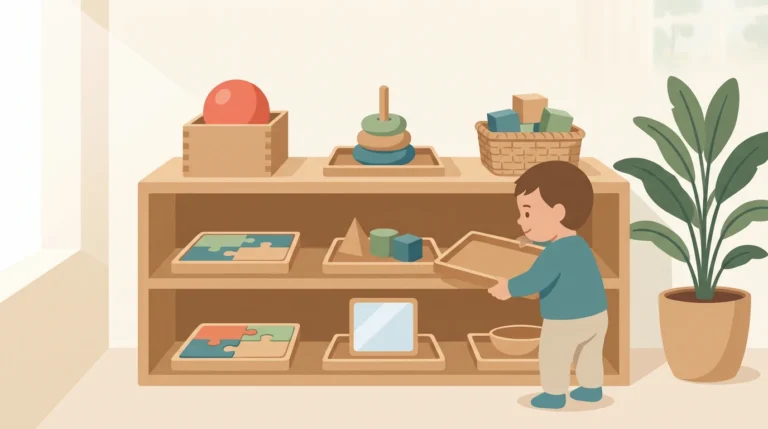
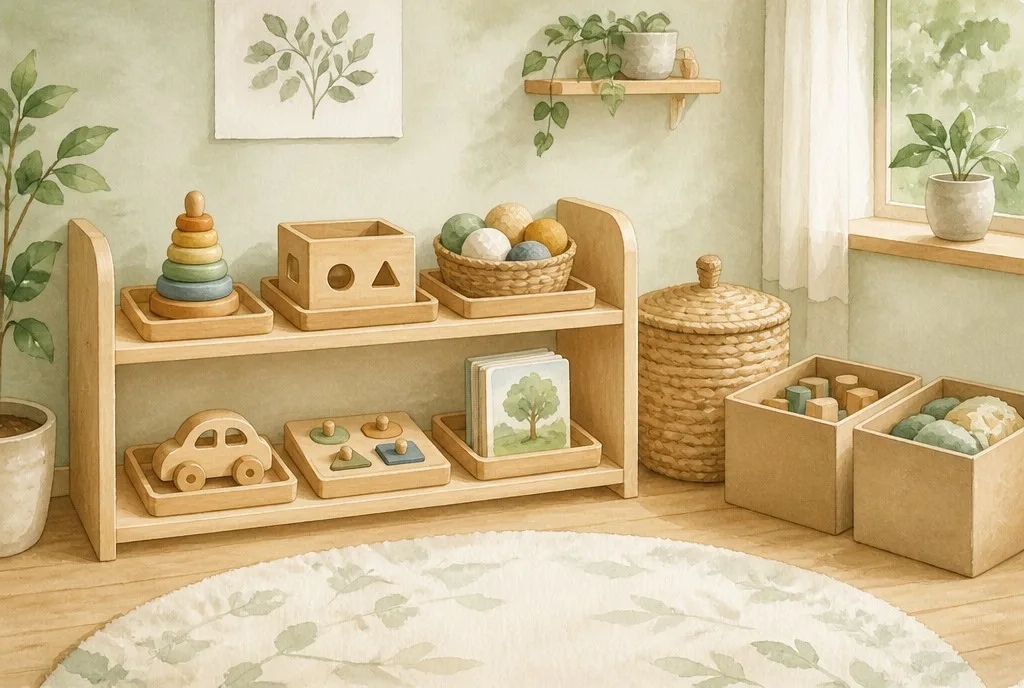
Toy rotation is a simple storage habit. You divide the toys you already own into small groups. One group is out on an open, low shelf where your child can see and reach everything. The other groups wait in closed bins or a closet. Every so often, you swap a few toys out and bring a few “new” ones back.
It is not a rule about owning fewer toys, buying special Montessori materials or following a rigid schedule. You can rotate plastic cars, cardboard boxes and secondhand puzzles just as well as wooden toys. The point is how many things your child sees at once, not what they cost.
The idea fits naturally with Montessori principles. Montessori classrooms use a prepared environment with a limited set of materials on open shelves, and adults observe the child and adjust what is offered based on their interests. The American Montessori Society describes this as children following their own interests while teachers act as guides who observe and provide the right tools. At home, a rotation shelf is the same idea on a small scale.
Why fewer toys can mean better play
The most cited study on this topic was published in 2018 in the journal Infant Behavior and Development by occupational therapy researchers at the University of Toledo. They watched 36 toddlers aged 18 to 30 months during supervised 15-minute free play sessions, once in a room with 4 toys and once with 16 toys. With only four toys, the toddlers had fewer separate bouts of play, played longer with each toy and used the toys in a greater variety of ways. The authors suggested that fewer toys may help toddlers focus and play more creatively.
It is a small study in a lab-like setting, with toys the children did not own, so it does not prove that rotation will transform your child’s attention span. But it lines up with what many parents notice at home: when everything is out, kids flit from toy to toy; when a few things are out, they settle in.
The American Academy of Pediatrics (AAP) points in the same direction from a different angle. In its report on selecting toys for young children, the AAP stresses that the most valuable toys are often the simplest ones, that toys do not need to be trendy or expensive, and that the most educational “toy” is one that brings a caregiver and child together in play. A calm shelf with a few open-ended toys makes that kind of shared play easier to start.
Other everyday benefits
- Easier cleanup. Six toys take two minutes to put away. Toddlers can help, because every toy has an obvious home.
- Old toys feel new again. A puzzle that was ignored for weeks often gets real attention when it returns after a break.
- You learn what your child needs. With fewer choices, it is easier to see what they are practicing, such as stacking, pouring, posting objects through holes or pretend cooking.
- Less buying. Rotation stretches the toys you already have, which also makes it easier to say no to the next impulse purchase.
How to set up a toy rotation in one afternoon
Step 1: Gather everything and do a safety sweep
Collect every toy from every room. As you go, set aside anything broken, anything with loose small parts and anything powered by a button or coin battery with a compartment that is not screwed shut. Recycle, repair or donate as needed. This is the single most useful safety step in the whole process (more on that below).
Step 2: Sort by type of play
The AAP groups good toys for young children into a few broad kinds of play. Sorting this way makes it easy to build a balanced shelf:
| Type of play | What it builds | Examples |
|---|---|---|
| Fine motor and problem solving | Hand control, cause and effect, early problem solving | Stacking rings, shape sorters, knob puzzles, nesting cups, blocks |
| Pretend and symbolic | Language, imagination, working through everyday events | Dolls, animal figures, toy food, pots and spoons, toy cars |
| Gross motor | Balance, strength, coordination | Balls, push and pull toys, ride-ons, tunnels |
| Language and books | Vocabulary, back-and-forth conversation | Board books, picture cards, puppets |
| Art and open-ended | Creativity, sensory exploration | Chunky crayons, playdough for older toddlers, cardboard boxes |
Step 3: Build your first shelf
Pick one or two items from each category, aiming for a mix of easy wins and things that are a bit challenging. A common starting point is about 6 to 10 toys for babies and young toddlers and up to around 10 to 12 for older toddlers, but there is no magic number. If your child still empties the shelf in a frenzy, take a few things away. If they seem genuinely restless, add one.
Give each toy its own spot, ideally on a tray or in a small basket, with space around it. Keep the shelf low and stable, and anchor it to the wall. Books can sit face-out in a separate low basket. For help choosing what is worth keeping, see our test for how to choose Montessori toys.
Step 4: Store the rest out of sight
Pack the remaining toys into two to four bins, each roughly balanced across the play categories. Clear bins with a photo on the front make swaps faster. Store them out of your child’s reach, in a closet or high shelf. Choose open bins or light lids rather than toy chests with heavy hinged lids that can fall on small fingers or heads.
Step 5: Rotate based on what you see
Instead of swapping everything every Sunday, watch for signals. Rotate a toy out when it has been ignored for several days, when your child has clearly mastered it, or when it is only being thrown. Keep favorites out longer. Most families end up swapping two or three items every one to two weeks, which keeps the shelf familiar but fresh.
What a rotation looks like by age
These are example shelves, not shopping lists. Adjust them to your child’s interests and abilities rather than the exact number of months.
| Age | Example shelf | Rotation tips |
|---|---|---|
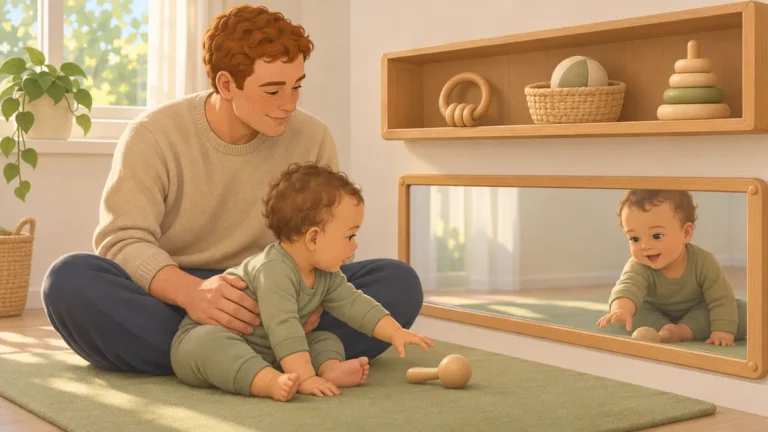
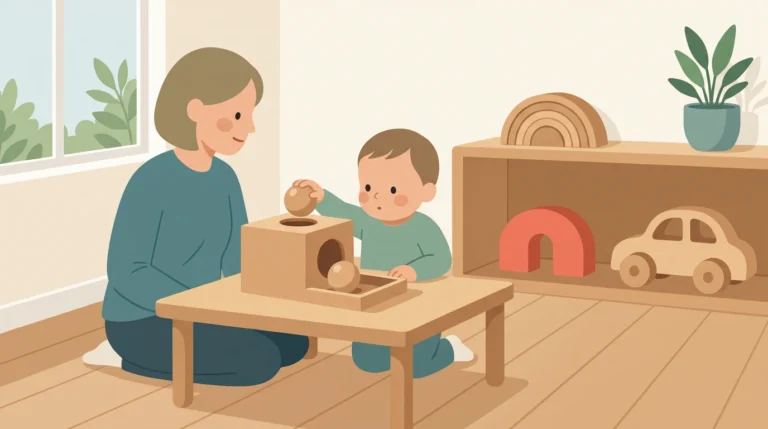
| Around 6 to 12 months | A soft ball, a rattle or grasping toy, an object permanence box or “peekaboo” toy, stacking cups, a board book, a mirror for floor time | Fewer items (around 4 to 6). Babies mouth everything, so every toy must pass the choking check. Swap when something stops getting reached for. |
| Around 12 to 24 months | Shape sorter, chunky knob puzzle, push toy, animal figures, a doll with a blanket, pots and wooden spoon, two or three board books | Toddlers love repetition, so keep favorites out longer. Add one slightly harder version of a mastered toy, like a puzzle with more pieces. |
| Around 2 to 3 years | Blocks, a simple train or car set, play kitchen items, playdough with tools, a puzzle, dress-up items, books | Group items into play “invitations,” such as a basket of animals with blocks to build a farm. Let your child help choose what comes out of storage. |
For age-specific ideas, see our picks of Montessori toys for 1-year-olds and Montessori toys for 2-year-olds. For babies discovering that hidden things still exist, our guide to object permanence games has simple toys that work well in a first rotation.
Safety checks every time a toy comes back out
Rotation gives you a natural moment to inspect toys. Use it. According to the AAP, choking is a leading cause of death in infants and young children, and balloons, balls, marbles and pieces of toys are among the objects that cause the most choking deaths.
- Small parts. In the United States, toys for children under 3 must not contain parts that fit inside a small test cylinder about 1.25 inches (3.17 cm) wide. At home, many parents use a toilet paper tube as a rough check: if a toy or piece fits inside, keep it away from babies and toddlers.
- Button and coin batteries. These can cause serious internal burns if swallowed or stuck in the nose or ear, as the AAP explains. Only keep battery toys whose battery compartment is secured with a screw, and check that it is still closed.
- Squeezable toys. The AAP also lists toys that can be squeezed to fit entirely into a child’s mouth as choking hazards.
- Wear and tear. Look for cracks, loose eyes on plush toys, splinters on wooden toys and frayed strings. Strings and cords longer than a few inches do not belong in a baby’s play space.
- Furniture. Anchor shelves to the wall and keep storage bins somewhere a climbing toddler cannot pull down.
- Sleep space. Rotation toys belong on the shelf, not in the crib. A safe crib has only a firm mattress and fitted sheet.
If your child ever shows signs of choking, such as being unable to breathe, cry or make sounds, call emergency services right away. A certified infant and child CPR course is one of the best things a caregiver can do.
Common toy rotation mistakes
- Making it a chore. You do not need labels, spreadsheets or a perfect Instagram shelf. A shelf and two bins is enough.
- Rotating too often. Toddlers learn through repetition. If you swap everything weekly, your child never gets to go deep with a toy.
- Taking away comfort objects. A favorite stuffed animal or lovey is not part of the rotation. Leave it with your child.
- Rotating instead of playing. The shelf is a starting point. The AAP is clear that toys are not a substitute for warm, responsive time with caregivers. Get on the floor, follow your child’s lead and talk about what they are doing. Our guide to reading to babies shows how the same back-and-forth works with books.
When to mention play to your pediatrician
Every child plays differently, and a toddler who prefers balls to puzzles is perfectly normal. But bring it up at a well visit if your child shows very little interest in toys or in playing with people, has lost skills they used to have, or is not exploring objects with hands and mouth in ways that seem typical for their age. Pediatricians routinely check development and can tell you whether anything needs a closer look.
Frequently asked questions
At what age can you start toy rotation?
You can start as soon as your baby begins reaching for and exploring toys, often in the first half of the first year. With young babies, rotation is mostly about offering a few interesting objects during floor time rather than a full shelf.
How often should you rotate toys?
There is no research-based schedule. Many families swap a few toys every one to two weeks, but watching your child is a better guide than the calendar. Rotate out what is being ignored and keep what is being used.
How many toys should be out at once?
A common range is about 6 to 12, depending on age and space. In the toddler study described above, a room with 4 toys led to longer and more varied play than a room with 16, which suggests that fewer is fine.
Does toy rotation work with siblings?
Yes. Keep a shared shelf with toys that work across ages, and store small-part toys for older children somewhere the baby cannot reach. Older siblings can have their own bin that stays out of rotation.
Do I need special Montessori toys?
No. Simple, open-ended toys you already own work well. What matters more is a calm, reachable display and an adult who notices what the child is interested in.
Sources
- Dauch C, Imwalle M, Ocasio B, Metz AE. The influence of the number of toys in the environment on toddlers’ play. Infant Behavior and Development, 2018.
- British Psychological Society, Research Digest. An over-abundance of toys may stifle toddler creativity.
- American Academy of Pediatrics, HealthyChildren.org. Toy Buying Tips for Babies & Young Children: AAP Report Explained.
- American Academy of Pediatrics, HealthyChildren.org. Ignore the Flashing Screens: The Best Toys Go Back to the Basics.
- American Academy of Pediatrics, HealthyChildren.org. Choking Prevention for Babies & Children: What Every Parent Needs to Know.
- American Academy of Pediatrics, HealthyChildren.org. Button Battery Injuries in Children: A Growing Risk.
- American Montessori Society. Fast Facts: What Is Montessori?
This article was researched and written by the BabyU Editorial Team following our Editorial Policy. It is general educational information and does not replace advice from your child’s pediatrician or another qualified professional.