Montessori Activities for Babies: Ideas by Age From 0 to 12 Months

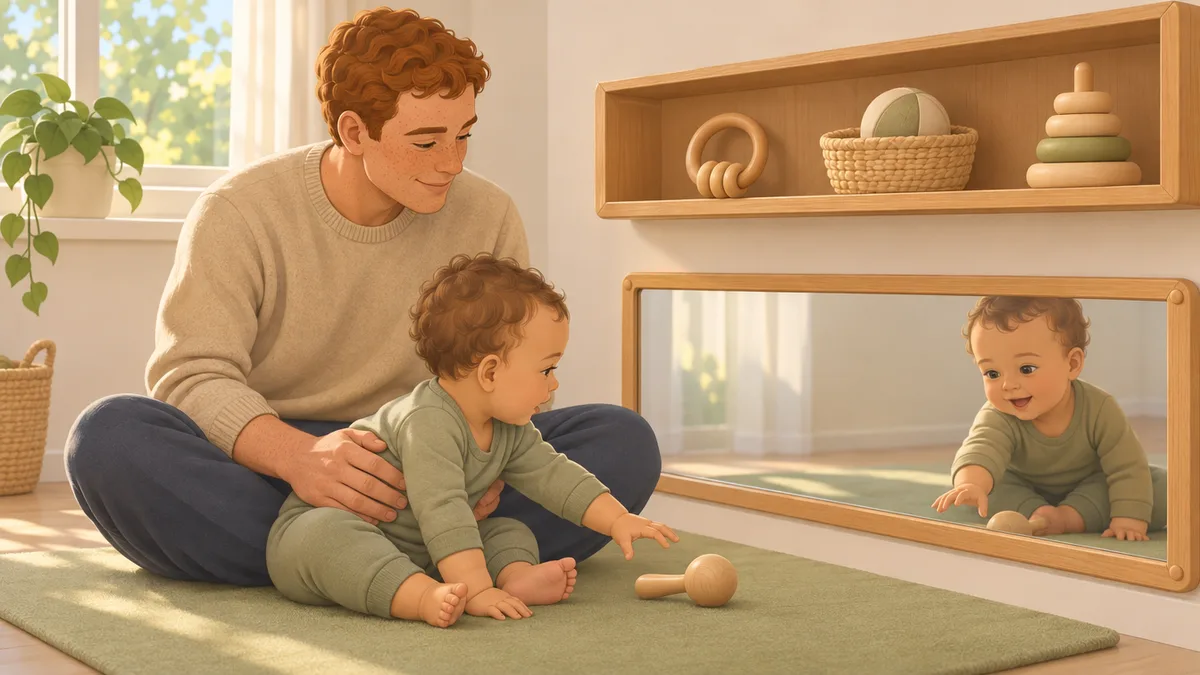
Quick answer: Montessori activities for babies are simple, real-life experiences that let an infant move freely, explore with their hands and mouth, and practice one skill at a time while an adult watches more than directs. In the first year that usually means floor time on a firm mat, a low unbreakable mirror, high-contrast and then colorful mobiles to watch, easy-to-grasp rattles and rings, a basket of safe everyday objects, and lots of talking and reading. You do not need special furniture or expensive kits. Pick activities that match what your baby is already working on, keep only a few items out, and follow standard safety rules: back to sleep, supervised tummy time and nothing small enough to choke on.
Montessori is often presented as a style of toy or a beige playroom. For a baby, it is closer to a way of watching. Maria Montessori’s approach starts from the idea that children are driven to learn by doing, and that adults support that drive by preparing a safe space and stepping back. This guide translates that idea into practical activities for each stage from birth to about 12 months, explains what research can and cannot tell us, and covers the safety points that matter most at this age.
What makes a baby activity “Montessori”?
The Association Montessori Internationale (AMI) describes its birth-to-3 programs as environments designed to “foster a sense of belonging, independence, and language acquisition.” For babies who are not yet walking, Montessori programs use a space called the Nido (Italian for “nest”). At home, the same principles usually look like this:
- Freedom of movement. Plenty of awake time on the floor instead of in bouncers, seats or walkers, so the baby can stretch, roll, pivot and eventually crawl.
- A prepared environment. A small, safe area where everything within reach is OK to touch and mouth.
- Few, real, simple materials. Natural textures, objects that do one thing, and toys the baby makes work, rather than toys that perform.
- Observation first. The adult notices what the baby is trying to do (reach, grasp, transfer, drop) and offers something that fits.
- Uninterrupted concentration. If a baby is absorbed, you wait. You step in for safety, comfort or when they lose interest.
- Language everywhere. Naming objects, narrating care routines and reading together.
If you are deciding what to buy, our test for how to choose Montessori toys walks through these same principles item by item.
Montessori activities by age: a quick chart
| Age (approx.) | What baby is working on | Montessori-style activities |
|---|---|---|
| 0 to 3 months | Focusing, tracking, lifting the head, discovering hands | Black-and-white mobile, faces and talking, short tummy time sessions, floor time on the back |
| 3 to 6 months | Reaching, batting, first grasps, rolling | Colorful or reachable hanging toys, wooden or fabric rings, low mirror, rattle within reach |
| 6 to 9 months | Sitting, transferring hand to hand, mouthing, early crawling | Treasure basket, balls to roll and chase, simple container to drop things into |
| 9 to 12 months | Pulling up, cruising, pincer grasp, cause and effect | Object permanence box, stacking rings, a sturdy low shelf or bar to pull up on, push toy once steady |
Ages are rough guides. Babies develop on their own timeline, and premature babies are usually assessed by corrected age. Follow your baby’s current skills rather than the label on the box.
Montessori activities for newborns (0 to 3 months)
Floor time on a firm mat
A firm, flat play mat or a thin rug on a clean floor is the core of a Montessori baby space. On their back, newborns kick, stretch and start discovering their hands. Keep the area clear of pillows, positioners and loose blankets, and stay close by.
Supervised tummy time
The American Academy of Pediatrics (AAP) recommends placing babies on their back for every sleep and giving supervised tummy time while they are awake, starting in the first days at home. Short, frequent sessions build neck, shoulder and core strength, which later supports rolling, sitting and crawling. Lying on a parent’s chest counts too. See our tummy time by age guide for how to build it up week by week.
Visual mobiles
Montessori infant programs use a sequence of mobiles that babies only look at: first high-contrast black-and-white shapes, then simple colored forms, later shapes that move gently with air. Hang a mobile above the play mat, not over the crib, about 8 to 12 inches (20 to 30 cm) from the baby’s face at first, securely attached and well out of reach of hands and feet. Offer it for a few minutes when your baby is alert, and take it away when they look away or fuss.
Faces, voices and care routines
Your face is the most interesting thing in a newborn’s world. Diaper changes, baths and feeds are natural “activities”: slow down, make eye contact, tell your baby what you are doing (“Now I’m lifting your legs”) and pause for their response.
Montessori activities for 3 to 6 months
Reachable hanging toys
Once a baby starts swiping at things, swap the look-only mobile for a sturdy hanging toy they can bat at and, later, grab: a wooden ring on a ribbon or a small bell secured inside a closed case. Use a short, strong cord fixed at the top, and take hanging toys down as soon as the baby can sit or pull on them.
Grasping toys
Offer one item at a time: a wooden or silicone ring, interlocking discs, a rattle with a slim handle, a soft fabric ball. Place it slightly out of reach on the mat so your baby has a reason to stretch or roll toward it.
A low, unbreakable mirror
A shatterproof mirror mounted securely along the wall at floor level is a classic of Montessori infant rooms. Babies watch their own movements during tummy time and floor play. Use acrylic or safety mirror only, fix it firmly to the wall, and check edges regularly.
Rolling practice
Lots of floor time, with interesting objects placed to the side, is all most babies need to work on rolling. Avoid propping a baby in a seat for long periods during this stage. Our article on when babies roll over covers what is typical and when to stop swaddling.
Montessori activities for 6 to 9 months
The treasure basket
A treasure basket is a low, sturdy basket with a handful of safe, everyday objects of different textures, weights and temperatures: a wooden spoon, a stainless steel cup, a silicone whisk, a natural sponge too big to fit in the mouth, a fabric napkin. A seated baby picks them up, mouths them, bangs them together and compares them. Choose items too big to choke on, with no loose parts, peeling paint, batteries or sharp edges, and supervise the whole time.
Rolling and chasing a ball
A soft fabric ball or a ball with finger holes rolls just far enough to tempt a baby to reach, pivot or crawl after it. It is a simple way to encourage movement without placing the baby in a device.
Transferring and dropping
Babies at this age love putting objects into a container and taking them out again. A wide bowl with a few large wooden blocks or rings works well. Expect lots of dumping: that is the activity.
Shared books
Board books with real photographs or realistic pictures fit Montessori’s preference for reality before fantasy at this age. Point, name and pause. Our guide to reading to babies shows how to turn any book into a conversation.
Montessori activities for 9 to 12 months
Object permanence box
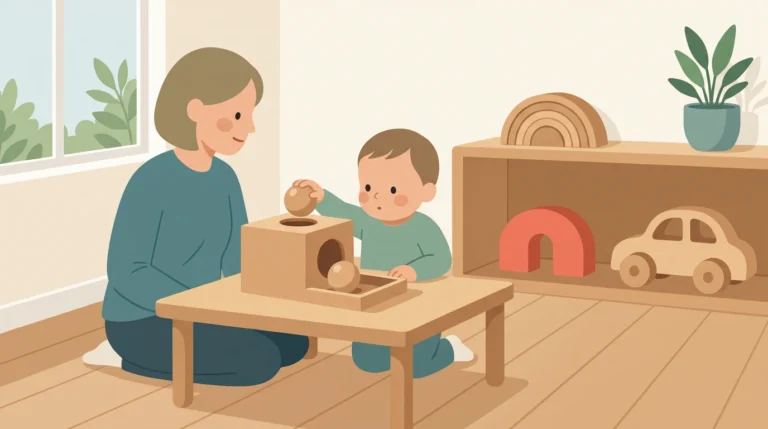
A box with a hole on top and a tray in front: the baby drops a ball in, it disappears, and then rolls back out. It plays directly with the discovery that things still exist when out of sight. Make sure the ball is large enough to pass a small-parts check (see the safety section below). Read more in our guide to object permanence in babies.
Stacking rings and simple nesting cups
Start with a ring stacker that has a straight post and just two or three large rings. At first babies mostly take rings off, which is perfectly normal.
Pulling up and cruising
A heavy, stable low shelf, an ottoman or a pull-up bar anchored to the wall gives a baby a safe place to pull to stand and practice cruising. Anchor furniture that could tip, and remove anything that slides.
Real-life participation
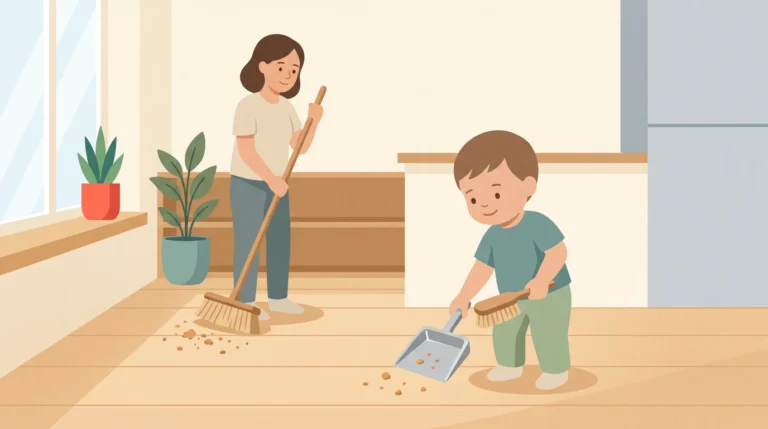
Montessori encourages including babies in daily life: holding a spoon at meals, helping put a sock in the basket, waving bye-bye at the door. These moments build both motor skills and a sense of belonging.
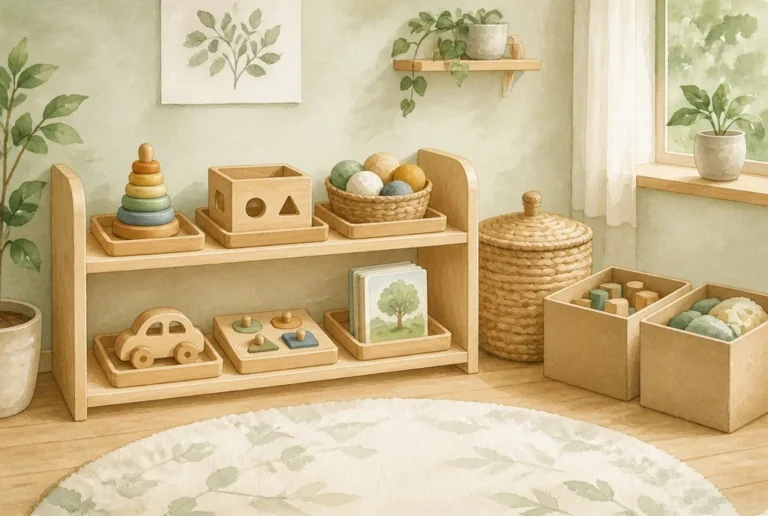
Setting up a small Montessori corner at home
You do not need a dedicated room. A safe corner of the living room can work if it includes:
- a firm mat or rug;
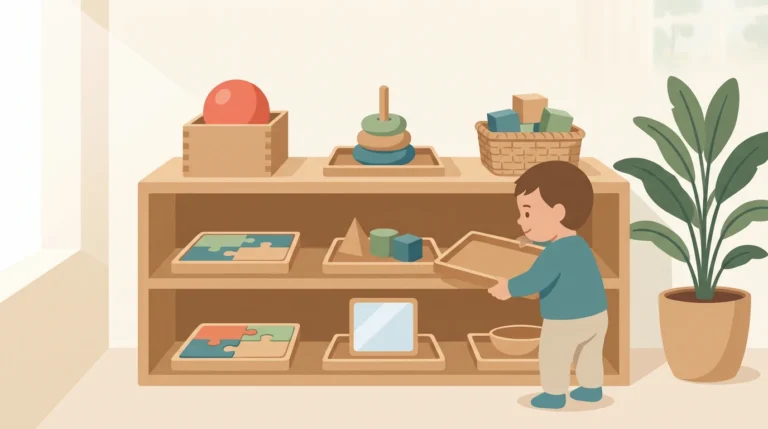
- a low shelf with only three to six items at a time (rotate the rest; see our toy rotation system);
- a secured, unbreakable mirror at floor level;
- a basket of books;
- outlets covered, cords removed, and heavy furniture anchored to the wall.
Some Montessori families also use a floor bed. If you are considering one, read our Montessori floor bed guide first, because current safe sleep advice for babies under 12 months has specific requirements.
What research says about Montessori
The best-known study, published in Science in 2006, compared children who won a lottery place at a public Montessori school in Milwaukee with children who applied but were not admitted, and reported advantages in several academic and social measures at ages 5 and 12. It was a small study of school programs, not of home activities with babies.
There is no strong research showing that Montessori-branded toys or activities make babies develop faster. What is well supported, including by the AAP, is the value of the ingredients Montessori emphasizes: plenty of floor play and tummy time, simple toys that encourage interaction rather than screens, and lots of talking, reading and responsive play with caregivers. That is a good reason to use Montessori ideas as a framework, without worrying about doing it “perfectly.”
Safety first: what to watch for
- Choking. Anything that fits inside a toilet-paper tube is a choking risk for children under 3, according to AAP guidance. Check every object in a treasure basket.
- Button batteries and magnets. Keep remote controls, musical cards, small electronics and magnetic toys away from the play area.
- Cords and strings. Keep cords on hanging toys short and secure, and remove them once the baby can grab or pull on them. No necklaces or long ribbons near babies.
- Mirrors and shelves. Use shatterproof mirrors and anchor shelves and furniture to the wall.
- Sleep. Play mats, floor corners and baskets are for awake time only. For sleep, place your baby on their back on a firm, flat surface with nothing else in it.
- Supervision. Montessori “stepping back” means observing, not leaving the room. Babies should always be supervised during floor play and tummy time.
When to talk to your pediatrician
Montessori activities are not therapy and do not replace developmental check-ups. Talk to your child’s pediatrician if your baby:
- does not seem to follow faces or objects with their eyes by around 2 to 3 months;
- does not bring hands to the mouth, reach for toys or hold their head steady by around 4 to 6 months;
- seems unusually stiff or floppy, or consistently uses only one side of the body;
- does not respond to sounds or their name, or stops babbling;
- loses skills they already had at any age.
Trust your instincts. If something feels off, ask early. The CDC’s milestone checklists are a helpful way to prepare for that conversation.
Frequently asked questions
At what age can you start Montessori with a baby?
From birth. Montessori for newborns is mostly about the environment and the adult: floor time, a calm space, simple things to look at, and talking to your baby during everyday care.
Do I need to buy Montessori toys?
No. Many classic Montessori baby activities use household items or a few simple toys. A firm mat, a safe mirror, a couple of grasping toys and a basket of everyday objects cover most of the first year.
How long should a Montessori activity last?
As long as your baby is interested. That might be 30 seconds for a newborn and 10 minutes or more for an older baby who is absorbed. Watch for signs of tiredness or overstimulation, such as looking away, fussing or rubbing eyes.
Are baby walkers and bouncers Montessori?
Not really. Montessori favors free movement on the floor. The AAP also advises against mobile infant walkers because of the risk of injury. If you use a seat or bouncer, keep sessions short.
Can I do Montessori if I also use regular toys?
Yes. Montessori is a set of principles, not a rule against plastic or bright colors. Choose toys your baby can act on, offer a few at a time and keep the space safe.
Sources
- Association Montessori Internationale. Montessori 0–3: Assistants to Infancy.
- American Montessori Society. What Is Montessori?
- HealthyChildren.org (AAP). Back to Sleep, Tummy to Play.
- HealthyChildren.org (AAP). What to Look for in a Toy.
- HealthyChildren.org (AAP). Choking Prevention.
- HealthyChildren.org (AAP). Button Battery Injuries in Children: A Growing Risk.
- Safe to Sleep (NICHD, National Institutes of Health). Tummy Time.
- Lillard A, Else-Quest N. The early years: Evaluating Montessori education. Science, 2006.
- CDC. Important Milestones: Your Baby By Four Months.
This article was researched and written by the BabyU Editorial Team following our Editorial Policy. It is general educational information and does not replace advice from your child’s pediatrician or another qualified professional.