Montessori Toys for 2 Year Olds: When Real Beats the Toy Version

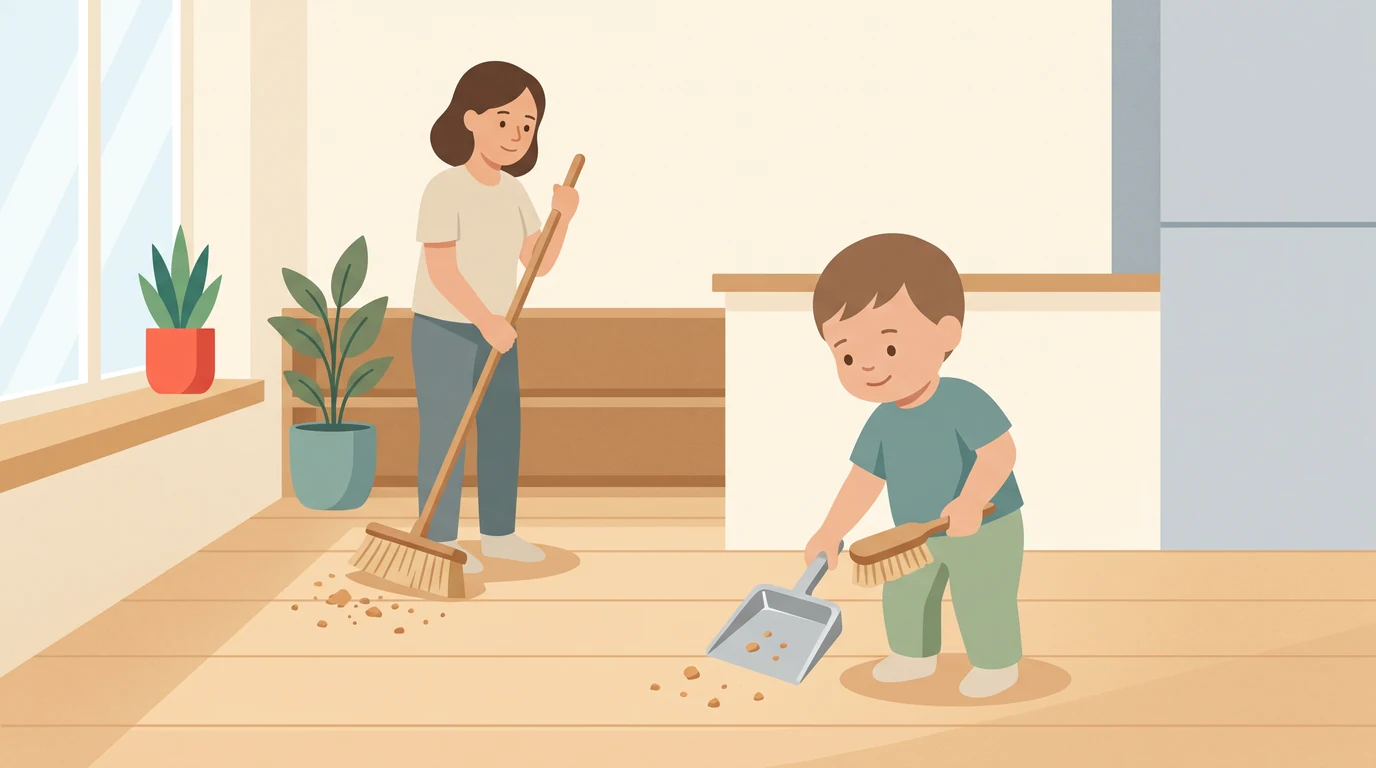
Something shifts around age 2. A child stops wanting to watch you sweep, pour, or wipe the counter and starts wanting to do it, with the actual broom, the actual cup, the actual cloth. Montessori educators call this practical life.
That shift is why the best montessori toys for 2 year olds are often not toys at all. A child size dustpan that actually collects crumbs beats a plastic cleaning playset that never does. This article compares the toy version against the real version on price, durability, and attention span, a comparison most gift guides skip.
Why a real dustpan beats a toy cleaning set
A 2 year old picks up a toy broom, makes a couple of passes, and puts it down. Nothing happened: the toy just rattled. A real, child size broom gets a different response, because the crumbs actually move into a dustpan, a result the child can see.
This is the real mechanism behind Montessori’s preference for real materials, not a style choice. A 2 year old is building sequences: open the drawer, take the cloth, wipe, fold, put back. A toy that only approximates the job breaks that sequence right where the payoff should land.
Real also tends to cost less, for a boring reason: toy versions carry costs a real object does not, from licensed characters to batteries and packaging. A child size broom or pitcher is often just a smaller version of something made for adults. The table below runs the comparison across eleven everyday jobs.
Shopping for a child closer to 12 months? The comparison tips the other way; see our guide to montessori toys for 1 year olds.
The head to head: toy version vs. real version
Prices below are current US ranges gathered from major retailers in 2026, not exact figures, since prices move and vary by material and brand. Use them to compare categories, not to shop one listing.
| What they want to do | Toy version | Real version | Which costs less | Which holds attention longer | What to check for safety |
|---|---|---|---|---|---|
| Sweeping a floor | Plastic broom and dustpan playset, $8 to $18 | Child size broom and dustpan in wood or metal, $12 to $30 | About even | Real | Soft bristles, handle at chest height, no small clip on pieces |
| Pouring a drink | Plastic tea set, $10 to $30 | Small stainless steel or melamine pitcher with two child cups, $10 to $25 | Real, usually | Real | Steel or melamine until pouring is reliable; cool liquids only |
| Cleaning a surface | Pretend cleaning caddy with a spray toy, $10 to $20 | A small spray bottle and a cloth, $3 to $8 for the bottle | Real | Real | Water only; an adult fills, labels, and stores the bottle |
| Washing dishes | Plastic play sink and dish set, $20 to $45 | Small basin, mild soap, sponge, and unbreakable cups, $10 to $25 | Real | Real | Warm water only; stable step stool if the basin is at the sink |
| Preparing food | Velcro cutting food playset, $10 to $25 | Soft fruit, a child safe nylon or silicone serrated knife, a small cutting board, $8 to $20 | About even | Real | Soft foods only; full supervision, seated at a table |
| Doing laundry | Pretend washing machine playset, $25 to $60 | A mini basket, a few pairs of socks, and oversized clothespins, $10 to $20 | Real | Real | Clothespins too large to choke on; no drawstrings on fabric used |
| Gardening | Plastic gardening pretend set, $15 to $30 | Child size trowel, gloves, and a small watering can, $15 to $40 | About even | Real | Rounded trowel tip; no real fertilizer or pesticide nearby |
| Baking or mixing | Toy mixer and play oven set, $30 to $70 | Child size whisk, mixing bowl, and measuring cups, $10 to $25 | Real | Real | Kept away from the stove, oven, and any powered mixer |
| Getting ready | Pretend vanity and hairbrush set, $10 to $25 | A hairbrush, comb, and a small shatter resistant mirror, $8 to $20 | About even | Real | Acrylic or metal mirror, not glass; the child’s own brush |
| Setting the table | Pretend plastic tea party dishes, $10 to $20 | Child size unbreakable plates, cups, and utensils, $15 to $30 | About even | Real | Melamine or bamboo, not glass; rounded utensil tips |
| Washing hands | Pretend sink toy, $15 to $30 | A stable step stool at the real sink, real soap, a small nail brush, $15 to $35 for the stool | About even | Real | Stable stool; check water temperature; never leave a toddler alone at a sink |
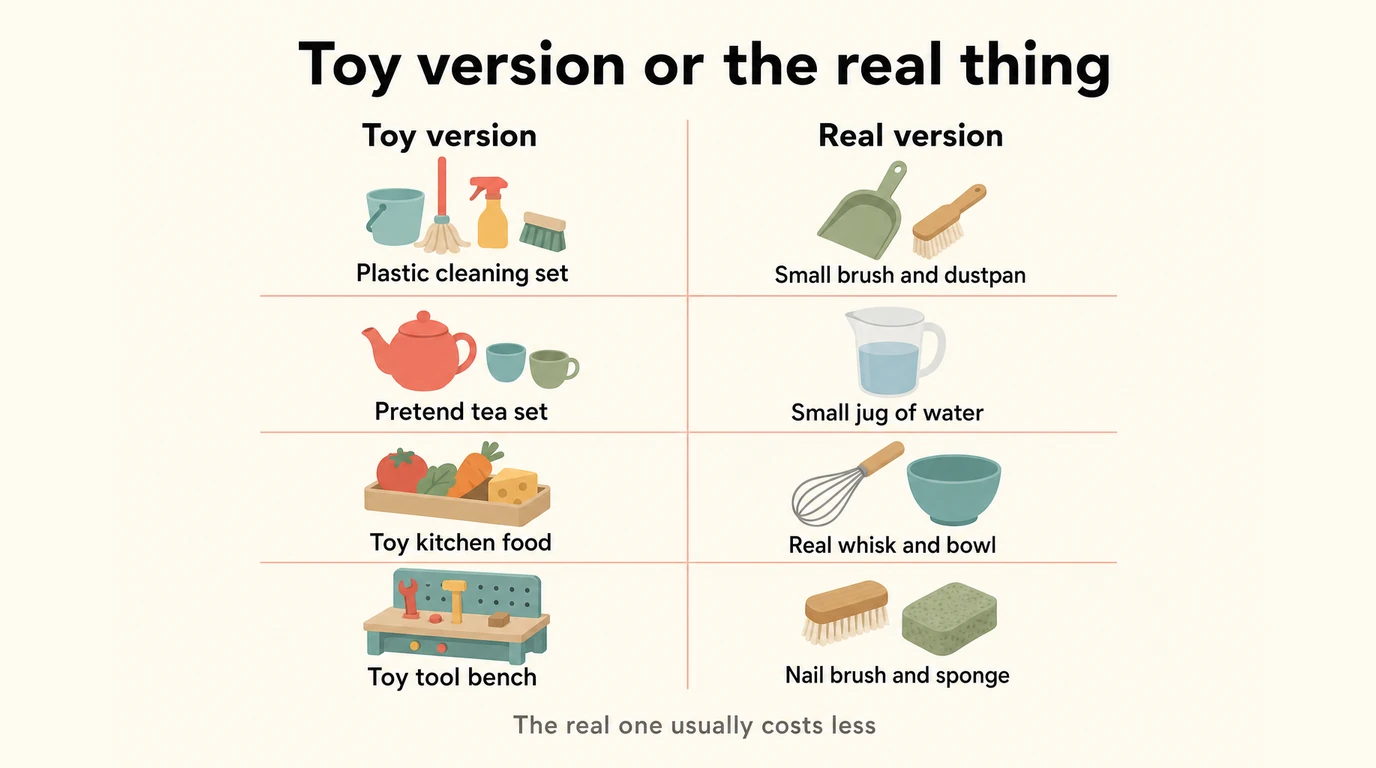
If you already own a broom, a pitcher, or a mixing bowl, you may not need to buy anything at all. A light adult broom, handed over as is if a 2 year old can lift and control it, does the same job as a toddler version. Spend only where child scale genuinely matters, and skip the rest.
A practical life starter set
A full starter set is six to eight real items, not thirty. Each one should do one job, fit a 2 year old without help, and take under a minute to demonstrate. The point is the doing, not the result: a 2 year old who sweeps will not clean the floor, and one who pours will spill more than lands in the cup. That is normal, and it is the whole point.
Child size broom and dustpan
Look for a handle around chest height and bristles soft enough not to scratch a wood floor; a light, one hand dustpan matters more than the material. Hang it on a low hook near where spills happen, and demonstrate the sequence once, slowly.
Small pitcher and two cups
Choose a pitcher holding about a cup, so it stays liftable full. Stainless steel or heavy melamine is the safer start; save glass for later, once pouring is reliable. Set it on a tray with a sponge, and start with a spoonful of water.
Spray bottle and cloth
Pick a bottle that fits one hand, with a trigger loose enough for a toddler’s grip. Fill it with plain water only, since a 2 year old cannot tell a real cleaner from a toy one. Present it at a low table, and show the spray and wipe motion first.
Small basin, mild soap, and a nail brush
A basin sized for a low table works better than one made for adult dishes, and should stay light enough to carry to a sink. Present it as one sequence every time: wet, soap, scrub, rinse, dry.
Child size trowel and small watering can
If there is even a windowsill plant, this earns its place. Look for a rounded trowel tip and a watering can that is still liftable full. Use it outside or over a tray, away from any real fertilizer or pesticide.
Whisk, small mixing bowl, and measuring cup
A light whisk with a handle that fits a small fist beats a shrunken adult one. Present it with something forgiving to mix, like batter or a salad, at a table well away from the stove.
Step stool
Look for a wide base and non slip feet; push it from the side before trusting it near a sink. Height should bring hands level with the counter, not just eyes. This is worth spending more on, since it gets used for years.
Mini laundry basket and oversized clothespins
Use clothespins too large to be a choking hazard on their own, and a basket light enough to carry empty. Start with a small load, a few socks or washcloths, so the job can actually finish.
Montessori toys for 2 year olds that still earn their place
Not everything should be a real object. Some categories work better as purpose built toys, and the six question test in our guide to how to choose Montessori toys still applies. Here are six picks that pass it.
Chunky wooden puzzle
Four to eight large knobbed pieces give feedback a real object cannot: a piece only fits one way. Every piece must be too large for the CPSC’s small parts test cylinder, since objects still go in mouths. Expect $15 to $30 for solid wood.
Object to picture matching cards
Simple photo cards of real, familiar objects build vocabulary faster than most toys at this age. Look for cards too large to be a mouthing hazard. Sets run $10 to $25.
Wooden unit blocks
Open ended building rewards more pieces, since a 2 year old stacks, knocks down, and starts over. A 20 to 40 piece hardwood set runs $30 to $60; check for sanded edges and no small connecting pieces.
Stacking or nesting toy
This is one of the few categories where the classic toy beats a real substitute, since graduated sizing is the whole point. Expect $10 to $25, with pieces too large for the small parts cylinder.
Balance bike or simple ride on
Outdoor gross motor equipment is where the toy version wins outright, for reasons covered below. A balance bike sized for a 2 year old runs $40 to $90. For more ways to burn this energy without equipment, see our gross motor activities for 2 year olds guide.
Large ball
A ball 8 to 10 inches across is easy to kick, throw, and chase, and cheap: $5 to $15. Anything smaller edges toward the CPSC’s small ball restriction for children under 3.
Where the toy version actually wins
The comparison above favors real objects most of the time, but not always, and pretending otherwise would make the rest of this less trustworthy. Purpose built toys win whenever a real object would introduce heat, a blade, or breakage a family cannot absorb. A real stove, a real kitchen knife, and fine glassware belong nowhere near a 2 year old’s hands.
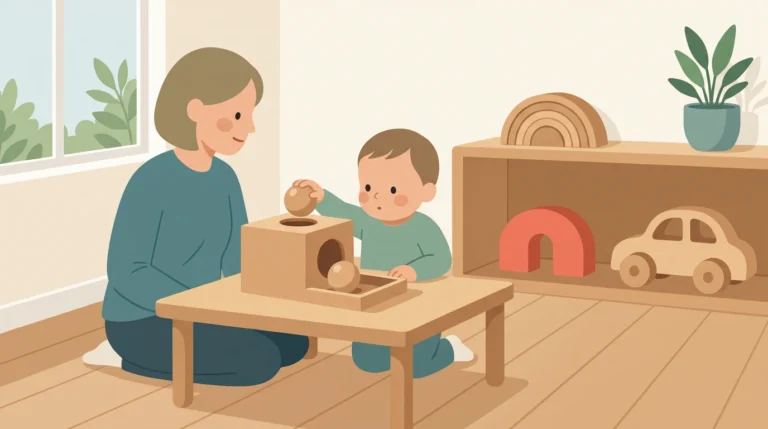
Toys also win for anything with a built in control of error, where the object itself shows whether the child got it right, the way a puzzle piece fits or does not. Real objects rarely offer that instant, wordless feedback. The same goes for early language material like picture cards: there is no real world version of a flashcard.
Outdoor gross motor equipment is the clearest case. A toddler climbing triangle or arch is engineered around a specific fall height, grip spacing, and weight limit. A ladder from the garage, or a chair on a table, is not a scaled down version of that; it is unsupervised risk with no engineering behind it. Here, paying for the purpose built version is the safer, and the only sensible, choice.
Buying for someone else’s 2 year old
A lot of searches for montessori gifts for 2 year olds come from someone who is not the parent: a grandparent, an aunt, a friend buying for a house they do not live in and cannot see the shelf, the closet, or the toy bin that is already full.
Three rules help:
- Ask about space before size. A small apartment absorbs a puzzle far better than a play kitchen.
- One good item beats a set of five mediocre ones: a well made puzzle over a plastic set that scatters immediately.
- Consumables and experiences are underrated as montessori gifts for 2 year olds: good paper and crayons, a zoo membership, or a gift card earmarked for later, none of which add to a pile the child outgrows before your next visit.
If you do not know the house, three defaults rarely go wrong: a solid wood puzzle sized for age 2, quality art supplies such as thick paper and chunky crayons (see our craft activities for 2 year olds guide for ways to use them), or an outdoor item like a ball. None commit the family to floor space it may not have.
When the real thing goes wrong
Real objects come with real messes, and this approach only holds up with a plan for when it does not go as demonstrated.
The spray bottle ends up used on the sofa. Move the activity to a spot where water is fine, like tile or a tray, and try again there. If it happens again the same day, put the bottle away and offer it tomorrow.
The pitcher gets poured out on the floor on purpose. This is usually curiosity about cause and effect, not defiance. Keep a small towel on the tray, hand it over to help clean up, and end the session if the pouring continues.
Sweeping turns into dumping the dustpan back out and starting over, on repeat. Model the sequence once more, calmly. If it continues, let them dump dry rice into a bowl instead, and bring the broom back another day.
How much should be out at once
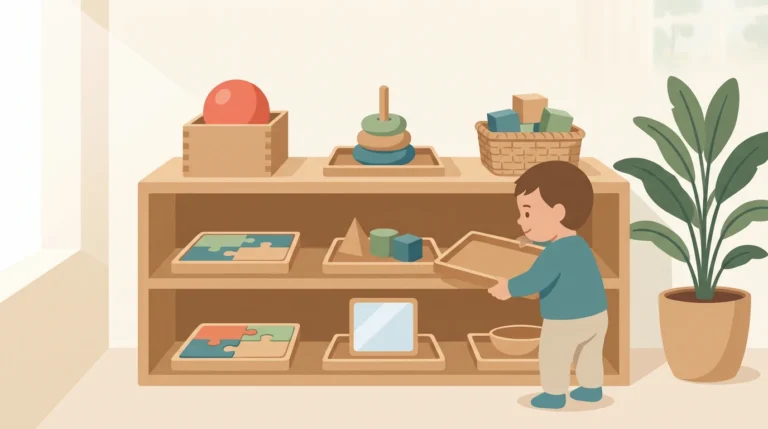
Five to eight items on a low, open shelf is enough for a 2 year old, rotated every one to two weeks. More becomes noise: a toddler faced with fifteen options touches each for a few seconds and moves on. Fewer than five removes real choice.
Rotation matters more than quantity: an item untouched for two weeks goes into a closet for a month, and one the child keeps returning to stays out. This also keeps daily play screen free without extra effort; see our screen-free activities for 2 year olds guide for more of what can fill the day.
Frequently asked questions
What Montessori toys are best for a 2 year old birthday?
A single well made item beats a stack of smaller ones: a wooden puzzle matched to skill level, a starter practical life item like a broom and dustpan, or wooden unit blocks.
Is a play kitchen Montessori?
Not really. A play kitchen is pretend: the food is fake and nothing cooks. Real stirring and pouring under supervision delivers more of the actual practical life idea.
How many toys should a 2 year old have?
Total ownership matters less than what is visible. Five to eight items on a shelf, rotated in, beats a bare room or a floor covered in options. Our activities for 2 year olds hub covers the rest of the day.
Are real glasses safe for a 2 year old?
A small real glass works at this age if one fact is accepted upfront: it will eventually break. Families comfortable with that, under close supervision, can start once pouring is reliable; others should use stainless steel or heavy melamine.
What makes a toy Montessori rather than just wooden?
Wood is a material, not a method. A toy earns the label with one clear purpose, feedback the child can see, and a fit for their current hand and body size, not its material, and a cheap plastic toy that does so beats an expensive wooden one that does not.
Is a real kitchen knife appropriate at 2?
Not a metal one. A child safe knife made of nylon or silicone, with a blunt serrated edge for soft foods like banana, works at 2 under full adult supervision; a real metal kitchen knife stays in the toy wins category until later.
Sources and notes
Guidance on toddler development and the shift toward purposeful, real world tasks around age 2 draws on material from the American Academy of Pediatrics and HealthyChildren.org. Safety information on small parts and choking risk draws on the US Consumer Product Safety Commission’s small parts regulation, which defines the test cylinder used to judge whether an object is too small to be safe for children under 3. Current US price ranges were checked against major retailers in 2026 and given as ranges, since prices change. Sources were checked for the safety points that matter most here: glass, cords and straps, cleaning products, and tools with points or edges.
Sources checked on October 25, 2026. Primary references: