When Do Babies Sit Up? Typical Ages, Stages and How to Help

Quick answer: Most babies sit on their own somewhere around 6 months, but the healthy range runs from about 4 to 9 months. In the World Health Organization’s motor development study, healthy babies first sat without support between 3.8 and 9.2 months, with a median of 5.9 months. The CDC’s checklist says most babies lean on their hands to sit by 6 months and sit without support by 9 months. If your baby is not sitting without support by 9 months (corrected age for preemies), seems very floppy or stiff, or loses skills, talk with your pediatrician.
Sitting up changes everything for a baby. Hands are suddenly free to grab, shake and explore, the room looks different from upright, and mealtimes and play become more interactive. This guide covers the typical age range, the stages that lead to independent sitting, signs your baby is getting close, easy ways to help at home, safety points about baby seats, and when to check in with your doctor.
When do babies sit up? The real age range
The best data on timing comes from the WHO Multicentre Growth Reference Study, which followed healthy children in Ghana, India, Norway, Oman and the USA and estimated a “window of achievement” for six gross motor milestones. Sitting without support had the narrowest window of all six milestones, yet it still spans more than five months.
| WHO percentile | Age baby first sat without support |
|---|---|
| 1st (earliest sitters) | 3.8 months |
| 25th | 5.2 months |
| 50th (median) | 5.9 months |
| 75th | 6.7 months |
| 90th | 7.5 months |
| 99th (latest healthy sitters) | 9.2 months |
In the WHO study, “sitting without support” meant the baby sat up straight with the head erect for at least 10 seconds without using arms or hands to balance. The CDC’s “Learn the Signs. Act Early.” milestones use a different approach: they list skills that at least 75% of children have by a given age. That is why the CDC places “sits without support” at 9 months, later than the median above.
If your baby was born early, compare milestones using their corrected age, meaning their age counted from the due date. A baby born two months early who is 7 months old is developmentally closer to a 5-month-old.
The stages of sitting up
Sitting is not a single skill. It is built step by step as the neck, back and trunk muscles get stronger and balance improves. Here is the usual sequence, though ages vary.
| Stage | What it looks like | Typical timing |
|---|---|---|
| Head control | Holds head steady when held upright; lifts head and chest during tummy time | First months |
| Supported sitting | Sits on a lap or propped by your hands, back still rounded | Around 3 to 5 months |
| Tripod sitting | Leans forward on both hands to stay upright | CDC: most do this by 6 months |
| Sitting without support | Stays upright with hands free when placed in sitting | Median about 6 months; most by 9 months |
| Getting into sitting alone | Moves from tummy or crawling position into sitting without help | CDC: most do this by 9 months |
The American Academy of Pediatrics (AAP) notes that by about 6 to 8 months, many babies placed in sitting will stay upright without leaning forward on their arms, but getting into a sitting position alone usually comes later. Before that, expect plenty of slow-motion tip-overs. They are part of learning balance.
Signs your baby is getting ready to sit
- Steady head control, with no wobble when you hold them upright.
- Pushing up on straight arms during tummy time.
- Rolling, especially from tummy to back.
- Reaching for toys while propped, and catching themselves with a hand when they lean.
- Staying upright for a few seconds in tripod position.
How to help your baby learn to sit
Babies do the work themselves. Your job is to give them lots of chances to practice on the floor, with you nearby.
1. Keep up tummy time
Tummy time builds the neck, shoulder and back strength that sitting depends on. The AAP suggests building up to at least 15 to 30 minutes of supervised tummy time a day by about 7 weeks, in short sessions. See our guide to tummy time by age for ideas that work at each stage.
2. Practice supported sitting on the floor
Sit on the floor with your legs in a V and place your baby between them, facing out, so your body gives a soft wall on both sides. As they get steadier, move your hands from their chest to their hips and give less help over time.
3. Put something interesting in front of them
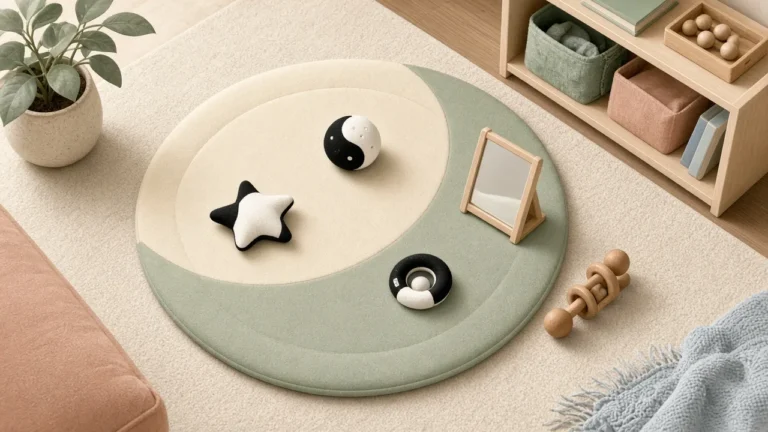
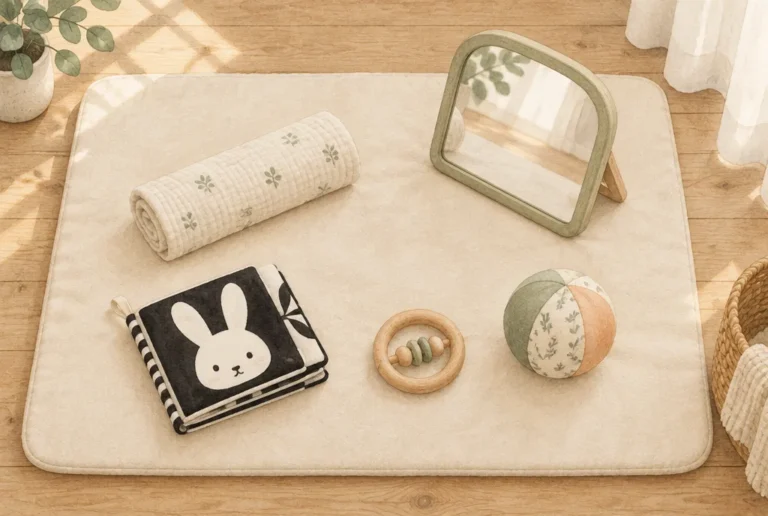
The AAP suggests placing interesting toys in front of a baby who is learning to sit, so they have a reason to stay upright and look forward. Good options include a soft ball, a rattle, an unbreakable baby mirror or a board book. Our guide on how to choose Montessori toys explains how to pick a few simple, open-ended options.
4. Encourage reaching
Once your baby can sit briefly, offer a toy slightly to one side. Reaching and coming back to center trains balance. Celebrate the effort, not just success.
5. Make tip-overs safe
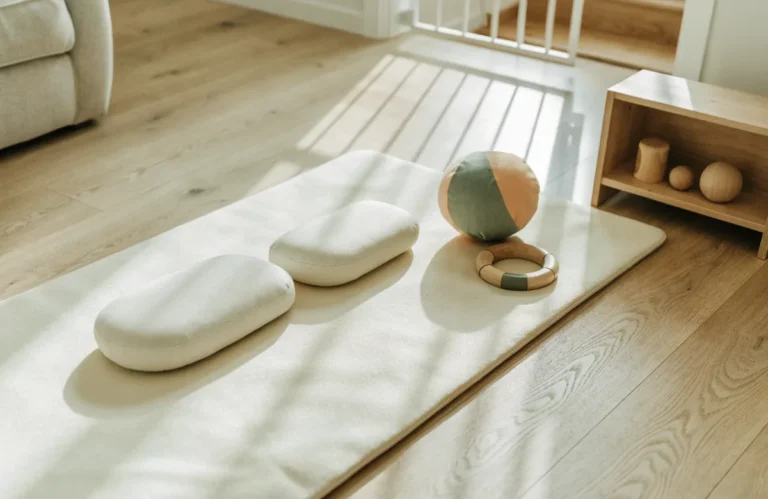
Practice on a play mat or rug, away from furniture corners, and stay within arm’s reach. A pillow behind the baby can soften a backward tumble during awake, supervised practice, but never leave a baby alone propped on pillows.
6. Limit time in containers
Bouncers, swings and seats can be handy for a few minutes, but floor time is where babies practice the movements that lead to sitting, rolling and, later, crawling.
Baby seats and sitting devices: safety points
Upright baby seats can hold a baby in a sitting position before they can sit alone, but they do not teach sitting, and they come with safety rules:
- Floor only. Never place a baby seat on a table, counter, bed, sofa or any raised surface. Babies can wiggle or rock out of seats.
- Always supervise and use the restraint if the seat has one.
- Not for sleep. The AAP advises that if your baby falls asleep in a car seat, stroller, swing, infant carrier or sling, you should move them to a firm, flat sleep surface on their back as soon as possible.
- Follow age and weight limits on the label and stop using the seat once your baby can climb or rock out of it.
Sitting up and sleep
Some babies who are learning to sit start pushing up to sit in the crib and then get stuck or cry. Keep following safe sleep basics: lay your baby down on their back on a firm, flat mattress with only a fitted sheet, and keep pillows, blankets, bumpers and soft toys out of the crib. Lots of daytime practice usually helps babies learn to lie back down on their own.
What comes after sitting
Once babies sit steadily, many begin to pivot, reach farther and push into hands and knees. From there come crawling (or scooting), pulling to stand, cruising along furniture and, eventually, first steps. Read more in our guides on when babies crawl and when babies walk.
When to talk to your pediatrician
The CDC encourages parents to act early: if your child is not meeting one or more milestones, has lost skills, or you have concerns, talk with your child’s doctor and ask about developmental screening. Bring it up if:
- your baby is not sitting without support by 9 months (corrected age if born early);
- your baby does not lean on their hands to sit, or still has poor head control, around 6 months;
- your baby feels unusually floppy, or unusually stiff, when you hold them;
- your baby consistently uses one side of the body more than the other;
- your baby loses a skill they used to have;
- you simply have a feeling something is off. You know your baby best.
Early checks are not a sign that something is wrong. They are a way to get support sooner if it is needed. In the US, families can also contact their state’s early intervention program directly.
FAQ
What is the earliest age babies sit up?
In the WHO study, the earliest healthy babies (1st percentile) sat without support at about 3.8 months. Most babies are closer to 5 to 7 months.
Is it bad to sit my baby up before they can do it alone?
Short, supervised supported sitting on your lap or between your legs is fine and gives babies a new view. Just balance it with plenty of tummy time and floor play, and avoid propping a baby who is not ready and leaving them alone.
Should my baby sit up before crawling?
Many babies sit before they crawl, and the WHO study found that about 90% of children followed a common sequence for most milestones. Still, the order varies, and some babies never crawl on hands and knees at all.
My baby can sit but cannot get into sitting alone. Is that normal?
Yes. Staying upright once placed usually comes first. Moving into sitting without help typically comes later; the CDC lists it among skills most babies have by 9 months.
Do baby seats help babies sit sooner?
There is no good evidence that they speed up sitting. Babies learn by moving freely on the floor, so use seats sparingly and only on the floor.
Sources
- World Health Organization. Motor development milestones.
- World Health Organization. Percentiles for six gross motor milestones (PDF).
- WHO Multicentre Growth Reference Study Group. WHO Motor Development Study: windows of achievement for six gross motor development milestones. Acta Paediatrica, 2006.
- CDC. Milestones by 6 months and Milestones by 9 months.
- American Academy of Pediatrics (HealthyChildren.org). Movement Milestones: Babies 4 to 7 Months.
- American Academy of Pediatrics (HealthyChildren.org). Corrected Age for Preemies.
- American Academy of Pediatrics (HealthyChildren.org). How to Keep Your Sleeping Baby Safe.
This article is for general information and does not replace advice from your child’s pediatrician.