Reading to Babies: How to Turn Any Book Into a Conversation

Quick answer: you can start reading to your baby from birth, and you don’t need to finish the book or read the words on the page. What matters most is the back-and-forth: point, name, pause, let your baby respond (with a look, a babble or a word), then build on that response. The American Academy of Pediatrics recommends shared reading from birth, and research on “dialogic reading” (reading as a conversation) suggests this interactive style supports vocabulary more than reading straight through, with the clearest effects seen around ages 2 to 3. A few minutes a day, in a routine you can keep, beats a long session you dread.
Plenty of parents buy a stack of board books, sit down with a 5-month-old and watch the book go straight into the baby’s mouth. Others read a whole story to a toddler who wanders off after two pages. Neither means reading “isn’t working.” It usually means the reading is shaped for an older listener. This guide shows a simple method you can use with any book, how the same book changes as your child grows, and how to keep it going on the days when nobody wants to sit still.
Why the conversation matters more than the story
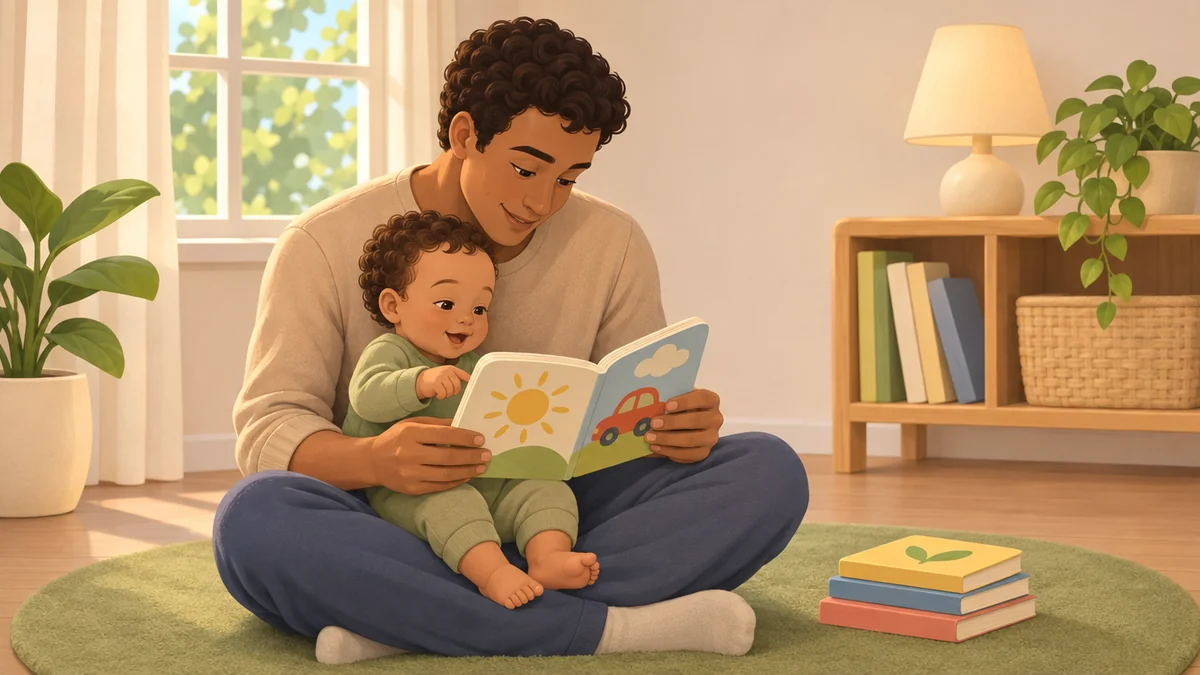
When adults read aloud, we tend to perform the text: the child listens, we turn pages. With babies and toddlers, the learning happens in the gaps between the words. Every time you pause and your child points, coos or answers, and you respond, they get a turn in a conversation. Those turns are what build early language.
That idea is the core of dialogic reading, a method developed by psychologist Grover Whitehurst and colleagues. In 2024, the AAP updated its policy on literacy promotion and specifically encouraged pediatricians to model this kind of interactive reading for families, starting at birth and continuing at least through kindergarten. A 2008 meta-analysis that pooled studies of parents trained in dialogic reading found a moderate boost in children’s expressive vocabulary compared with typical shared reading, with the largest effects in 2- and 3-year-olds and smaller effects in 4- and 5-year-olds. In other words, the toddler years are exactly when this approach seems to pay off most.
For younger babies the research is thinner, but the logic is the same: face-to-face attention, your voice, and responding to their signals. You’re not teaching letters. You’re teaching that books are a place where someone talks with them.
The 4-step loop you can use with any book
Dialogic reading is often summarized as PEER. It sounds formal, but once you try it a few times, it becomes the way you talk anyway.
- Prompt. Invite your child to respond. With a baby, the prompt can be as simple as pointing and looking at them expectantly. With a toddler, ask a question: “What’s that?”
- Evaluate. Notice what they offered. A point, a sound, or a word like “dah” for “dog” all count.
- Expand. Add a little more. If they say “dog,” you say “Yes, a big brown dog!”
- Repeat. Give them a chance to try the longer version: “Can you say big dog?” No pressure if they don’t.
The key is the pause. Count to five in your head after a prompt. Babies and young toddlers need time to process and respond, and most adults jump in too fast.
Five kinds of prompts, from easiest to hardest
Reading specialists use the shorthand CROWD for the types of prompts. Whitehurst notes that recall and distancing prompts are harder and are best used often only with 4- and 5-year-olds, so here they are in the order they usually become useful.
| Prompt type | What it sounds like | Usually works from |
|---|---|---|
| Wh- questions (simplest form: “what”) | “What’s this?” while pointing at a picture | Once your child points or says a few words, often in the second year |
| Completion | “Twinkle, twinkle, little…” then pause | Toddlers who know a rhyme or repeated line |
| Recall | “What did the bear find at the end?” | Harder: use lightly from about 3, more often at 4 to 5 |
| Open-ended | “Tell me about this page.” | Around 2 1/2 to 3 and up |
| Distancing | “The girl has a red ball. Where is your ball?” | Harder: simple versions from about 2 1/2, fuller use at 4 to 5 |
For babies under 12 months, skip the question types and do the “infant version”: point, name the thing in a warm voice, wait, and respond to whatever your baby does. If your baby is in the early talking stage, our guide on first words explains what counts as a word.
One book, three ages
You don’t need different books for every month. Picture a simple board book with a farm on each page. Here’s how the same page might sound at different ages:
At 4 months
Your baby is in your lap or lying on their back beside you. You hold the page about 20 to 30 centimeters from their face and say, “Look, a cow. Moo!” You wait. Your baby kicks and stares. You smile: “You like the cow!” That’s the whole interaction, and it’s enough. High-contrast images and faces are easier for young babies to look at.
At 12 months
Your baby wants to turn the pages, chew the corner and point. Let them. You follow the point: “That’s a duck. Quack quack. The duck is yellow.” If they make a sound, copy it back. You might never get past page three, and that’s fine.
At 2 1/2 years
Now you can ask, “What’s the cow doing?” Your child says, “Eating.” You expand: “Yes, the cow is eating grass.” Once in a while, connect it to real life: “What did you eat for lunch?” The book is a launch pad for talking about the child’s own day.
Choosing books that invite talk
The best books for this style aren’t necessarily the ones with the best stories. Look for:
- Clear, uncluttered pictures of familiar things: animals, food, vehicles, faces, bath time.
- Repetition and rhyme, which make completion prompts easy.
- Durable formats for babies: board books, cloth books and bath books. Mouthing is normal exploration.
- Real photos of babies’ faces and everyday objects, which many young babies enjoy.
- Books in your home language(s). If your family speaks more than one language, read in the language you speak most naturally. Rich talk in any language supports development.
- A few longer picture books for toddlers, with scenes that have lots going on to describe.
Keep books where your child can reach them. A low, front-facing shelf or basket, like the ones in our toddler playroom setup guide, lets them choose, which makes them more likely to bring a book to you. The same low-shelf thinking shows up in choosing Montessori toys: fewer, visible options get more use.
A few safety notes
- Check books for loose parts: pop-up pieces, attached toys, googly eyes or ribbons that could come off. Small parts are a choking hazard for children under 3.
- Sound books often use small button batteries. Make sure the battery compartment is screwed shut, and take the book away if it cracks. Button batteries can cause severe internal burns if swallowed.
- Read together, then put books away from the sleep space. Soft cloth books are lovely for awake time, but the AAP recommends a bare crib with no soft objects for sleep.
When your child won’t sit still
Wiggling isn’t a sign of failure. Many toddlers listen while moving. Some ideas that help:
- Read in short bursts. Two minutes, several times a day, is real reading.
- Let them hold or turn the pages, even if it means skipping around.
- Pick the right moment. After a bath, during a diaper change with a book propped up, while waiting at the doctor’s office.
- Act it out. Roar with the lion, stomp with the elephant, pretend to eat the fruit on the page.
- Follow, don’t steer. If they only want the truck page, talk about the truck page.
- Use books as part of a routine. A book before nap or bedtime gives reading a predictable home. Our list of screen-free activities for 2-year-olds has more quiet ideas for the day.
What about e-books, apps and audiobooks?
The AAP’s 2024 policy favors print books for young children and points out that interaction is what counts when digital books or audiobooks are used. Electronic “enhancements” like sounds and animations can pull attention away from the story and the conversation. If you use an e-book, sit together, turn off the auto-read, and talk about the pages just as you would with a print book. For babies under 18 months, the AAP recommends avoiding screen media other than video chatting.
When to check in with your pediatrician
Reading is a great window into how your child communicates. Bring it up at a well-child visit, or call sooner, if you notice any of these:
- Your baby doesn’t react to sounds or your voice, or doesn’t turn toward you when you talk.
- By around 12 months, your baby doesn’t point, wave or babble with different sounds.
- By 18 months, your child isn’t trying to say at least a few words.
- By 2 years, your child isn’t putting two words together or doesn’t point to pictures in a book when you name them.
- Your child loses words or skills they used to have, at any age.
The CDC’s free milestone checklists are a helpful reference. If you’re worried, you don’t have to wait for the next checkup. Early evaluation, including a hearing test when needed, is quick and helpful.
Frequently asked questions
When should I start reading to my baby?
From birth. The AAP recommends shared reading starting in infancy, including in the NICU when possible. With a newborn, simply talking about the pictures in a soft voice is enough.
How long should I read to my baby each day?
There’s no official number of minutes. Short, frequent, enjoyable moments work better than long sessions. Many families aim for a book or two each day, often as part of the bedtime routine.
Is it okay if my baby only chews the book?
Yes. Mouthing is how babies explore. Offer sturdy board or cloth books, keep talking about the pictures, and the looking and pointing will come.
Do I have to read the words exactly as written?
No. Describe the pictures, shorten the text, or make up your own story. As your child gets older and starts to enjoy the actual text, read it more fully.
Should I read the same book over and over?
If your child asks for it, yes. Repetition helps toddlers predict, join in and eventually “read” the book back to you, which is perfect for completion and recall prompts.
Does reading to my baby help them talk earlier?
Interactive reading is linked with stronger vocabulary in toddlers, but every child develops at their own pace. Think of reading as one of many ways to give your child rich conversation, along with talking during play, meals and daily care. Our activities for 1-year-olds are full of chances to do just that.
Sources
- American Academy of Pediatrics. Literacy Promotion: An Essential Component of Primary Care Pediatric Practice: Policy Statement. Pediatrics, 2024.
- American Academy of Pediatrics, HealthyChildren.org. Beyond Literacy: Shared Reading Starting at Birth Offers Lifelong Benefits.
- Mol SE, Bus AG, de Jong MT, Smeets DJH. Added Value of Dialogic Parent-Child Book Readings: A Meta-Analysis. Early Education and Development, 2008.
- Reading Rockets. Dialogic Reading: An Effective Way to Read Aloud with Young Children.
- Centers for Disease Control and Prevention (CDC). CDC’s Developmental Milestones.
- American Academy of Pediatrics, HealthyChildren.org. Choking Prevention for Babies and Children.
- American Academy of Pediatrics, HealthyChildren.org. How can I protect my child from the dangers of lithium coin and button batteries?
- American Academy of Pediatrics, HealthyChildren.org. How to Keep Your Sleeping Baby Safe: AAP Policy Explained.
This article was researched and written by the BabyU Editorial Team following our Editorial Policy. It is general educational information and does not replace advice from your child’s pediatrician or another qualified professional.