Baby Sign Language: First Signs, When to Start and What Research Says

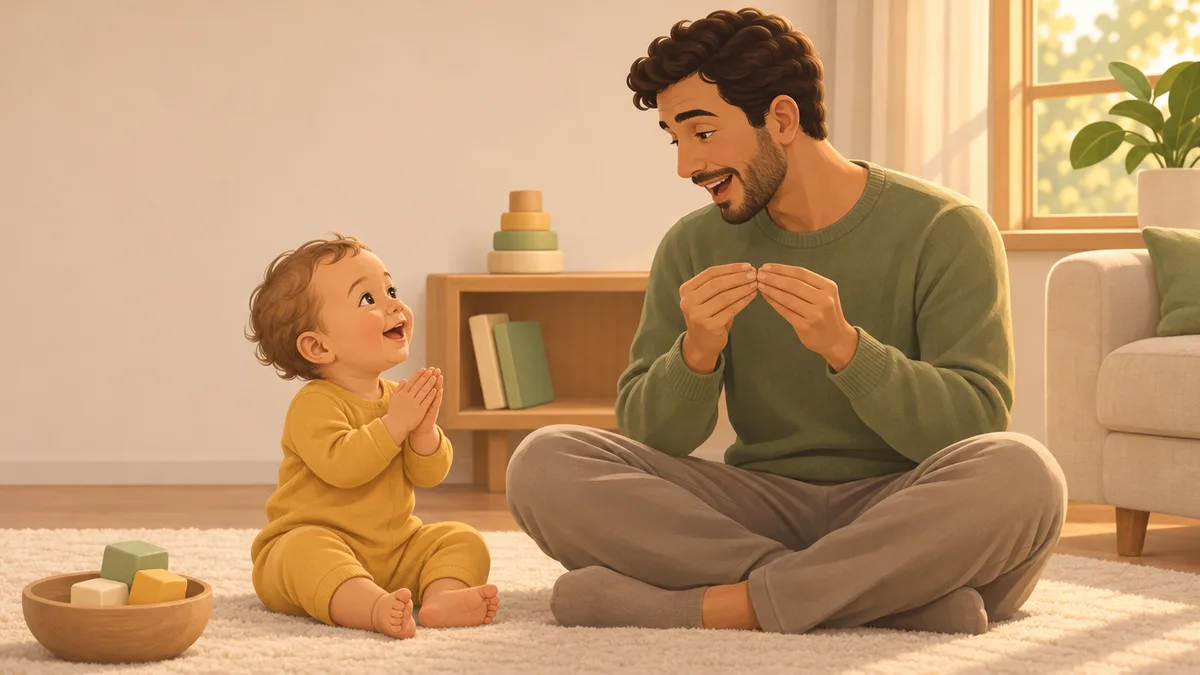
Quick answer: baby sign language means using a handful of simple hand signs, usually borrowed from American Sign Language (ASL), alongside the spoken word so a baby can tell you things like “more,” “milk” or “all done” before they can say them. Many families start showing signs at around 6 to 8 months; most babies don’t sign back until roughly 8 to 12 months, once they can copy gestures such as waving. The CDC suggests simple baby sign language as one way to help your baby tell you what they want before they have words. Keep expectations realistic, though: research has not shown that signing speeds up talking, and it also hasn’t shown that it delays it. The real value is a little less guessing, a little less frustration and a lot of face-to-face back-and-forth.
Water? More banana? Out? A few signs can turn the high-chair guessing game into a two-second exchange. This guide covers the useful first signs and how to make them, when to start, a simple four-week plan built around daily routines, what the research actually says (including the claims you’ll see online that don’t hold up), and when a communication concern is worth raising with your pediatrician.
What baby sign language is (and isn’t)
Baby sign language is not a separate language and you don’t need a course to use it. In practice, it is a small set of signs for the things a baby wants, sees or does most often, used every time you say the matching word. Most English-language resources use signs taken from ASL, but you can use signs from your own country’s sign language (British Sign Language, Auslan and others) or simply invent consistent gestures. Babies care far more about consistency than about which system you pick.
It is also different from learning a full sign language. According to the National Institute on Deafness and Other Communication Disorders, ASL is a complete, natural language with its own grammar and the primary language of many North Americans who are deaf or hard of hearing. If your baby is deaf or hard of hearing, a full sign language may be part of the plan your care team recommends, which is a bigger and more structured commitment than the handful of “baby signs” this guide is about.
Signing also builds on something babies do anyway. Gestures are part of normal communication development: the CDC lists “lifts arms up to be picked up” among the things most babies do by 9 months, “waves bye-bye” by 1 year, and “points to ask for something or to get help” by 15 months. A sign for “more” is simply one more gesture with a specific meaning.
When to start baby sign language
There is no exact start date. Sources agree on a few practical points:
- Showing signs: many families start at around 6 to 8 months. The American Academy of Pediatrics’ parent site notes there is no reason you have to wait until 6 months, but asks parents to be realistic about results.
- Signing back: babies usually need until roughly 8 to 12 months to have the hand control and imitation skills to make a sign themselves. A good clue that your baby is ready is when they begin copying gestures like waving, clapping or arms up.
- Starting later: it is not too late at 12 or 18 months. Toddlers who understand a lot but say few words often pick up signs quickly, and the CDC’s 15-month tips again suggest teaching simple gestures and sign language.
Expect a lag. It is common for weeks to pass between the first time you show a sign and the first time your baby uses it. After the first sign “clicks,” new ones often come faster.
12 useful first signs and how to make them
Start with two or three signs tied to things that happen several times a day and that your baby actually cares about. The descriptions below are the common ASL versions, simplified. Your baby’s version will almost always be a rough approximation, and that is fine. If they clap their fists together every time they want more, that is their sign for more.
| Sign | How to make it (ASL, simplified) | Best moment to use it |
|---|---|---|
| More | Bunch the fingertips of each hand together, then tap the two sets of fingertips against each other a few times. | Meals, tickles, swinging, a song you can repeat |
| All done | Hold both open hands up, palms toward you, then twist them so the palms face out. | End of a meal, bath or game |
| Milk | Open and close one fist a couple of times, as if squeezing. | Before a breastfeed, bottle or cup of milk |
| Eat | Bring the bunched fingertips of one hand to your lips, tapping lightly. | Sitting down to a meal or snack |
| Drink / water | Shape one hand as if holding a cup and tip it toward your mouth. | Offering a cup |
| Help | Rest a thumbs-up fist on the flat palm of your other hand and lift both together. | Stuck toy, lid that won’t open, climbing down |
| Up | Point one index finger upward. | Before you pick your baby up |
| Bath | Rub both fists up and down on your chest, as if washing. | Walking to the bath, running the water |
| Sleep | Draw an open hand down over your face, closing the fingers as your eyes close. | The start of the nap or bedtime routine |
| Book | Press your palms together, then open them like a book. | Reading time |
| Hurt | Point both index fingers toward each other and twist them, near the spot that hurts. | Bumps, teething, a scraped knee |
| Mommy / daddy | Open hand, thumb tapping the chin (mommy) or the forehead (daddy). | Greetings, naming people in photos |
Want to see the movements? Free sign language dictionaries with short videos, such as ASL University (Lifeprint), are an easy way to check a sign before you start using it.
Which signs should come first?
Pick signs that solve a real friction point in your day. If mealtimes end in tears because you can’t tell “full” from “more,” start with more and all done. If your toddler gets frustrated with toys, add help. The AAP’s parent site makes the same point: the most useful signs describe the things your baby most often sees, does or wants.
How to teach baby signs: 7 habits that matter
- Always say the word. Sign and speak, every time: “More? You want more peas?” The goal is to add a channel, not to replace talking. Your baby needs to keep hearing the words.
- Pair sign, word and thing. Make the sign while the object or action is right there, so the meaning is obvious.
- Sign where your baby is looking. Bring your hands near your face or near the object so they don’t have to choose between watching you and watching the food.
- Repeat inside routines. Short, natural repetitions at meals, baths, diaper changes and bedtime work better than “lessons.” There is no need for drills or flash cards.
- Respond to attempts, not perfection. When your baby makes anything close to the sign, respond right away and say the word: “More! Here’s more.” That quick payoff is what teaches them the sign works.
- Don’t force hands. Gently showing a hand shape once in a while is fine, but repeatedly moulding your baby’s hands can turn a fun exchange into a struggle. Let them watch and copy.
- Get everyone on the same signs. Share your short list with your partner, grandparents and childcare providers so the baby gets the same response everywhere and nobody misses a request.
A simple four-week starter plan
This is a sample rhythm, not a schedule. Stretch any step as long as you like.
| Week | Focus | What it looks like |
|---|---|---|
| 1 | More and all done at meals | Use both at every meal and snack. Hold out a spoonful, sign and say “more?”, pause a beat, then offer it. |
| 2 | Add milk or drink | Sign before each feed or cup. Keep using the week-1 signs; also try more during games like tickles or bouncing. |
| 3 | Add one routine sign: bath, book or sleep | Make the sign at the start of that routine every day so it becomes a “what happens next” cue. |
| 4 | Notice and expand | Watch for your baby’s own versions. When a sign sticks, add one more that fits your day, such as help or up. |
If nothing has come back after a month, that is normal, especially before 10 to 12 months. Keep going while it’s fun, or pause and return later.
What the research says about baby sign language
Baby sign language is often sold with big promises. The evidence is more modest.
- Talking earlier: not shown. In a randomized controlled trial that followed 40 babies from 8 to 20 months, published in Child Development in 2013, babies whose mothers were trained to model signs did not differ in language outcomes from babies in the comparison groups.
- Harm to speech: not shown either. A 2014 systematic review in First Language, which included 10 reports on typically developing hearing babies, concluded that the benefit of baby signs for communication development remains unclear, and found no evidence that signing interferes with typical development.
- Effects on parents: an interesting hint. In that same 2013 trial, mothers in the signing group were more responsive to their babies’ nonverbal cues. That fits with what makes signing pleasant in everyday life: it makes you watch your baby more closely.
- IQ, tantrums and self-esteem: we could not find good-quality, peer-reviewed studies supporting these popular claims, so treat them with caution.
The fair summary: signing is a low-cost, low-risk way to communicate a bit earlier with some babies. It isn’t a shortcut to speech or a brain booster, and skipping it won’t hold your baby back.
Baby sign language and talking: keep the words coming
Signs work best as a bridge. The most powerful things for language are still the everyday basics: talking about what you’re doing, responding to babbles, naming things your baby points at, singing and reading together. When your baby signs, answer with words: if they sign more, say “More crackers? Okay, more crackers.” As spoken words arrive, most children drop the signs on their own, often using sign and word together for a while first. You don’t need to “phase out” signing.
For a closer look at how spoken language usually unfolds, see our guide on when babies start talking and what counts as a first word. Signing also uses hand control, so it develops alongside fine motor skills like the pincer grasp, which is one reason many babies can sign a few months before they can say much.
Common problems (and simple fixes)
“My baby watches but never signs back.”
Very common, especially before 10 to 12 months. Make sure you’re using the sign at the moment it matters, and pause for a second or two before handing over the thing, so there’s room to respond. Understanding usually comes well before signing back.
“My toddler signs instead of trying words.”
Keep answering with the word, and give them a moment to try it before you hand something over. If your toddler is not adding spoken words, or seems to understand much less than you’d expect, mention it at the next checkup rather than assuming signing is the cause.
When to talk to your pediatrician
Signing doesn’t replace developmental checkups, and a baby who doesn’t take to signing is not a cause for concern on its own. Do bring up communication with your child’s doctor if you notice any of the following:
- Your baby doesn’t respond to sounds or voices, doesn’t turn when you call their name, or you wonder about their hearing at any age.
- By around 9 months, they rarely babble or don’t lift their arms up to be picked up.
- By around 12 months, they don’t wave or use other gestures, or don’t seem to understand simple words like “no.”
- By around 15 months, they don’t point to ask for things or don’t try to say any words beyond “mama” or “dada.”
- They lose words, sounds, gestures or other skills they used to have, at any age.
The milestone ages above come from the CDC, whose checklists describe what most children (75% or more) do by a given age, so many children reach them earlier. If something worries you, the CDC’s advice is not to wait: talk with your child’s doctor and ask about developmental screening. In the United States, you can also contact your state’s early intervention program directly.
Frequently asked questions
Is baby sign language worth it?
It can be, if you enjoy it and use it to connect. Many families find a few signs reduce guessing at meals and transitions. It’s optional: research hasn’t shown it speeds up speech, and plenty of babies learn to talk beautifully without it.
How many signs should I teach?
Start with two or three and add one at a time once those are part of your routine. Some families stick to a handful forever, and that’s enough to be useful.
When will my baby stop signing?
Usually on their own, as spoken words become easier. Many toddlers use sign and word together for a while before the sign fades.
Does signing help with sleep or tantrums?
A routine sign like sleep or bath can work as a predictable cue, much like a song or a bedtime book. There’s no good evidence that signing prevents tantrums, but being able to say “more,” “help” or “all done” may make some moments easier. If big feelings around goodbyes are the issue, our guide to separation anxiety in babies may help.
Sources
- Centers for Disease Control and Prevention. Milestones by 9 Months.
- Centers for Disease Control and Prevention. Milestones by 1 Year.
- Centers for Disease Control and Prevention. Milestones by 15 Months.
- American Academy of Pediatrics (HealthyChildren.org). Baby Sign Language: These Hands Were Made for Talking.
- American Academy of Pediatrics (HealthyChildren.org). Language Development: 8 to 12 Months.
- Kirk E, Howlett N, Pine KJ, Fletcher BC. To sign or not to sign? The impact of encouraging infants to gesture on infant language and maternal mind-mindedness. Child Development, 2013.
- Fitzpatrick EM, Thibert J, Grandpierre V, Johnston JC. How HANDy are baby signs? A systematic review of the impact of gestural communication on typically developing, hearing infants under the age of 36 months. First Language, 2014.
- Cleveland Clinic. When and How To Teach Your Baby Sign Language.
- National Institute on Deafness and Other Communication Disorders. American Sign Language.
- ASL University (Lifeprint). Free online ASL dictionary and lessons.
This article was researched and written by the BabyU Editorial Team following our Editorial Policy. It is general educational information and does not replace advice from your child’s pediatrician or another qualified professional.