Baby Milestones by Month: What Most Babies Do From 0 to 12 Months

Quick answer: Baby milestones are skills that most babies show by a certain age. The CDC’s checklists, updated with the American Academy of Pediatrics (AAP) in 2022, describe what at least 75% of babies can do by 2, 4, 6, 9 and 12 months. In broad strokes: by 2 months most babies smile at people and lift their head on their tummy; by 4 months they coo, hold their head steady and swing at toys; by 6 months they laugh, roll from tummy to back and lean on their hands to sit; by 9 months they sit without support, babble “mamama” and get wary of strangers; and by 12 months they pull up to stand, cruise along furniture, wave bye-bye and pick up small bits of food with thumb and finger. Ranges are wide, and premature babies should be measured by corrected age. If your baby misses a milestone for their age or loses a skill, talk to your pediatrician early rather than waiting.
Milestone charts can be reassuring one week and stressful the next, especially when a friend’s baby of the same age is already doing something yours is not. This guide explains what milestones actually mean, lists what most babies do at each checkpoint in the first year, shows how wide the normal windows for big motor skills really are, and covers simple ways to support development at home and when to ask for help.
What “milestone” means (and what it does not)
A developmental milestone is a skill that most children reach by a given age, such as smiling, rolling, babbling or pulling to stand. Milestones are usually grouped into four areas:
- Social and emotional: smiling, recognizing familiar people, reacting when you leave.
- Language and communication: cooing, babbling, gestures like waving or lifting arms to be picked up.
- Cognitive: looking at faces and toys, exploring with the mouth, looking for hidden objects.
- Movement and physical: head control, rolling, sitting, standing, using hands and fingers.
In 2022 the CDC and the AAP revised the checklists parents use. As described in the journal Pediatrics, each milestone is now placed at an age when 75% or more of children would be expected to show it, and new checkpoints were added at 15 and 30 months. That choice matters for how you read the list: a milestone on the CDC checklist is not something a typical baby has “just started” doing; it is something most babies already do by that age. So if your baby is not doing one of them yet, that is a reason for a conversation with your doctor, not a reason to panic.
Two more points help keep the lists in perspective. First, babies rarely progress evenly. Many put their energy into one area for a while, such as moving, and seem to pause in another. Second, the checklists are not a diagnostic test. The CDC states that they do not replace standardized developmental screening tools used by health professionals.
Born early? Use corrected age
For babies born preterm, the AAP’s HealthyChildren.org recommends using corrected age during the first 2 years. To calculate it, subtract the number of weeks your baby was born early from their age since birth. A baby born at 32 weeks was about 8 weeks early, so at 4 months after birth they would be expected to show the skills of a 2-month-old born at term.
Baby milestones by month: quick chart
The table below summarizes the CDC’s “what most babies do by” lists for each checkpoint in the first year.
| By | Social and emotional | Language | Cognitive | Movement |
|---|---|---|---|---|
| 2 months | Calms when spoken to or picked up; looks at your face; smiles when you talk or smile | Makes sounds other than crying; reacts to loud sounds | Watches you as you move; looks at a toy for several seconds | Holds head up on tummy; moves both arms and legs; opens hands briefly |
| 4 months | Smiles on their own to get attention; chuckles | Coos (“oooo”, “aahh”); makes sounds back when you talk; turns toward your voice | Opens mouth for breast or bottle when hungry; looks at own hands | Holds head steady when held; holds a toy put in their hand; swings at toys; pushes up on elbows on tummy |
| 6 months | Knows familiar people; likes looking in a mirror; laughs | Takes turns making sounds; blows “raspberries”; squeals | Mouths things to explore; reaches for a toy they want; closes lips to refuse more food | Rolls from tummy to back; pushes up on straight arms; leans on hands when sitting |
| 9 months | Shy or clingy with strangers; several facial expressions; looks when you call their name; reacts when you leave; enjoys peek-a-boo | Babbles “mamama”, “bababa”; lifts arms to be picked up | Looks for objects dropped out of sight; bangs two things together | Gets to sitting alone; sits without support; moves things hand to hand; rakes food toward self |
| 12 months | Plays games like pat-a-cake | Waves bye-bye; calls a parent “mama”, “dada” or another special name; understands “no” | Puts something in a container; looks for things they saw you hide | Pulls to stand; walks holding furniture; drinks from an open cup you hold; picks up small food with thumb and pointer finger |
Month by month: what to expect in the first year
Newborn to 2 months
The early weeks are mostly about getting to know the world through faces and voices. By the 2-month checkpoint most babies calm when picked up or spoken to, look at faces and smile back. On their tummy they can briefly lift their head. This is why short, supervised tummy time sessions while your baby is awake are recommended from the start; our tummy time by age guide shows how to build it up.
Ways to play: talk, sing and read to your baby, copy their sounds, and give them a baby-safe mirror or high-contrast pictures to look at. Holding and responding to your baby does not spoil them; the CDC notes that responsiveness helps babies feel safe and learn.
3 to 4 months
Babies become more social and more physical. By 4 months most babies smile on their own to get your attention, chuckle and coo, and turn toward your voice. Head control becomes steady when held upright, and on the tummy they push up on their forearms. Hands come into play: holding a rattle you place in their hand, swinging at a toy and bringing hands to the mouth.
Ways to play: floor time on a firm mat with safe toys to reach and kick at, slow-moving toys to track with their eyes, simple back-and-forth “conversations” and peek-a-boo. Try not to keep your baby in swings, bouncers or strollers for long stretches.
5 to 6 months
Laughter, raspberries and squeals arrive. Most babies recognize familiar people, enjoy their reflection and reach for toys they want. Rolling from tummy to back is on the 6-month list, along with pushing up on straight arms and leaning on the hands to sit. If rolling is on your mind, our guide to when babies roll over explains the stages and what changes for safe sleep.
Ways to play: place toys just out of reach to encourage rolling and reaching, name the things your baby looks at, and support them in sitting so they can look around. Talk with your pediatrician about starting solid foods, which usually begins around this age.
7 to 9 months
This is often when babies become mobile and much more aware of people. By 9 months most babies sit without support and get into a sitting position by themselves, pass toys from hand to hand and rake food toward themselves. Socially, many become shy or clingy with strangers and protest when you leave, which is a normal sign of attachment. Babbling becomes repetitive (“bababa”), and they lift their arms to be picked up. Many babies start crawling in this period, though some scoot, roll or skip crawling altogether; our article on when babies crawl covers the different styles.
Ways to play: hide a toy under a cloth and let your baby find it, pass toys back and forth, dump and refill a container of blocks, and repeat your baby’s sounds back with a real word (“bababa… book!”).
10 to 12 months
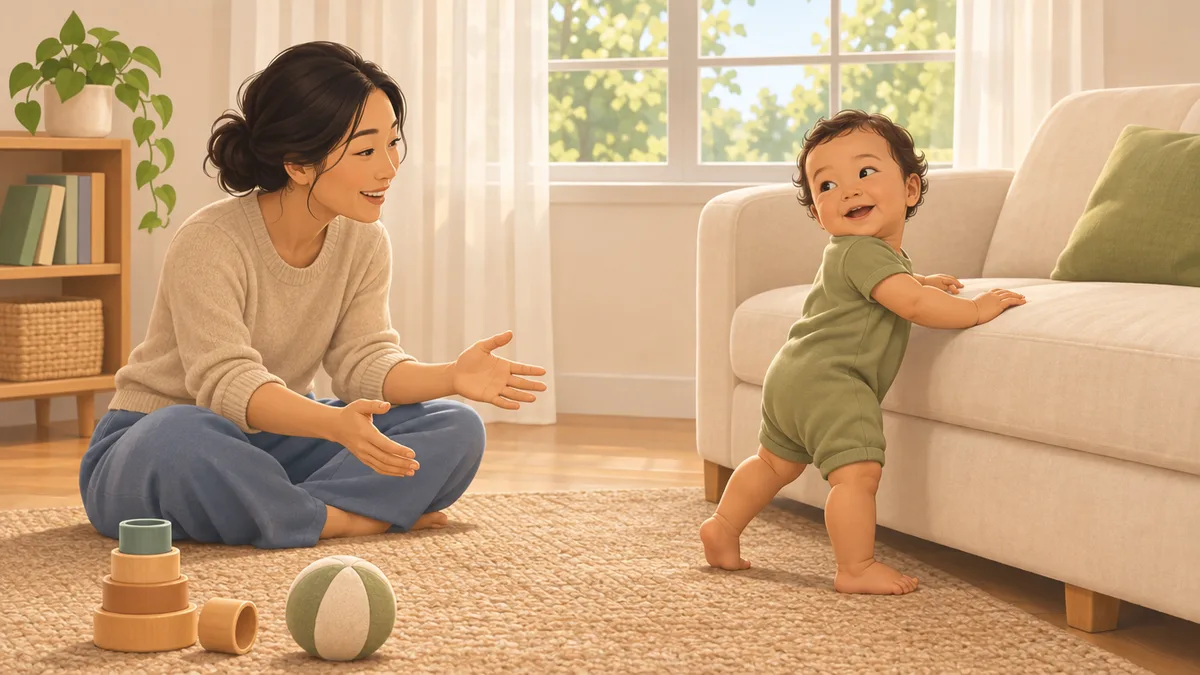
By the first birthday most babies pull up to stand and walk while holding on to furniture (cruising). The pincer grasp, picking up small items between thumb and pointer finger, appears on the 12-month list. Babies wave bye-bye, use “mama” or “dada” or another special name for a parent and understand “no.” Many take their first independent steps around this time, but plenty walk later; see when babies walk for the full range.
Ways to play: push toys or a sturdy empty box to walk behind, blocks and containers, books with flaps, pots and pans to bang, and simple songs with gestures. Respond with words when your baby points. For language at this stage, our guide to when babies start talking explains what counts as a first word.
How wide are the normal windows? The WHO motor study
Big motor skills vary a lot from baby to baby. The World Health Organization followed 816 healthy children in Ghana, India, Norway, Oman and the United States and recorded when they reached six gross motor milestones. The windows below run from the 1st to the 99th percentile, meaning almost all healthy children in the study reached the skill within that range.
| Motor milestone | Window of achievement (months) |
|---|---|
| Sitting without support | 3.8 to 9.2 |
| Standing with assistance | 4.8 to 11.4 |
| Hands-and-knees crawling | 5.2 to 13.5 |
| Walking with assistance | 5.9 to 13.7 |
| Standing alone | 6.9 to 16.9 |
| Walking alone | 8.2 to 17.6 |
The same study found that about 4.3% of children never crawled on hands and knees. Crawling also does not appear as a milestone on the current CDC checklists for 9 and 12 months. The WHO notes that these windows describe normal variation and can help signal when a child appears late and should be screened.
Simple ways to support development at home
- Talk, read and sing every day. Narrate what you are doing and respond when your baby makes sounds. Back-and-forth exchanges are the foundation of language.
- Give plenty of floor time. A firm, clean mat is where babies practice rolling, pushing up, sitting and crawling.
- Offer simple, safe toys. Rattles, rings, soft balls, stacking cups, board books and everyday objects that are too big to choke on.
- Keep screens to video calls. The CDC does not recommend screen time for children under 2, apart from video chatting with loved ones.
- Skip baby walkers. The CDC’s 1-year guidance says walkers are not recommended; let your baby hold your hands or safe furniture instead.
- Follow your baby’s lead. Notice when they are engaged and when they turn away or fuss because they need a break.
Safety as new skills appear
Each new skill brings a new risk, often before parents expect it:
- Rolling: never leave your baby alone on a bed, sofa or changing table, even for a moment.
- Sleep: always place your baby on their back to sleep on a firm, flat surface with no pillows, bumpers, blankets or toys. Once a baby rolls both ways on their own, they can stay in the position they choose, but they should still be put down on their back.
- Sitting and pulling up: lower the crib mattress before your baby can sit and set it to the lowest position before they can stand.
- Mouthing and the pincer grasp: keep coins, button batteries, magnets and small toy parts out of reach, and learn which foods are choking risks.
- Crawling and cruising: install gates at stairs, anchor furniture to the wall and lock away medicines and cleaning products.
When to talk to your pediatrician
The CDC’s advice is clear: you know your child best, and you do not need to wait. Talk to your baby’s doctor if:
- your baby has not reached one or more milestones on the checklist for their age (or corrected age);
- your baby loses a skill they used to have, at any age;
- your baby does not respond to sounds, does not look at faces, or does not seem to see well;
- one side of the body seems much stronger or more used than the other;
- your baby feels very stiff or very floppy;
- you simply have a feeling that something is not right.
Well-child visits are built around these questions. The AAP schedule includes checkups at 2, 4, 6, 9 and 12 months, and, as the CDC notes, the AAP recommends screening every child’s development with a standardized tool at 9, 18 and 30 months, and for autism at 18 and 24 months. If you or your doctor are concerned, ask about a referral for a full evaluation. In the United States, every state has a free or low-cost early intervention program for children under 3; you can call it yourself (the CDC lists contacts at cdc.gov/FindEI). Getting support early is never a waste of time, even if your baby turns out to be simply on their own schedule.
Frequently asked questions
My baby is behind on one milestone but ahead on others. Should I worry?
Uneven progress is common. Because CDC milestones reflect what at least 75% of babies do by that age, missing one is a reason to mention it at the next visit or call sooner if you are worried. Your doctor will look at the whole picture, including whether your baby is still making progress.
Do milestones predict intelligence?
No. Reaching a motor milestone early or late within the normal window does not tell you how smart your child will be. Milestones are tools for spotting babies who might benefit from a closer look.
Is it a problem if my baby skips crawling?
Not on its own. In the WHO study, a small share of healthy children never crawled on hands and knees, and the CDC no longer lists crawling as a milestone. What matters more is that your baby is finding some way to move and explore and is progressing toward standing and walking.
When do babies say their first word?
By 12 months most babies use “mama,” “dada” or another special name for a parent.
Should I use a milestone app?
The CDC offers a free Milestone Tracker app and printable checklists. They are useful for noting what your baby does and preparing questions for checkups. They are not a diagnosis.
What counts as “losing a skill”?
Stopping something your baby did consistently, such as no longer babbling, smiling, making eye contact or using their hands the way they did before. Tell your doctor promptly about any loss of skills.
Sources
- CDC. CDC’s Developmental Milestones.
- CDC. Milestones by 2 Months.
- CDC. Milestones by 4 Months.
- CDC. Milestones by 6 Months.
- CDC. Milestones by 9 Months.
- CDC. Milestones by 1 Year.
- Zubler JM et al. Evidence-Informed Milestones for Developmental Surveillance Tools. Pediatrics, 2022.
- WHO Multicentre Growth Reference Study Group. WHO Motor Development Study: Windows of achievement for six gross motor development milestones. Acta Paediatrica, 2006.
- World Health Organization. Motor development milestones.
- HealthyChildren.org (AAP). Corrected Age for Preemies.
- HealthyChildren.org (AAP). AAP Schedule of Well-Child Care Visits.
- HealthyChildren.org (AAP). Make Baby’s Room Safe: Parent Checklist.
- Safe to Sleep (NICHD, National Institutes of Health). Ways to Reduce Baby’s Risk.
- MedlinePlus (National Library of Medicine). Developmental milestones record.
This article was researched and written by the BabyU Editorial Team following our Editorial Policy. It is general educational information and does not replace advice from your child’s pediatrician or another qualified professional.