25 Gross Motor Activities for 2-Year-Olds, Indoors and Out

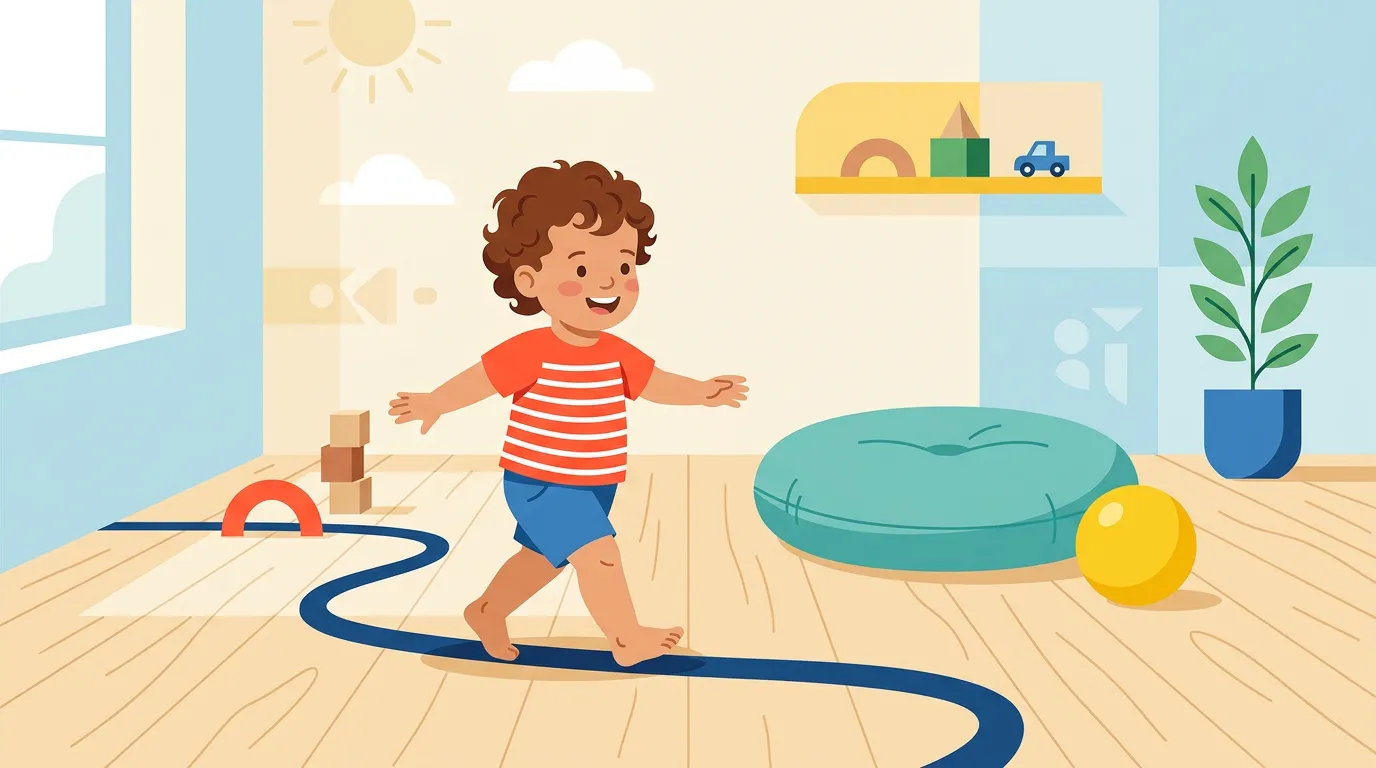
A two-year-old does not need drills to build gross motor skills. Running to a chalk mark, pushing a light basket, stepping over a towel, and kicking a large ball all give the body useful practice. The trick is choosing a challenge the child can repeat without turning it into a test.
The CDC lists running, kicking a ball, and walking up a few stairs with or without help among the movement milestones most children (75% or more) can do by age 2. Milestones are observation points, not a scorecard, and the CDC checklist is not a substitute for standardized developmental screening. CDC milestones by 2 years, updated May 15, 2026.
Pick the movement first, then the activity
| If your child wants to… | Useful activities below | What the body practices |
|---|---|---|
| Run and stop | Freeze dance, bubble chase, run-and-stop | Changing speed, balance, listening |
| Push or carry | Basket push, toy delivery, water carry | Leg and trunk strength, steering |
| Climb or crawl | Box tunnel, low cushion route, age-matched playground | Shoulder strength, spatial planning, coordination |
| Throw or kick | Sock toss, ball goal, soft-target throw | Weight shift, aiming, arm and leg coordination |
| Balance | Tape path, towel step-over, chalk route, gentle hill | Controlled steps and body awareness |
The World Health Organization recommends that children ages 1 and 2 accumulate at least 180 minutes of varied physical activity at any intensity across the day. That is not a three-hour class. Walking between rooms, active care routines, outdoor play, dancing, and several short games can all contribute. WHO recommendations for children under 5.
12 indoor gross motor activities
Clear the route first. Remove cords, hard-edged objects, loose toys, and access to stairs. A rug or nonslip surface is more useful than an elaborate obstacle course.
- Tape-line walk. Put one straight strip of painter’s tape on the floor. Invite the child to walk beside it, on it, or backward along a small section. Easier: make a path with two parallel strips. Next step: add one gentle curve. Setup: 1 minute.
- Rolled-sock basket toss. Put a laundry basket two or three steps away and throw clean rolled socks into it. Collecting misses adds squatting and carrying. Easier: move the basket closer. Next step: try one overhand and one underhand throw. Cost: free.
- Light basket push. Let the child push an empty laundry basket along a clear hallway. Add one soft toy only if the basket moves easily and does not tip. Easier: shorten the route. Next step: steer around one wide marker.
- Freeze dance. Play part of a familiar song and pause it. The child can freeze, crouch, or simply slow down. Easier: march together before adding stops. Next step: let the child choose the movement.
- Cardboard-box tunnel. Open both ends of a sturdy wide box and place it flat on the floor. Remove staples, cords, plastic wrap, and loose tape. Easier: use a short box the child can see through. Next step: place a toy at the far opening.
- Low cushion route. Put two firm, flat cushions on a nonslip rug for crawling across or walking around. Do not stack them. Easier: crawl around both. Next step: step onto one while holding an adult’s hand.
- Towel step-over. Roll a bath towel loosely and place it on the floor as a low boundary. Step across, turn, and come back. Easier: leave the towel flat. Next step: carry a soft toy over it.
- Animal movement copy. Try two familiar actions, such as waddling like a duck and stomping like an elephant. A two-year-old does not need to perform a precise bear crawl or crab walk. Easier: copy one action. Next step: let the child invent the animal.
- Toy delivery. Place three large toys in one basket and an empty basket a few steps away. Carry one item at a time. Easier: put the baskets together. Next step: add a tape line to cross.
- Bubble reach and pop. Blow a few bubbles into an open area and let the child reach, squat, or move after them. Keep the solution out of reach and wipe slippery spills immediately. Easier: blow bubbles low and close. Next step: alternate high and low bubbles.
- Marching parade. March around one room carrying a washcloth or a lightweight, age-appropriate instrument. Easier: march in place. Next step: switch between slow and normal pace.
- Copy two movements. Demonstrate ‘touch your knees, then reach up.’ Keep it playful and accept a child’s own version. Easier: use one movement. Next step: let the child lead.
Why there is no balloon game here: balloons and broken balloon pieces are serious choking hazards. The CPSC advises keeping deflated balloons away from children younger than 8. Bubbles, a light washcloth, or a slow-rolling large ball provide tracking and reaching without introducing that particular risk. CPSC toy safety guidance.
13 outdoor gross motor activities
- Sidewalk-chalk route. Draw one line, two circles, and a stop mark on a traffic-free surface. Easier: walk a straight path. Next step: add one turn.
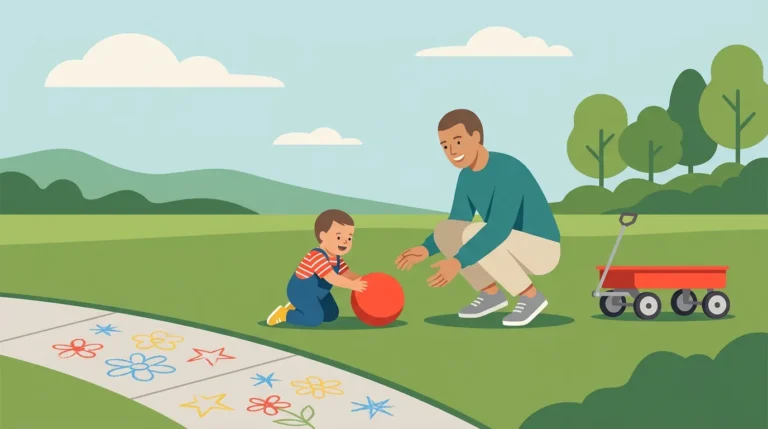
- Wide-goal ball kick. Put two shoes or cones far apart and place a large soft ball close to the goal. Easier: let the child push the ball with a foot. Next step: move back one child-sized step.
- Run-and-stop. In a fenced or otherwise vehicle-free space, call ‘go’ and ‘stop.’ Easier: walk. Next step: let the child give the signal.
- Playground climb-and-slide. Choose equipment posted for the child’s age and size. Stay close, but do not lift the child onto a platform they cannot reach independently. Easier: use one or two steps and come back down.
- Push-toy route. Use a stable push toy on flat ground away from traffic, pools, and slopes. Easier: keep the route straight. Next step: make one wide turn.
- Nature carry walk. Carry one large leaf or an adult-approved large pinecone to a basket. Check the area for litter, sharp plants, and small objects. Easier: carry the empty basket. Next step: squat to choose a second item.
- Gentle hill walk. Walk up a dry, low grassy slope and return by the easiest route. Stay close enough to help. Easier: hold hands and walk uphill only. Next step: pause halfway and restart.
- Puddle step. Step through a shallow, clean puddle in suitable footwear. Easier: touch it with a boot. Next step: step across a narrow dry line beside it. Stop on slippery ground.
- Ride-on straightaway. Use an age-appropriate ride-on toy on flat ground, following the manufacturer’s size limits and protective-gear instructions. Keep the route away from driveways. Easier: provide a wide straight path.
- Small-cup water carry. Put a little water in a lightweight cup and walk it to a plant. Use level, nonslip ground; empty all larger water containers after play. Easier: carry an empty cup.
- Soft-target throw. Throw large soft balls or rolled socks toward a box or chalk circle. Easier: stand close. Next step: choose between two targets.
- Ground-level obstacle route. Walk around a cone, step over a pool noodle lying flat, then carry a ball to a finish mark. Easier: offer one action. Next step: connect two actions.
- Outdoor follow-the-leader. Take turns marching, side-stepping, turning, and reaching. Easier: repeat one movement. Next step: follow two child-chosen actions.
For a broader mix of nature, water, and neighborhood options, use the separate guide to 35 outdoor activities for 1- and 2-year-olds. This page stays focused on whole-body movement practice.
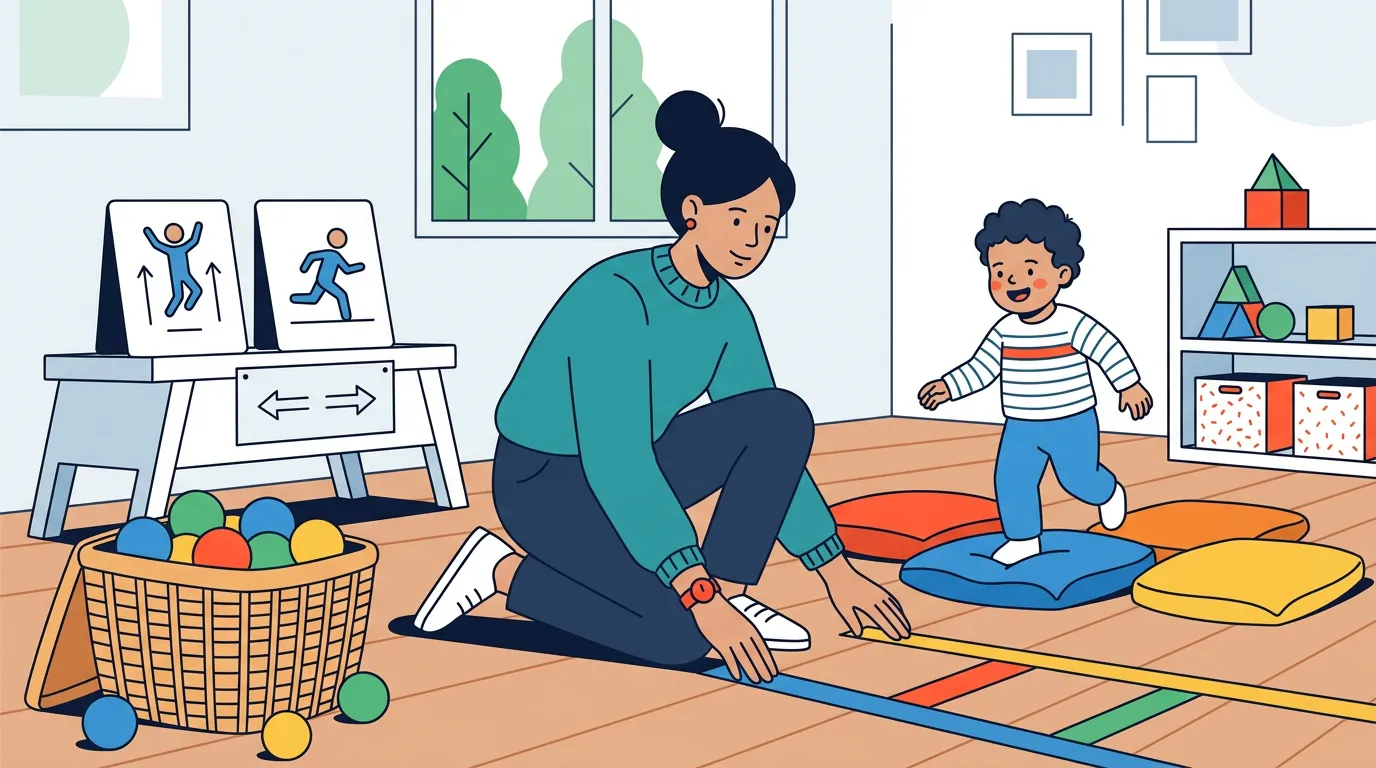
Make an activity easier or harder without adding height
Change one variable at a time. That makes it easier to see whether the child is learning the movement or simply dealing with too many new demands.
| Variable | Easier | More challenging without more risk |
|---|---|---|
| Distance | Shorten the route | Add one or two steps |
| Target | Move it closer and make it wider | Move it slightly farther |
| Directions | Use one action | Link two familiar actions |
| Support | Demonstrate or offer a hand | Stand nearby and let the child initiate |
| Surface | Use flat, dry ground | Add a painted curve or route change, not an elevated object |
A cautious mover may watch, hold a familiar object, or repeat the easiest version. That still counts as participation. A child with a mobility, vision, hearing, sensory, or medical difference may need an individualized adaptation from a physical therapist, occupational therapist, or pediatric clinician; avoid assuming that one activity list fits every body.
Use a 30-second safety scan
- Floor: remove cords, wet spots, loose toys, and sliding mats.
- Fall zone: keep routes away from stairs, glass, hard corners, traffic, pools, and driveways.
- Equipment: follow age and size signs; check for broken parts and hot surfaces.
- Clothing: remove necklaces, drawstrings, straps, and corded items around playground equipment.
- Supervision: move close enough to act quickly during climbing, riding, slopes, and water play.
The CPSC’s July 2025 Public Playground Safety Handbook says toddlers and preschoolers require more attentive supervision than older children. It also advises checking broken equipment, surfacing, entanglement hazards, and hot surfaces. One especially useful correction to a common habit: do not take a child down a slide on an adult’s lap, because a caught foot can lead to a leg fracture.
A repeatable week, not a checklist marathon
Choose three reliable activities and repeat them. For example:
- Monday: five minutes of tape-line walking and sock toss.
- Tuesday: child-led outdoor walk plus wide-goal kicks.
- Wednesday: freeze dance while dinner is being prepared nearby.
- Thursday: box tunnel and toy delivery.
- Friday: playground or ground-level outdoor route.
These sessions do not need to account for every minute of a child’s movement. Ordinary walking, climbing into a chair with help, carrying safe items, and outdoor wandering also contribute to an active day. If you need quiet options around the active ones, see 30 screen-free activities and the independent-play guide.
When to raise a development concern
Variation is normal, but concern deserves attention. Contact the child’s doctor if a child loses a skill they once had, seems to be in pain, consistently uses one side very differently, has repeated falls beyond what you expect for their experience, or cannot take part in everyday movement in a way that worries you. The CDC advises acting early when a child is not meeting milestones, has lost skills, or when a caregiver has another concern; ask about developmental screening rather than trying to diagnose from an activity list.
Frequently asked questions
How long should a gross motor activity last for a 2-year-old?
It can last two minutes or twenty. Stop when movement becomes less controlled, frustration rises, the child is overheated, or interest has ended. Several short opportunities across the day are more realistic than one long session.
What if my 2-year-old cannot jump with both feet?
Use stepping activities: cross a flat tape line, step over a rolled towel, or walk through a shallow puddle on safe ground. Do not make jumping a test or increase the height of an obstacle. Bring an ongoing concern to the child’s clinician.
Do I need a balance beam, climbing triangle, or indoor gym?
No. Tape, a large ball, rolled socks, a sturdy box, and clear floor space cover walking, throwing, crawling, pushing, and kicking. If buying equipment, use the manufacturer’s age, size, installation, and supervision instructions and make sure the surrounding surface is appropriate.
What are the key physical milestones at 2?
The CDC’s May 2026 list includes running, kicking a ball, walking up a few stairs with or without help, and eating with a spoon. A checklist helps monitor development but does not replace formal screening or an individual clinical assessment.
Sources and review notes
Milestone, activity, and playground claims were reviewed in July 2026. Key references include:
- CDC: milestones by 2 years (May 15, 2026)
- WHO: activity guidance for children under 5 (April 24, 2019)
- CPSC: Public Playground Safety Handbook (July 2025)
- American Academy of Pediatrics: How Active Is Your Toddler? (January 6, 2026)