10 Winter Sensory Bins for Toddlers Without Tiny Fillers

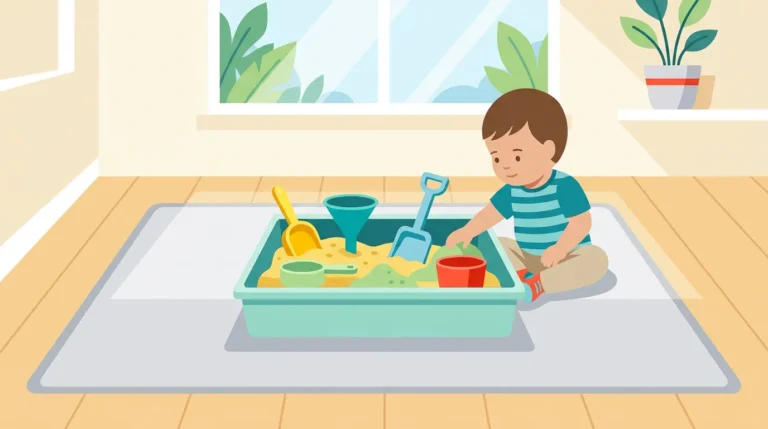
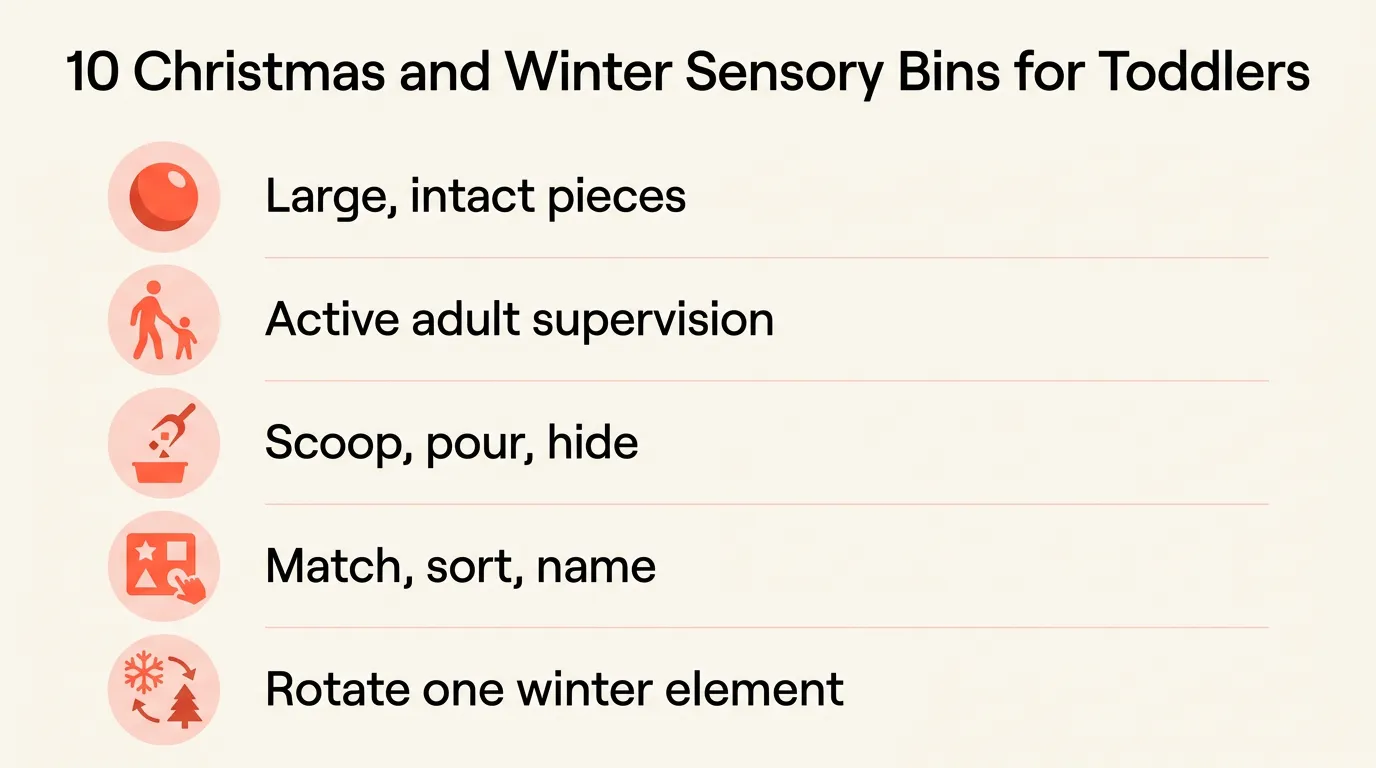
A winter sensory bin does not need dyed rice, plastic snow, miniature ornaments, or a shopping cart full of themed pieces. For a toddler, a shallow tray with a few large materials and one clear action (hide, carry, match, wrap, or sort) is easier to use and easier for an adult to supervise.
The ten ideas below rely on fabric, paper, large age-appropriate toys, and household containers. They avoid water beads and do not require glitter, candy, ornament hooks, bells, beads, buttons, or other tiny holiday decorations.
Choose the bin that fits the time and mess you can handle
| Idea | Setup | Cleanup | Cost if using household items | Main action |
|---|---|---|---|---|
| 1. Fabric snowdrift | 2 minutes | Very low | Free | Hide and uncover |
| 2. Paper snowstorm | 5 minutes | Low | Free | Crumple and transfer |
| 3. Big-ice rescue | Freeze ahead; 3-minute setup | Wet | Free | Slide and melt |
| 4. Mitten laundry | 2 minutes | Very low | Free | Pair and carry |
| 5. Felt tree | 10-20 minutes once | Very low | Low | Press and rearrange |
| 6. Gift delivery | 5 minutes | Low | Free | Fill and empty |
| 7. Red-and-white cloth sort | 2 minutes | Very low | Free | Sort and compare |
| 8. Arctic fabric landscape | 5 minutes | Very low | Low if figures are already owned | Pretend and position |
| 9. Woodland winter trail | 5 minutes | Low | Low | Make paths and shelters |
| 10. Washcloth snowball delivery | 3 minutes | Very low | Free | Throw and carry |
‘Free’ means the setup uses clean items already in the home. Do not buy or improvise a material solely because it appears in a table. Check its condition, manufacturer age guidance, and suitability for the child in front of you.
1. Fabric snowdrift: the easiest first bin
Materials: two or three white washcloths, one blue cloth, a large cup, and two chunky toys rated for the child’s age.
Set up: Loosely fold the white cloths in a shallow tray and partly hide the toys. Put the empty cup beside them.
Play invitation: ‘The bear is under the snow.’ The child can uncover, cover, carry, and put the cloth in the cup. For a younger child or a child who mouths materials, this simple fabric-only version is the best place to start.
2. Paper snowstorm: crumple, post, and pour
Materials: clean plain white paper, a wide cardboard tube, and a large bowl.
Set up: Tear the paper into broad strips larger than the child’s hand. Remove staples, labels, plastic windows, tape, and sharp cardboard edges. Avoid confetti and finely shredded paper.
Play invitation: Crumple a strip, push it through the tube, and tip it into the bowl. Paper that becomes wet, chewed, or torn into small pieces goes straight into recycling or trash; it is not saved for another session.
3. Big-ice rescue: a short melting investigation
Materials: one large block of plain ice frozen in a food container, a rimmed tray, one large silicone spoon, and towels.
Set up: Release the block onto the tray and place the tray on a stable, nonslip surface. Do not freeze a small toy inside, because a released toy or broken ice piece can become a mouth hazard.
Play invitation: Slide the block, spoon a little warm, not hot, water over it, and notice where it changes. Stay within arm’s reach, keep the session brief, prevent licking or biting, and remove any piece that breaks small enough to enter the mouth.
4. Mitten laundry: pair, fill, and carry
Materials: two or three clean pairs of child-size mittens and a basket.
Set up: Separate the pairs and place them loosely in the basket.
Play invitation: A younger toddler can fill and empty the basket. A child ready to compare can look for two mittens with the same color or pattern. There is no need to correct every mismatch; talk about what the child notices.
5. Felt tree: reusable Christmas arranging
Materials: one large flat felt tree and several large, simple felt shapes with no buttons, sequins, bells, wire, or glued-on gems.
Set up: Put the tree flat on the tray or attach it to a vertical felt board according to the board’s instructions. Count the pieces before and after play.
Play invitation: Press, remove, and rearrange. Use location words: top, under, beside. If the child chews or tears felt, put this setup away and return to intact washcloths.
6. Gift delivery: boxes without ribbon
Materials: two small sturdy boxes with lids removed, large fabric squares, and one basket.
Set up: Inspect the boxes and remove staples, plastic, loose tape, cord handles, and damaged flaps. Do not add curling ribbon, twine, or gift-bag handles.
Play invitation: Put a cloth ‘gift’ in a box, carry it to the basket, and empty it. Try the words in, out, full, and empty. The child can decide what the box represents.
7. Red-and-white texture sort
Materials: large red and white washcloths, felt sheets, and sturdy fabric squares, plus two containers.
Set up: Choose pieces with contrasting textures but no loose threads or detachable decoration.
Play invitation: Sort by color, or skip sorting and compare how a washcloth and felt feel. This gives a candy-cane color cue without candy, plastic canes, pom-poms, or glitter.
8. Arctic fabric landscape
Materials: blue fabric for water, white felt for ice, and two or three large Arctic animal figures rated for the child’s age.
Set up: Lay the fabrics side by side rather than filling a deep tub. Inspect figures for cracks, loose paint, or parts that could detach.
Play invitation: Move an animal from water to ice, cover it with ‘snow,’ or make a resting place. Ask an open prompt, ‘Where will the seal go?’ and accept the child’s story.
9. Woodland winter trail
Materials: broad strips of brown paper, white cloth, two chunky woodland figures, and two large blocks.
Set up: Make one paper path through the fabric snow. Put the blocks beside it as possible shelters.
Play invitation: Walk the animal along the path, hide it behind a block, or change the route. This bin is about spatial language and pretend play; it does not need real pinecones, twigs, moss, or unknown plants. Those nature materials can be sharp, moldy, brittle, or tempting to mouth.
10. Washcloth snowball delivery
Materials: three or four white washcloths and two laundry baskets.
Set up: Loosely roll each cloth and place the baskets a few steps apart on a clear floor.
Play invitation: Carry the ‘snowballs’ from one basket to the other or toss them into a nearby basket. This is the most active idea in the collection and works well when a seated bin is not matching the child’s energy.
The safety rules that matter more than the theme
Under age 3: no small parts
U.S. rules prohibit toys intended for children under 3 from containing or releasing small parts in required use-and-abuse testing. A household object is not automatically toddler-safe just because it looks large at first; buttons, pom-poms, caps, bells, foam pieces, ornament tops, and parts of damaged toys can detach. Follow product age labels and inspect every item before each session. CPSC small-parts and choking-hazard FAQ.
Keep water beads out of the play space
Water beads are not a toddler sensory filler. The CPSC says they can expand to many times their original size, may be almost impossible to spot after a spill, and can cause intestinal blockage, internal injury, or death if swallowed. A federal safety standard took effect in March 2026, but that does not make water beads suitable for a toddler bin; the CPSC information center still urges caregivers and child-care settings to avoid them. CPSC Water Beads Information Center.
Holiday electronics do not belong in a sensory bin
Keep light-up ornaments, musical cards, battery tea lights, and decorations with coin or button batteries out of reach. A battery compartment is not a play feature. Also remove magnets, ornament hooks, tinsel, long ribbon, glass, and decorations not designed as children’s toys. The CPSC’s 2025 holiday guidance emphasizes age labels and keeping small parts away from children. CPSC holiday safety sheet.
Supervision changes with the material
Fabric and large toys still need an available adult. Ice and any water require the adult to stay within arm’s reach and keep attention on the child. If a child repeatedly mouths, tears, or throws a material, remove it rather than repeating a warning the child is not developmentally ready to follow.
Use open-ended prompts without turning play into a quiz
NAEYC describes open-ended materials as items children can use in many ways for sensory, creative, or dramatic play. The adult can model one action, then step back. NAEYC: open-ended materials.
- Describe: ‘You covered the bear with the white cloth.’
- Compare: ‘This felt is smooth; the towel has little loops.’
- Offer a problem: ‘The gift does not fit in that box. What could we try?’
- Add a position word: ‘The mitten is beside the basket.’
Avoid a rapid series of questions such as ‘What color? How many? Which animal?’ because that turns child-led play into a lesson. One useful comment followed by quiet observation is enough.
Build one reusable winter kit
Store two white cloths, one blue cloth, large felt sheets, a cup, and a shallow tray together. Add age-appropriate figures already owned. That kit supports the snowdrift, color sort, Arctic scene, and woodland trail without four separate purchases. Wash fabric after it becomes dirty or wet, dry it fully, and discard damaged paper or felt.
If you want to compare fillers and tools beyond the seasonal theme, read How to Make a Sensory Bin. For a larger idea bank, use 45 sensory bin ideas for toddlers. The fall collection and not-scary Halloween collection reuse many of the same large materials, which is more economical than buying a new filler for each holiday.
Frequently asked questions
What is the safest winter sensory bin for a toddler who mouths objects?
Use two or three intact washcloths in a shallow tray, with an adult close by. Skip figures, paper, natural objects, loose filler, and ice until the child’s current behavior makes those materials manageable.
Can I use dry rice, beans, pasta, or fake snow?
They are not necessary, and they are poor default choices for a child who still mouths materials. Fake snow may expand or contain ingredients not intended for ingestion. Fabric, broad paper, and large age-rated toys are easier to account for and reset.
Are water beads safe now that there is a 2026 federal standard?
No toddler sensory activity needs them. The standard limits aspects of water-bead toys sold in the United States, but the CPSC still warns that water beads can cause severe injury if swallowed and urges caregivers to remove them from environments with young children.
How long should a sensory-bin session last?
There is no required duration. Five engaged minutes can be enough. End sooner if the child mouths materials, tries to climb into the bin, throws hard objects, becomes upset, or loses interest.
Sources and review notes
Product-safety and play guidance was reviewed in July 2026. Key references include:
- CPSC: Water Beads Information Center (current through 2026)
- CPSC: small-parts and choking-hazard FAQ
- CPSC: holiday safety guidance (November 2025)
- NAEYC: open-ended materials (2022)