Activities for 2 Year Olds on a Plane: A Timing Plan That Actually Works

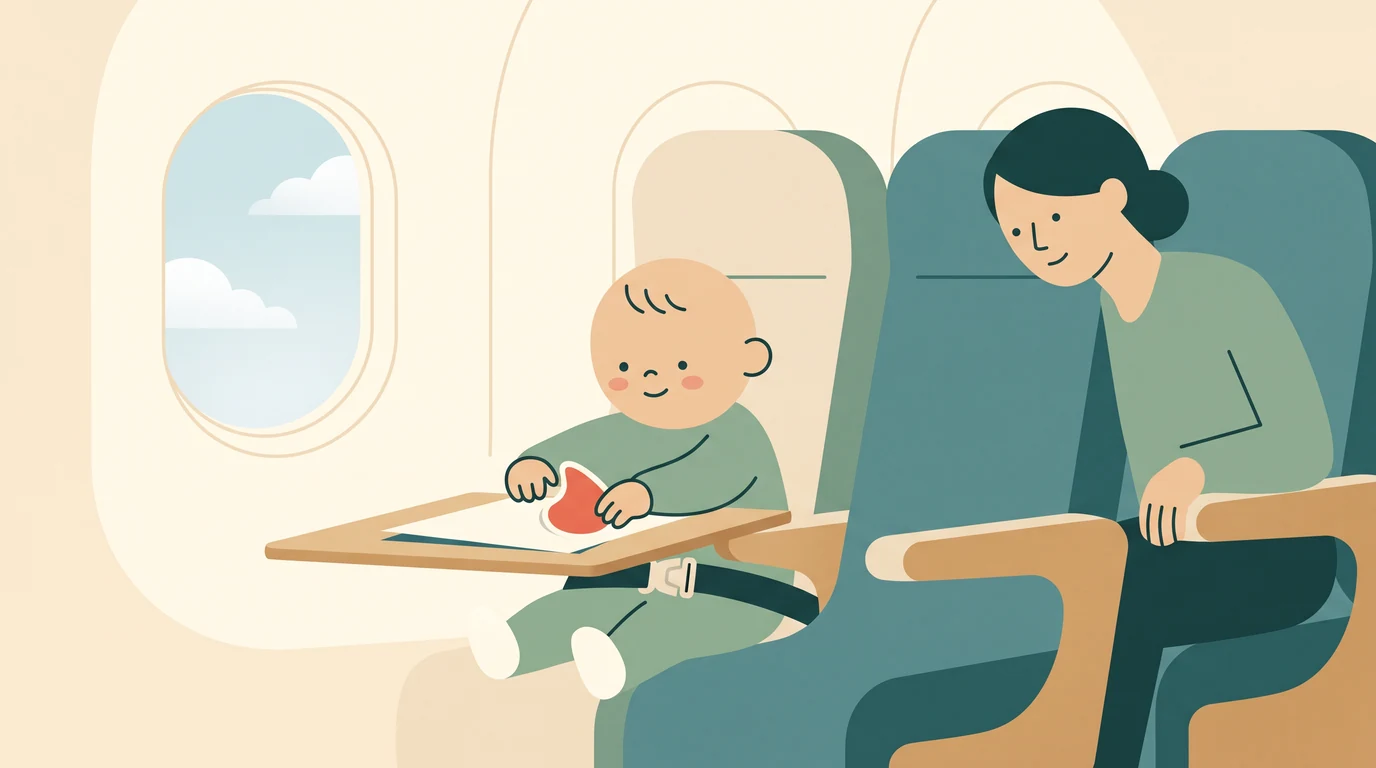
Most guides to activities for 2 year olds on plane trips are packing lists: stickers, a water reveal book, painter’s tape, snacks. Pack all eight and you can still end up with a meltdown at cruising altitude, because the items were never the problem. Everything got opened in the wrong order, usually all in the first twenty minutes, while your toddler was still fine on their own.
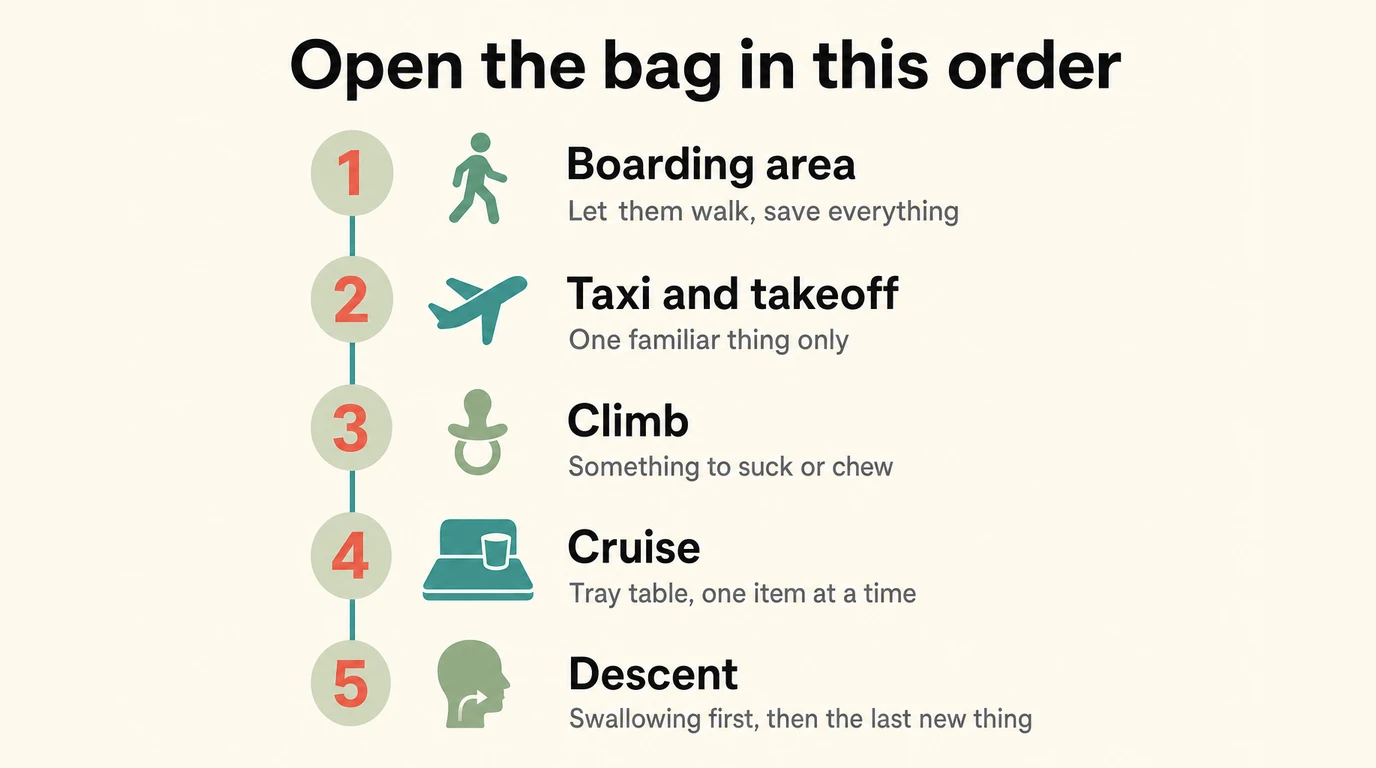
A flight is not one long stretch of boredom. It is five situations stacked back to back: a waiting area where your toddler can still move, a taxi with the seatbelt sign on and nothing to do yet, a climb and descent that hurt physically rather than bore, a long cruise with a tray table down, and a final stretch where everyone has run out of patience. Handing over the right item at the wrong phase wastes it. This guide is built around that timeline, with one specific rule for the order things come out of the bag.
Pack in reverse order of appeal
The single most useful idea on this page, the one no packing list bothers to say: never open the best item first.
Pack your bag in reverse order of appeal. The least exciting item goes in first and comes out first. The item your toddler would pick over everything else, the one that reliably buys you 15 or 20 quiet minutes, goes in last and does not appear until the previous item has genuinely died, not just gone quiet for a moment.
The reason this matters is that novelty is the resource you are rationing, not entertainment in general. A 2-year-old on a plane does not run out of things to look at. They run out of things that are new, and every item has a shelf life measured in minutes. Once it is spent, showing it again rarely revives it. If the favorite toy comes out during taxi, before the plane has even left the ground, you have nothing left for descent, when your toddler is tired and their ears may hurt.
Rank everything you are bringing, from mildly interesting to best in the bag, before you leave the house, so you are not making the call under pressure mid-flight. When an item stops working, wait it out for a minute before reaching for the next one. A short bored stretch is not an emergency. Spending your best resource too early is what actually runs out your options.
The trip, phase by phase: activities for 2 year olds on plane trips
The table below breaks a flight, and a long car ride, into the phases that actually determine what will work. Use it to decide which item is used when, based on what is physically possible in that window, not on how bored your toddler looks.
| Trip phase | Roughly how long | What is possible here | What to hand over | What to hold back |
|---|---|---|---|---|
| Airport and boarding wait | 30 to 90 minutes | Open space to walk, climb and run | Nothing yet, this is movement time | Everything in the bag |
| Boarding and taxi | 10 to 25 minutes | Seatbelt on, engines loud, nothing started | The most boring item you packed | Screens, snacks, the favorite item |
| Climb | 10 to 20 minutes | Ears may start to hurt as pressure changes | A bottle, breast, sippy cup or a chewy snack | Everything else, not a boredom problem |
| Cruise | Remaining flight time | Tray table down, seatbelt sign off | Two or three mid-tier items, one at a time | The single best item, save it |
| Descent | 20 to 40 minutes before landing | Ears hurt again, often worse than climb | Same sucking or chewing item as climb | Anything new, wrong moment for it |
| Last 40 minutes | Final stretch of the flight | Reserves are gone for everyone | The favorite item, whatever is left | Nothing, this is what remains |
| Car, hour one | First 60 minutes | Fresh attention, window and talking are often enough | Little to nothing | Almost everything |
| Car, hours two and three | Roughly hour 2 onward | Restlessness sets in, cannot safely reach back if driving alone | Soft items placed within reach beforehand, audio | Anything needing you to look away from the road |
| Before a planned stop | Final stretch before a break | Patience is gone for real | Whatever is left, the promise of a stop | New purchases |
The airport and the boarding wait
This is the last chance to burn energy before your toddler is strapped into a seat for hours, so the correct move is physical, not the tablet. An empty gate area is a play space: walk it end to end, let them pull their own small rolling bag if they have one, or use a moving walkway a few times back and forth. Watching planes push back and take off through the window works for longer than you would expect.
Keep this phase screen-free if you can manage it. A toddler who spent the wait sitting still with a tablet arrives at the gate already tired of sitting still, the one thing you need them to tolerate next. Our guide to screen-free activities for 2 year olds has more ideas that need no equipment beyond space to move.
Time it right: keep them moving until the gate agent calls your boarding group, not an hour before. A toddler moving right up until the last minute walks onto the plane with the edge already taken off.
Boarding, taxi and the first twenty minutes
This is the highest-risk window for an early meltdown, and the one phase where you genuinely have nothing in reserve yet. Your toddler is confined, the seatbelt sign is on, the engines are loud, and nothing has started moving in a way that feels like progress to a 2-year-old. This is why the least exciting item in your bag goes first, not as a punishment but because it is the only thing you can afford to spend here.
A busy book with zippers, buttons or laces works well here: quiet, familiar, and it keeps small hands occupied without needing your full attention. Our roundup of fine motor skills activities for 1 and 2 year olds has more low-prep ideas that pack flat. Narrating what is happening helps too: “we’re waiting our turn,” “the plane is going to start moving now.” It does not need to entertain, only to hold steady.
Ear pressure on climb and descent
Climb and descent are not boredom problems. As cabin pressure changes, it can hurt, and no toy fixes that. The standard comfort measure is swallowing and sucking, which helps open the Eustachian tubes and equalize pressure. Offer a bottle, the breast, a sippy cup, or a chewy snack, and keep it going through the whole climb or descent, not just a minute at the start.
Time it to what the plane is actually doing, not to the announcement. Descent often begins before the seatbelt sign comes back on, so start the drink or snack as soon as you feel the plane losing altitude. Ear pain tends to be worse on descent than on climb, so if you only manage one of the two well, prioritize descent. If your toddler is asleep as descent starts, it is fine to gently wake them enough to nurse, sip or chew: a sleeping child swallows less often, which is exactly when ear pain builds.
This is ordinary in-flight comfort care, not medical treatment. If your toddler has a history of ear infections or struggles with pressure changes, talk to your pediatrician before the trip, including about any medication. That decision belongs with them.
The long middle stretch
Cruise is the phase with the most room to work with: tray table down, seatbelt sign usually off, no physical pain competing for attention. This is where mid-tier items earn their keep, deployed one at a time. A reusable sticker pad, a small magnetic drawing board, or a blank pad with a single marker all fit here and pack flat. For more low-mess options, our guide to craft activities for 2 year olds has ideas that work on a tray table.
Keep the deployment order running here too. On a long flight, it is tempting to hand over the favorite item because things went quiet for a moment. Resist it. Cruise is where the plan can quietly collapse if you spend your best resource out of habit instead of need. Save it for descent and the last 40 minutes, when you will actually need it.
Long car trips are a different problem
Car activities for 2 year olds need a different plan than plane activities, because the constraint is not ear pressure or a seatbelt sign. It is whether an adult can safely reach the back seat at all.
Hour one is usually free
Most toddlers do fine for the first hour on the window, the novelty of the trip, and conversation. Do not front-load activities here.
Hours two and three are the real problem
This is where restlessness builds, and the deployment order rule matters again: one item at a time, least interesting first, best item held until the final stretch before your next stop.
The handing-back problem when you are driving alone
Car seat use is not optional, and nothing here involves unbuckling a toddler in a moving vehicle. If you are driving alone, you cannot safely twist around to hand something back on demand. Load a seatback organizer or seat pocket beside them before you leave, in deployment order, so your toddler can reach the next thing themselves. Anything handed over in a car must be soft: hard toys or rigid pieces can become a projectile in a sudden stop, even at low speed. Keep the car bag to fabric books, soft balls and plush toys only.
Stop timing
Plan a stop roughly every two hours, and say so out loud before your toddler asks: “next stop in twenty minutes.” A named, upcoming stop is itself a deployment item, the thing you hand over in the final stretch, the same way you would use the favorite toy on a plane.
Car sickness limits what you can hand over
A moving car is a poor place for close-up focus. Books, drawing pads and screens held close to the face are a common trigger for car sickness in toddlers, because the inner ear senses motion while the eyes are fixed on something still. Audio works better here: music, a toddler podcast, or familiar songs do not require your toddler to look at anything. If you do offer something visual, keep it brief and stop the moment your toddler seems pale or unusually quiet.
What is actually worth packing
You do not need a $40 travel activity box. Since novelty, not quality, is what makes an item work, a handful of dollar store finds your toddler has not seen before will outperform an expensive kit they have already handled at home. Spend the money on the flight or the hotel instead. Every item also has to pass the small parts test for under 3s: if it fits through a toilet paper tube, it is a choking risk in a confined seat with a distracted adult. Here is what earns a spot, matched to the phase it serves.
- A busy book with zippers or buttons: boarding and taxi, quiet and familiar.
- A bottle, sippy cup or chewy snack: climb and descent, for swallowing and sucking.
- Reusable sticker pad: cruise, low mess and resets itself.
- Small magnetic drawing board: cruise, no loose pieces to drop.
- A single new soft toy, unseen before today: the favorite item, saved for descent or the last 40 minutes.
- Snacks paced across the whole flight: cruise and the last stretch, not all at once.
- A soft, familiar comfort item from home: boarding and the last 40 minutes, for regulation, not novelty.
- Headphones or an audio player with toddler content: car, hours two and three.
- A change of clothes for you as well as your toddler: any phase, spills happen.
- Wipes and a small trash bag: every phase, so cleanup never costs you time you don’t have.
For everyday ideas beyond the travel bag, our guide to activities for 2 year olds covers what to keep on hand between trips.
When it has already gone wrong
Sometimes the plan fails anyway. The favorite item got spent too early, descent hit harder than expected, or your toddler is simply done and everyone within three rows knows it. Here is what to do once the deployment order has run out.
If the seatbelt sign is off, a change of scenery genuinely helps: the back galley for a few minutes, a slow walk down the aisle, or looking out at clouds can reset a meltdown nothing in the bag was going to fix. A change of holder, a second caregiver taking over for ten minutes, often works better than anything you hand over, because the interaction has gone stale, not the toys. Cold water, on a cloth or to drink, can also help a toddler who is overheated calm down.
You also have permission to stop performing for the other passengers. Once you have tried the real options, comforting your toddler calmly and quietly is enough, even if it takes a while and they are still crying. What the row behind you thinks about it is not something you are responsible for managing on top of everything else.
Frequently asked questions
How do I keep a 2 year old busy on a plane?
Match the item to the phase instead of trying to keep them busy the whole flight: movement before boarding, the most boring item during taxi, a sucking or chewing item during climb and descent, mid-tier items during cruise, and the favorite item held back for the last 40 minutes. The order matters more than the items.
Should I bring a tablet?
A long flight is not the place to fight that battle. If a tablet is what gets everyone through, bring it loaded with something familiar and headphones sized for a toddler. But it should be late in the deployment order, not the first thing you reach for during taxi. Save it for cruise or the last stretch, when its ability to hold attention for a long stretch is worth the most.
Do toddlers need their own seat on a plane?
The FAA allows children under 2 to fly as lap infants, but it strongly recommends against it. Its guidance is that the safest place for a child under 2 is in an approved child restraint system in their own purchased seat, because an adult’s arms cannot securely hold a child during unexpected turbulence. Once your child has turned 2, an FAA-approved restraint or their own seat is required, not just recommended. If budget allows and your child is still under 2, buying the extra seat is the safer option.
What activities work for a 1 year old on a plane?
The same timeline and deployment order rule apply, but a 1-year-old leans more on movement, familiar objects and feeding than on structured play. Sticker pads matter less at this age than a familiar soft toy and a steady supply of snacks or milk for climb and descent. Our guide to activities for 1 year olds has age-matched ideas that translate well to a plane seat.
How many items should I pack for a short flight versus a long one?
For a flight under 2 hours, four or five items in deployment order is usually enough, since you will only get through boarding, climb, a short cruise and descent. For anything over 4 hours, plan on 8 to 10 items so you have enough mid-tier options to space across a longer cruise.
What if my toddler has a meltdown despite the plan?
It happens even with a good plan. Move to the recovery options once the deployment order has run out: a change of scenery if the seatbelt sign is off, a change of holder, cold water, and calm comforting rather than new toys. A meltdown despite good planning is not a sign you did anything wrong.
Sources and notes
Guidance on lap infants and child restraint systems reflects current Federal Aviation Administration guidance for traveling with children under 2. Guidance on ear pressure, swallowing, sucking, and why descent tends to hurt more than climb, reflects pediatric guidance published by Nemours KidsHealth for parents. Guidance on small parts, choking risk for children under 3, and keeping loose items in a moving vehicle soft rather than rigid reflects standards maintained by the Consumer Product Safety Commission. This article does not recommend or describe any medication; questions about pain relief or motion sickness treatment belong with your pediatrician.
Sources checked on October 25, 2026. Primary references: