Thanksgiving Sensory Bin Ideas That Skip the Choking Hazards

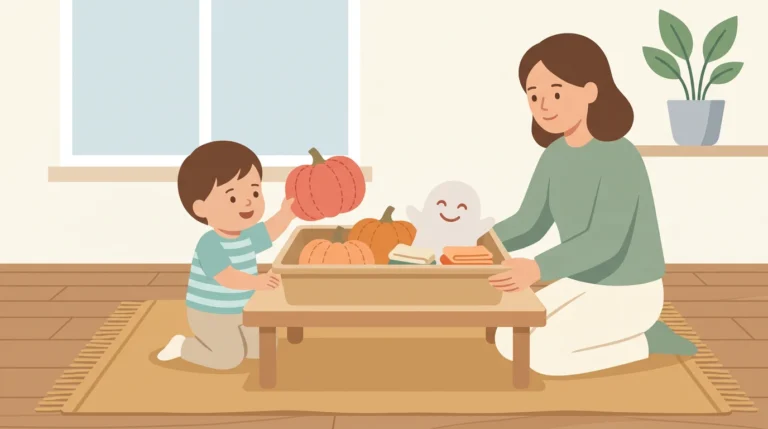
Search for Thanksgiving sensory bin ideas and you will find the same filler again and again: dried corn kernels, dried beans, popcorn kernels, mini pumpkins, small gourds, acorns and candy corn, poured loose into a bin for a toddler to scoop with bare hands. For a child under 3, several of those are among the worst materials you could hand over, and almost nothing online says so.
This article rebuilds the holiday from the filler up. Every bin below gives a 1 to 3-year-old the same pour, scoop and squish experience without the choking and aspiration risk, and it treats the day itself, not just the bin, as part of the plan. Thanksgiving sensory play for toddlers has to survive a hot kitchen and a house full of relatives, not a quiet Tuesday afternoon. If you have already tried our fall sensory bin ideas, Thanksgiving adds two problems fall does not: hazardous default fillers, and a room full of distracted adults.
Thanksgiving sensory bin ideas that leave out the classic hazards
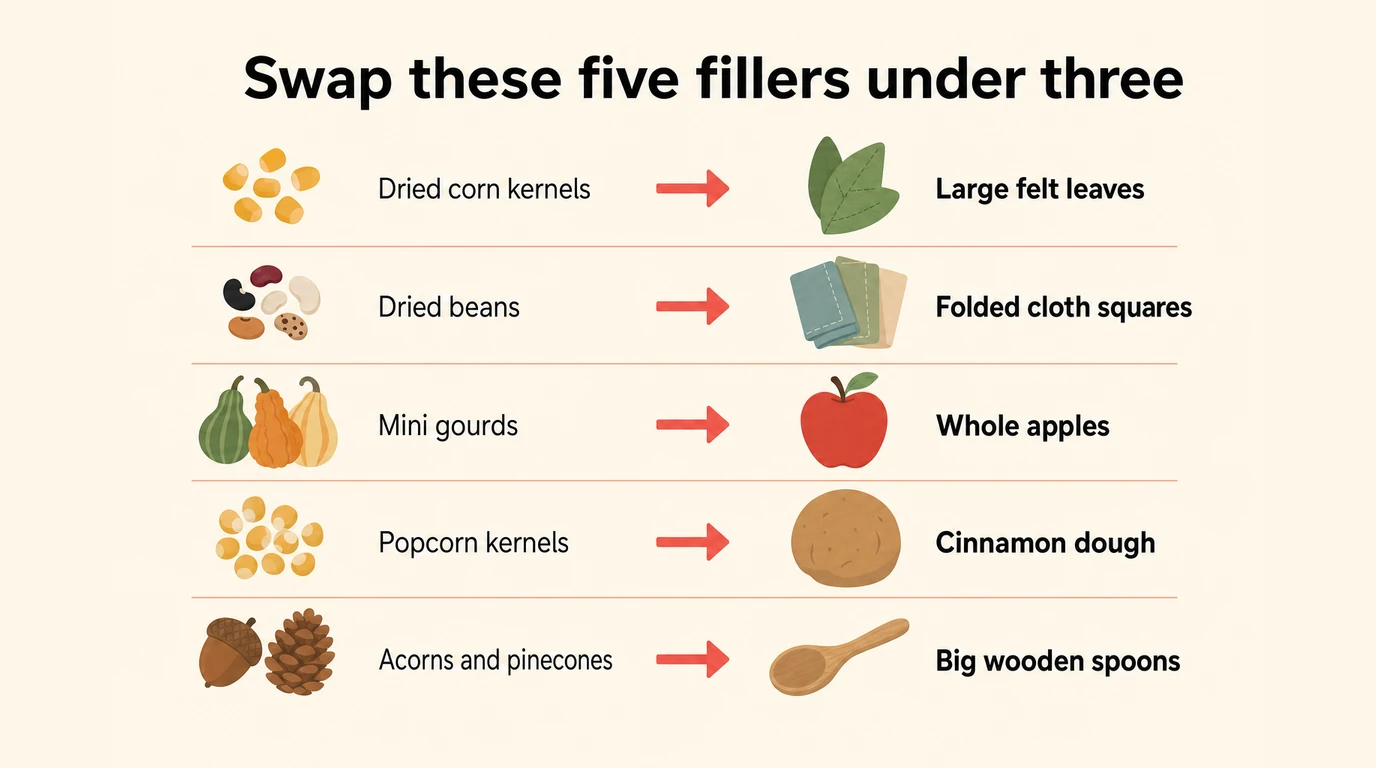
The table lines up the classic filler against what makes it risky for this age, then gives a swap that keeps the sensory payoff. For container depth and general setup, see our guide to how to make a sensory bin.
| Classic filler | Why it is a problem for under-3s | Use instead | What it still gives sensorily |
|---|---|---|---|
| Dried corn kernels | Hard, smooth, round and airway sized, handed over loose near the face. | Corn cooked and cooled, one supervised sitting only. | The scoop, the squish, the color. |
| Dried beans | Same hard, small profile as corn, and swells further if it gets wet. | Beans cooked, cooled and rinsed, offered the same way. | The give between fingers, the color, the weight. |
| Popcorn kernels, popped or not | Unpopped is hard and round. Popped is light and irregular, easy to inhale. Neither belongs near a toddler’s face. | Fabric pom-poms in pale yellow and cream. | The scoop-and-toss motion, the texture, the color. |
| Mini pumpkins and small gourds | Small enough to fit in a young mouth, hard enough not to give. | One full-size pumpkin, too heavy to lift to the mouth. | The heavy roll, the bumpy rind, the look. |
| Acorns and pinecones | Small, hard, irregular, gathered outside where size cannot be controlled. | Large felt leaves or wooden discs bigger than a fist. | The rustle, the stacking and sorting. |
| Whole cranberries | Round, smooth, grape sized, a recognized choking shape when left whole. | Cranberries halved by an adult, in a shallow tray, one-on-one only. | The burst and squish, the tart smell. |
| Small candy corn | Hard candy is a top choking item with no nutritional case for the risk. | Oversized felt candy corn shapes, sewn shut. | The sorting game, the pattern, the look. |
One more material to leave out entirely: water beads. They surface in some round-ups as a fix for dry fill, but they carry their own well documented hazard and have no place in a bin for this age group.
Why dry fill is a different risk from choking
Choking happens when something blocks the airway on the way down, usually while swallowing. Aspiration is related but not identical: something is drawn into the airway or lungs instead of staying clear, and it does not require the child to have been eating at all. A toddler exploring a bin with their face close to the container, sniffing, gasping mid-laugh, or bringing a fistful of small hard pieces near the nose and mouth can inhale a piece the same way they might while eating.
The federal rule banning small parts from products meant for children under 3 is titled around both risks at once, covering items that present “choking, aspiration, or ingestion hazards because of small parts,” sized to approximate a young child’s fully expanded throat. Separately, the American Academy of Pediatrics and HealthyChildren.org list hard, round, smooth foods, including nuts, seeds, popcorn and hard candy, as high-risk items to keep away from children until at least 4, since chewing and swallowing coordination is not developed enough yet.
Dried corn, dried beans and popcorn kernels meet that same profile: small, hard, roughly airway sized. A supervised bite at the table is already the safer setting for a risky food. A double handful poured loose into a bin, explored at nose height, is the riskier one, which is backwards from how most Thanksgiving sensory bins are set up online. If your child still mouths most new objects, our guide to sensory bins for 1 and 2 year olds covers that stage material by material.
Eight Thanksgiving sensory bins built without the hazards
1. Cinnamon spiced dough tray
- Unscented playdough, cinnamon and nutmeg kneaded fully in
- A rolling pin, one leaf or pie cutter, a metal pie tin
Mix the spice into the dough before your child sits down, so nothing loose sits near the face. Setup takes 5 minutes. Your child presses, rolls and tears, and gets a strong warm smell with every squeeze. Flatten the dough first to make it easier, or hand over the cutter for more challenge. Stay within arm’s reach. For more recipes for the mouthing stage, see our taste-safe paint for babies guide.
2. Torn fabric harvest bin
- Felt or cotton torn in advance into rust, gold and brown strips, edges smoothed
- Two bowls, a big wooden spoon, a small stuffed animal to bury
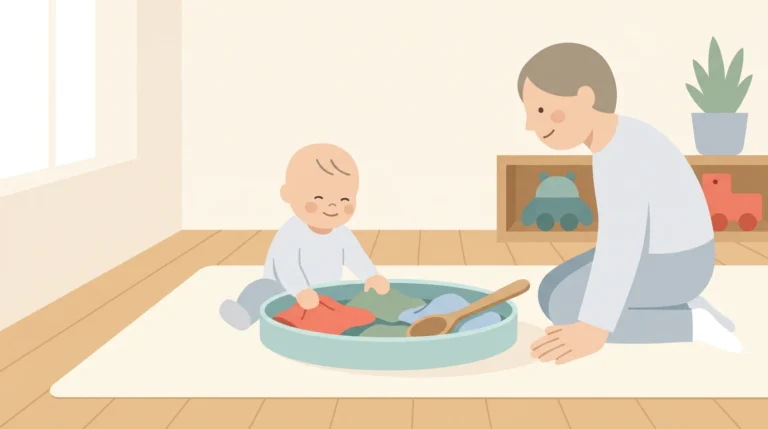
Setup takes about 10 minutes, mostly tearing fabric. Your child buries the toy, digs it out with the spoon, and buries it again. Start the toy half visible for less challenge, or hide two and ask for one by name. Fabric shakes out of carpet and packs flat for reuse. Stay close enough to see both hands.
3. Apple and orange wash station
- 2 to 3 whole apples and oranges, washed and checked for soft spots
- A basin of warm water, a scrub brush, a colander, a towel underneath
Setup takes 5 minutes. Your child scrubs, rolls the fruit between their palms, and drops each piece into the colander to hear it land. Discard anything bruised or leaking first. One piece and a bigger bowl is easier; more fruit and a smaller colander adds challenge. This is a water bin: stay at arm’s reach, never a set-and-walk task.
4. Golden broth pour and measure station
- Warm, wrist-tested water tinted golden with a drop of food coloring
- An unbreakable small pitcher, stacking measuring cups, a wide roasting pan
Setup is 5 minutes, most of it testing water temperature yourself. Pouring from the pitcher into the cups and back is the whole activity, and toddlers repeat it far longer than seems reasonable. One cup and no pitcher is easier; a named fill line adds challenge. Stay at arm’s reach for the whole session, not a check-in every few minutes.
5. Set the table fold and match bin
- 4 to 6 cloth napkins, large plastic napkin rings too big for a small parts tester
- Matching placemats, one unbreakable plate
Setup is under 5 minutes. Your child folds, rolls, slides the napkin through the ring, and matches napkin to placemat by color, which doubles as real help if you are setting a table that day. Fold halfway yourself for less challenge, or ask for a specific fold. This is the driest, lowest-risk bin here, so it tolerates supervision from across the room as long as you can see clearly.
6. Cranberry press and squish tray
- 1 cup fresh cranberries, halved by an adult beforehand, none left whole
- A shallow tray, a child-sized fork or small masher, a bowl for pulp
Setup takes about 10 minutes, mostly halving cranberries. Your child presses and squishes and watches the juice release, and gets a strong tart smell, the other scent-led bin here alongside the cinnamon dough. It stains, so expect an old shirt. As a prepared food still shaped like a choking hazard if swallowed whole, this needs one-on-one supervision at true arm’s reach, closed out after a few minutes.
7. Warm mashed sweet potato squish tray
- Cooked and cooled sweet potato or canned pumpkin puree, warm not hot
- A couple of cookie cutters, plastic forks, a shallow tray
Setup is 5 minutes if you already have cooked sweet potato. Your child squishes, cuts shapes and mixes with a spoon. Because the material is food, reach for this bin during the mouthing stage, when there should be no ambiguity about what is safe to eat. A softer scoop with no cutters is easier; firmer cutters add challenge. Test the temperature yourself first, and stay at arm’s reach.
8. Kitchen helper dump and fill bin
- A basket of real, whole, blunt kitchen tools: wooden spoons, a whisk, measuring cups
- Oven mitts, a cool empty pie tin, a stack of nesting bowls
Setup is whatever it takes to gather items from your own drawers, usually under 5 minutes. Your child dumps, fills, stacks and nests, and gets to feel like they are helping with the cooking nearby. Fewer items is easier; sorting tools by size before nesting adds challenge. Station this bin a full room away from the stove, not just an arm’s length away, for the whole session.
Building a bin around scent
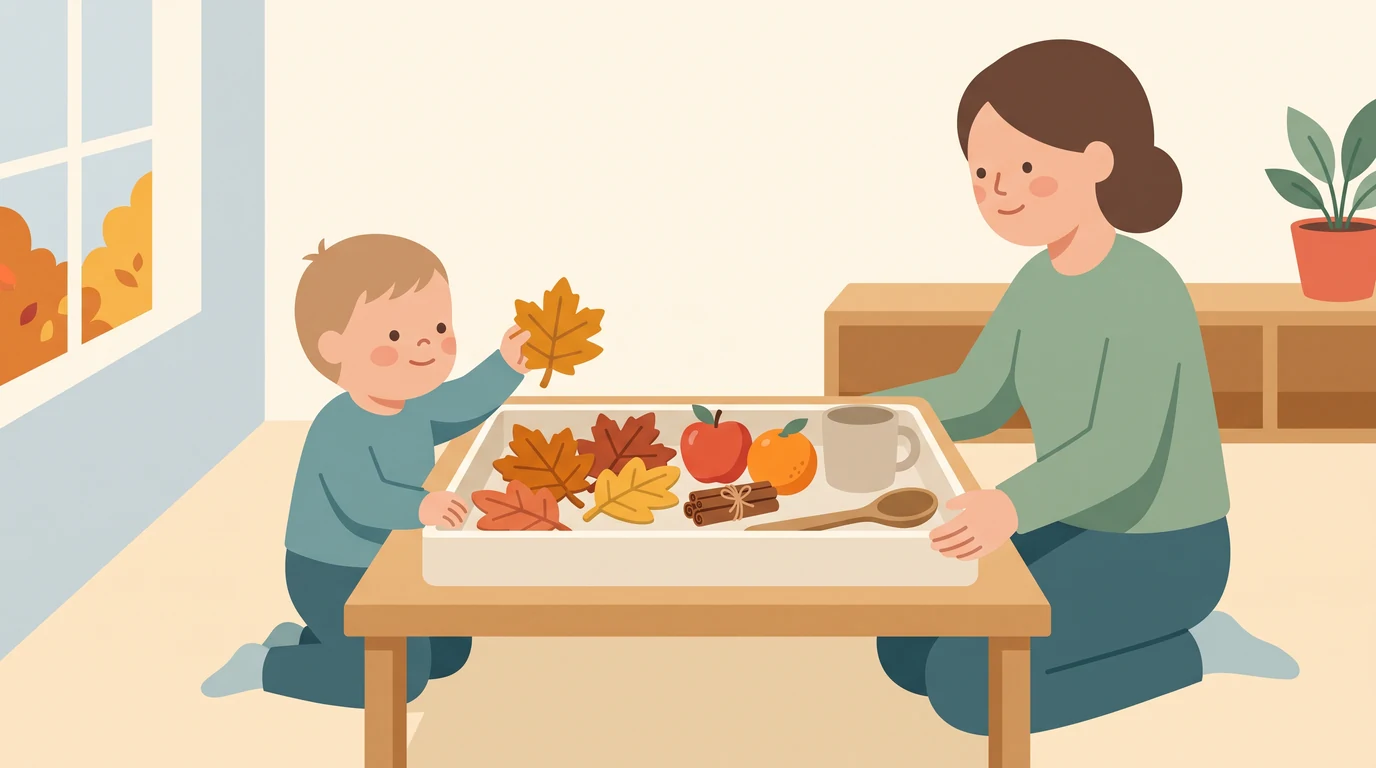
Scent is the one sensory channel most Thanksgiving sensory bin ideas skip, and the holiday is built for it. The cinnamon dough tray and the cranberry press above are both scent led by design, and they are worth doing back to back if smell is what your child responds to most.
For a third option, tie a cinnamon stick or a few whole cloves into a small knotted square of cloth, sealed so nothing loose can come out, and set it near a fabric bin rather than inside it. Your child gets the smell during play without any small hard piece near their hands or face.
Supervision on the day itself
Thanksgiving is the worst supervision day of the year for a toddler, even with completely safe materials. A hot kitchen, an oven running for hours, guests arriving in waves, several adults each assuming someone else is watching, and an overtired child off their normal schedule all stack on top of each other. A setup that is fine on a quiet afternoon is not automatically fine here.
Use a one-adult rule. One named adult is on the child at any given time, and the handoff is said out loud, not assumed. “I’ve got her” or “your turn, I’m starting the gravy” closes the gap where everyone thinks someone else is watching.
Place the bin somewhere with a clear sightline but physically outside the kitchen, not in the doorway and not against the wall the oven door swings open into. Hot liquids, an open oven door and a stovetop within reach are the specific injury risks of the day, and no sensory bin changes that math. A bin is also not a way to occupy a toddler while you cook. It buys a few focused minutes and still needs an adult present, just not necessarily the one cooking. Skip nut-based dough or shells if other children will be at the gathering; their allergies are not worth gambling on.
A Thanksgiving bin you can take to someone else’s house
Most Thanksgivings happen in a house that is not yours, with hazards at toddler height you have not childproofed. A travelling bin needs to pack into one bag, use items your host already owns, and leave nothing behind.
The set the table bin and the kitchen helper bin are the best candidates. Both are dry and quiet, built almost entirely from your host’s own napkins, spoons and measuring cups rather than gear you brought. Pack a small folding mat for the carpet, your own napkin rings for a guaranteed safe size, and a gallon bag for anything going home dirty.
Tell your host before you set up, not after: “we’re going to do a quiet activity in the corner for a bit.” It gets you a spot away from foot traffic and stops a relative from adding their own items mid-play. Choose a corner away from stairs and the kitchen doorway, and skip the water and food-based bins here. They are the ones most likely to mark a carpet you cannot replace.
When it goes wrong
The bin gets tipped onto a relative’s carpet. Do not scramble to hide it. Say what happened, clean it up together, and move to a hard floor or your travel mat. One spill is normal toddler play, not a crisis to manage around your host’s reaction.
Your child is overstimulated by the crowd. Watch for the early signs, not the meltdown itself: covering ears, going quiet, clinging harder than usual. Move to a low-stimulation room for five minutes before it escalates. The bin can wait or end early. It was never the main event.
A well-meaning guest adds something unsafe, candy corn is the likely offender. Say it plainly, before your child’s hands are on it: “thank you, but we keep hard candy out of her bins, she’s still at the age where that’s a choking risk.” Most relatives back off once you name the reason. If they push, remove the item yourself, calmly, and keep playing.
Frequently asked questions
What can I use instead of corn in a sensory bin?
For dried corn kernels specifically, use corn that has been cooked and cooled, offered for one supervised sitting, or switch materials entirely and use fabric pom-poms in corn colors for the scoop and pour motion without a hard, swallowable piece.
Is a sensory bin safe for a 1 year old at a holiday?
Yes, with two conditions: the materials suit a child who still mouths new objects, which rules out anything small and hard, and one specific adult watches at arm’s reach the entire time. A 1 year old at a holiday gathering is not a lower-supervision situation than at home. It is a higher one.
How do I keep a toddler busy while cooking Thanksgiving dinner?
Honestly, a sensory bin alone does not do this. It buys focused minutes, not an hour of hands-off cooking, and it still needs a present adult. The realistic version is a second adult on child duty, or short rotating activities, a bin, then a book, then a walk, none of which replace supervision. For more options, see our activities for 2 year olds hub.
How long should a Thanksgiving sensory bin session last?
Most toddlers stay engaged for 5 to 15 minutes, less for food-based bins where you supervise every handful. Treat that as a full session, not a warm-up. Repeating a shorter bin twice works better than stretching one past the point of interest.
What if my toddler tries to eat the fabric or dough?
Switch to a food-based bin, like the sweet potato squish tray, where there is no ambiguity about what goes in the mouth. Mouthing new materials is normal at this age, not a sign you chose the wrong activity. It just means this bin needs a different material for now.
Sources and notes
The choking and aspiration guidance here was checked against the American Academy of Pediatrics and HealthyChildren.org’s published choking prevention guidance, the CDC’s infant and toddler nutrition guidance on choking hazards, and the Consumer Product Safety Commission’s small parts regulation for products intended for children under 3, which treats choking, aspiration and ingestion as related but distinct hazards. Nothing here states a statistic, a study finding or a quotation beyond what these sources publish as plain guidance. For the full range of bins outside the holiday season, see our sensory bin ideas hub.
Sources checked on October 25, 2026. Primary references: