Object Permanence in Babies: When It Starts and Games to Try

Quick answer: Object permanence is your baby’s understanding that people and things still exist when they can’t be seen. Early signs show up after about 4 months, when babies start to notice that a hidden toy did not really vanish. Most babies begin actively searching for a toy hidden under a cloth around 8 to 10 months, and the CDC lists “looks for things he sees you hide, like a toy under a blanket” as a skill most babies have by 1 year. The skill keeps maturing well into the second year. Peekaboo, hide-the-toy games and simple “in and out” play are the easiest ways to practice it at home.
You will see object permanence in everyday moments: the baby who leans over the high chair to look for a dropped spoon, pulls a blanket off your face during peekaboo, or cries the second you step into the kitchen. This guide covers what the skill is, how it unfolds by age, why it often arrives with separation anxiety and sleep changes, and which games fit each stage.
What is object permanence?
Object permanence is the idea that an object or person keeps existing even when it is out of sight, out of hearing or out of reach. Adults take it for granted. Young babies have to build it, one experience at a time.
The concept comes from the Swiss psychologist Jean Piaget, who studied how infants search for hidden objects. Piaget concluded that babies do not really treat objects as permanent until somewhere around 8 to 9 months, when they start lifting a cover to retrieve a toy. Later research complicated that picture. In a well-known 1987 study published in Developmental Psychology, babies around 4½ months old (and some 3½-month-olds) looked longer at a staged “impossible” event in which a screen seemed to pass through a box hidden behind it, which suggests they expected the hidden box to still be there.
So which is right? Both, in a way. Researchers now generally describe a gap between what young babies seem to expect when they watch events and what they can do with their hands. Understanding that something still exists is one step; remembering where it went, planning a reach and moving a cover out of the way are additional skills that come later.
Object permanence by age
Every baby develops on their own timeline, and the ages below are typical ranges, not deadlines. If your baby was born early, use their corrected age (age counted from the due date) when you compare.
| Age (approx.) | What you might notice | Good games to try |
|---|---|---|
| 0–3 months | Follows faces and moving objects with the eyes, but out of sight is mostly out of mind | Face-to-face time, slowly moving a high-contrast toy across their view |
| 4–7 months | Begins to realize hidden things still exist; may look toward where a toy disappeared; recognizes familiar people | Peekaboo, partly hiding a toy so a corner still shows, dropping and returning toys |
| 8–10 months | Lifts a cloth to find a toy that was fully hidden while they watched; looks for dropped objects; reacts when you leave | Toy under a cloth, toy under one of two cups, “where did Mommy go?” peekaboo |
| 10–12 months | Keeps searching even when a toy is not where they expected; enjoys putting objects in containers and taking them out | Posting toys, simple hide-and-find with a sound clue |
| 12–24 months | Handles harder hiding (an object moved to a new spot), searches in more than one place, remembers where things are kept | Object permanence box, hide-and-find across the room, tidy-up games |
Two official reference points are worth knowing. The American Academy of Pediatrics (AAP) describes babies starting to understand object permanence sometime after 4 months, and by 8 months lifting a scarf to look for a toy hidden underneath. The CDC’s milestone checklists, which list skills at least 75% of children have by a given age, include “looks for objects when dropped out of sight” at 9 months and “looks for things he sees you hide, like a toy under a blanket” at 1 year.
Partly hidden comes before fully hidden
Research on infant search has consistently found the same order: babies first find objects that are partly covered, then objects that are fully covered, and only later objects that were moved while hidden. In one study, babies about 8¾ months old reliably uncovered a toy that was partly hidden but mostly failed when the same toy was completely hidden; by 10 months they succeeded much more often. Hiding a toy that made sound helped the 10-month-olds but not the younger group. For parents, the practical lesson is simple: start easy, with a corner of the toy peeking out, and make it harder only when your baby is finding it with confidence.
The “wrong cup” mistake is normal
Around 8 to 12 months, many babies show a famous quirk that Piaget described. If you hide a toy under cup A several times and then, in full view, hide it under cup B, your baby may still reach for cup A. This is often called the A-not-B error. It does not mean something is wrong. It reflects how memory, attention and the ability to stop a repeated action are still developing. Most babies grow out of it during the second year.
Signs your baby is developing object permanence
- Looking for dropped things. Your baby peers over the side of the high chair or stroller after a toy falls.
- Loving (and anticipating) peekaboo. They smile or laugh before your face reappears, or pull the cloth off themselves.
- Uncovering toys. They lift a blanket, cup or box lid to get a toy they watched you hide.
- The dropping game. They throw things off the tray again and again and watch where they go.
- Protesting when you leave. They cry, reach or crawl after you when you walk out of the room.
- Remembering where things live. Older babies and toddlers head to the toy basket or the door when they hear a familiar cue.
Object permanence, separation anxiety and sleep
The same skill that makes peekaboo fun can make goodbyes harder. Once your baby understands that you still exist when you leave, they also realize that you are somewhere else, and they do not yet understand time well enough to know you will be back soon. KidsHealth explains that babies develop object permanence between about 4 and 7 months, and that separation anxiety typically develops between 8 months and 1 year. The AAP notes that some babies show it as early as 4 to 5 months, while most develop a stronger version around 9 months, and some toddlers do not start until 15 or 18 months.
Sleep is often where families feel it most. The AAP describes separation anxiety as a common cause of disrupted nights beginning in the second half of the first year, with babies waking and crying for one or both parents, sometimes for several months. It usually fades around the second birthday. A few things tend to help:
- Keep a predictable bedtime routine. The same steps in the same order every night tell your baby what comes next.
- Say goodbye instead of sneaking out. The CDC recommends a quick, cheerful goodbye so your baby learns what to expect, and letting them know when you return. Sneaking away can make them more watchful.
- Use the words “I’ll be right back.” Say it even when you only step into the next room, then come back. Each return is evidence.
- Practice during the day. Peekaboo and short, cheerful separations in daylight make night-time separations less of a surprise.
- Stay calm and brief at night. Comfort, reassure, and keep the room dark and quiet.
Safe sleep reminder: It can be tempting to leave a scarf, blanket or favorite cloth from your hiding games in the crib for comfort, but the AAP recommends keeping soft objects, loose bedding and toys out of a baby’s sleep space for the first year. Babies should sleep on their back, on a firm flat surface, in their own crib or bassinet. Keep peekaboo cloths for awake, supervised play.
Object permanence games by stage
You do not need special equipment. Most of these use a cloth, a few cups and toys you already own. Keep sessions short and stop when your baby looks away, fusses or loses interest.
Around 4 to 7 months
- Classic peekaboo. Cover your eyes with your hands, then reveal your face with a big smile. Vary the timing so the “reveal” stays a surprise.
- Peekaboo with a cloth. Drape a light muslin over your own head and let your baby see it slide off. Later, they will start pulling it off.
- Half-hidden toy. During tummy time or supported sitting, tuck a favorite toy under a cloth with part of it showing. If your baby reaches, celebrate. (See our tummy time guide by age for positioning ideas.)
- Drop and return. When your baby drops a toy, pick it up and hand it back. The CDC suggests this simple game for teaching cause and effect.
Around 8 to 12 months
- Toy under the blanket. While your baby watches, cover a toy completely with a small cloth. Ask, “Where did it go?” and pause before helping.
- One cup, then two. Hide a toy under one upturned plastic cup. When that is easy, use two cups and let your baby choose. Expect the “wrong cup” mistake, and keep it light.
- Musical hide. Hide a toy that plays a tune under a cloth. The sound gives older babies an extra clue.
- Behind the pillow. Roll a ball behind a cushion and let your baby crawl around to find it, which combines thinking with movement. Our guide to when babies sit up covers the sitting balance that makes reaching games easier.
Around 12 to 24 months
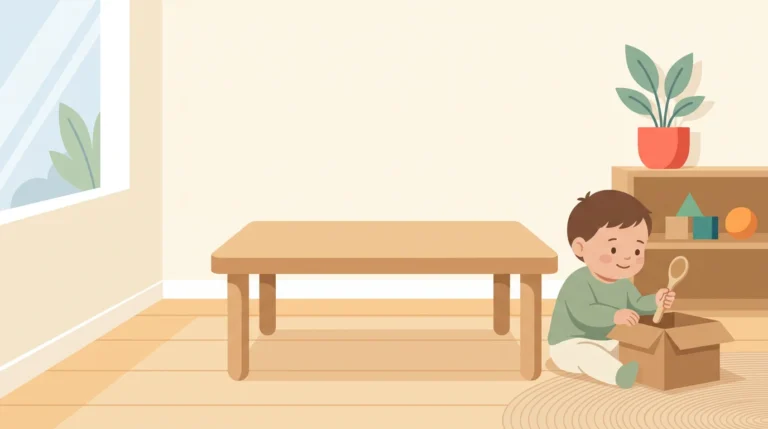
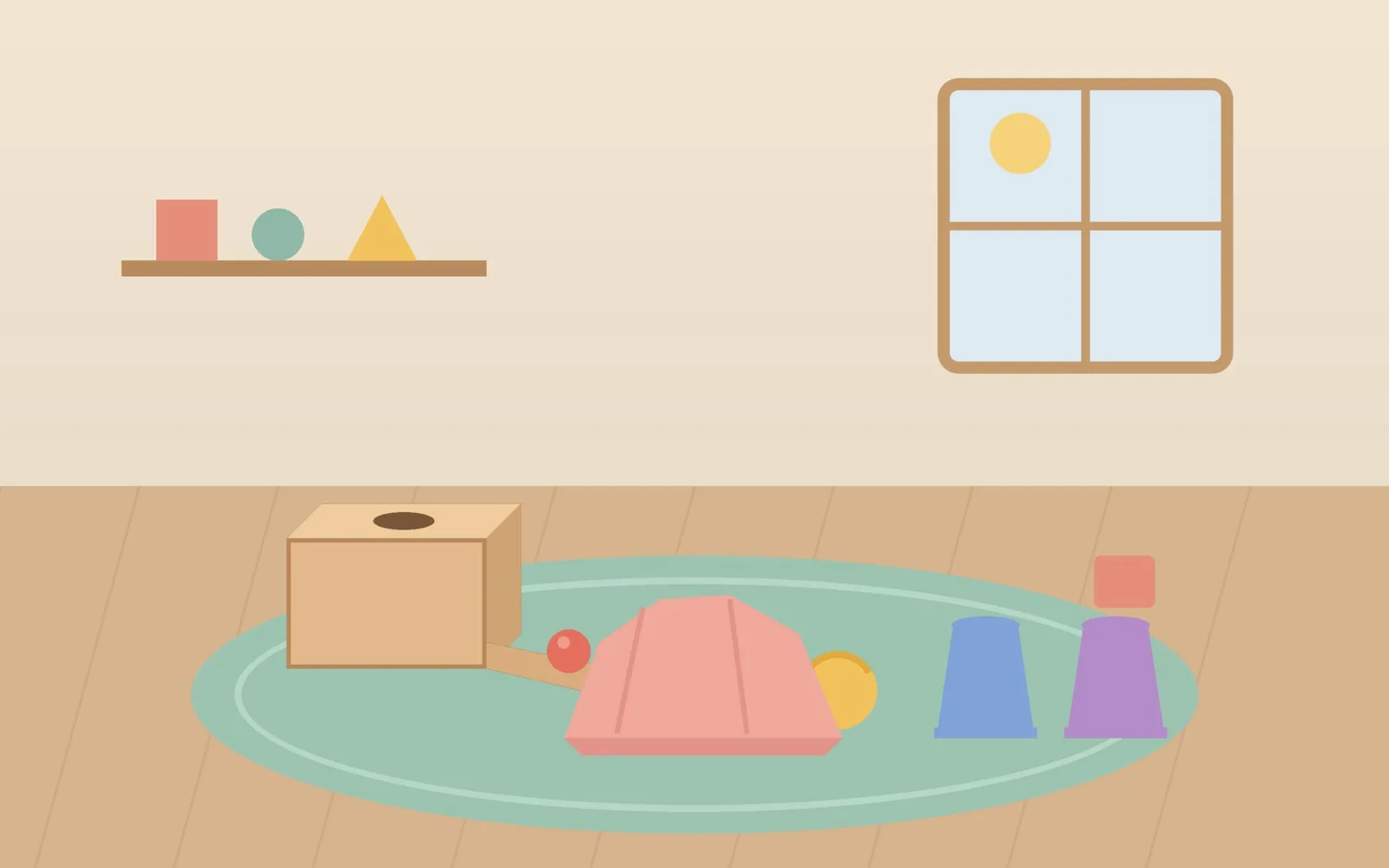
- Object permanence box. This classic Montessori material is a small wooden box with a hole on top and a tray. The child drops a ball through the hole, it disappears, and it rolls back out into the tray. If you are choosing one, our checklist on how to choose Montessori toys helps you separate well-made pieces from gimmicks.
- Posting games. Push large lids or chunky wooden discs through a slot in a container and open the lid to find them again.
- Hide-and-find around the room. Hide a teddy behind the couch while your toddler watches, then move to spots they did not see. Narrate: “Teddy is hiding. Let’s look under the table.”
- Tidy-up as a game. Toys “go to sleep” in their basket and come back tomorrow, which builds memory for where things belong.
For more ideas that fit this age, see our list of at-home activities for 1-year-olds and our guide to sensory play by age.
Keep hiding games safe
- Watch the size of hidden objects. In the U.S., toys for children under 3 must not have parts that fit entirely inside a test cylinder about 1.25 inches (31.7 mm) wide and 2.25 inches (57.1 mm) deep, because pieces that small are a choking risk. Use the same rule of thumb at home: if it fits inside a toilet-paper tube, it is too small for hiding games.
- Use light, breathable cloths and never cover your baby’s face or head. Babies should do the uncovering, not be covered.
- Stay within arm’s reach for cloth, scarf and box games, and put materials away afterwards.
- Skip anything with strings or long ribbons, which can wrap around a neck.
When to talk with your pediatrician
Babies vary a lot in how and when they show this skill, and a baby who is not interested in a hiding game on a given day is not a cause for concern. It is worth bringing up at a checkup, or calling sooner, if:
- By about 9 months your baby does not look for a toy that was dropped out of sight, or by 12 months does not look for a toy they watched you hide.
- Your baby shows little interest in faces, rarely makes eye contact, or does not respond to peekaboo or their name by around 9 months.
- Your baby has trouble following objects with their eyes, or you have any concern about how they see or hear.
- Your baby has lost skills they used to have, at any age.
- Separation anxiety is so intense or long-lasting that it disrupts daily life, or it continues every day beyond the preschool years.
The CDC’s advice is straightforward: if your child is not meeting one or more milestones, has lost skills, or you have other concerns, talk with your child’s doctor and ask about developmental screening. In the U.S., you can also contact your state’s early intervention program directly. Milestone checklists are not a diagnosis, and only a developmental screening or evaluation can tell you whether extra support would help.
Frequently asked questions
At what age do babies have object permanence?
It develops gradually. Early signs appear after about 4 months, most babies search for a fully hidden toy around 8 to 10 months, and most look for a toy they watched you hide by 1 year. Harder versions, such as finding something that was moved while hidden, keep developing in the second year.
Is peekaboo really good for babies?
Yes. Peekaboo lets your baby practice the idea that something hidden comes back, and it is social, which makes it fun. The AAP and the CDC both suggest peekaboo and hide-the-toy games as ways to support this stage.
Does object permanence cause sleep regression?
It can play a role. Once babies understand that you exist when you are not in the room, many begin protesting separations, including at bedtime and during night wakings. The AAP describes separation anxiety as a common cause of disrupted sleep starting in the second half of the first year. A consistent routine and calm, brief reassurance usually help.
Do I need an object permanence box?
No. It is a nice, durable toy for older babies and young toddlers, but a cloth, a few cups and a shoebox with a hole cut in the lid teach the same idea. Choose whatever you will actually use.
My baby doesn’t search for hidden toys yet. Should I worry?
Not necessarily, especially before 9 to 10 months. Some babies are simply more interested in moving than searching. Try making it easier, with part of the toy showing or a toy that makes sound. If your baby is not looking for hidden objects by around 1 year, or you have other concerns, mention it to your pediatrician.
Sources
- American Academy of Pediatrics, HealthyChildren.org: Cognitive Development in Infants: 4 to 7 Months
- American Academy of Pediatrics, HealthyChildren.org: Cognitive Development in Infants: 8 to 12 Months
- Centers for Disease Control and Prevention: Milestones by 9 Months and Milestones by 1 Year
- American Academy of Pediatrics, HealthyChildren.org: Separation Anxiety & Sleeping Trouble in Young Children
- American Academy of Pediatrics, HealthyChildren.org: How to Ease Your Child’s Separation Anxiety
- Nemours KidsHealth: Separation Anxiety
- American Academy of Pediatrics, HealthyChildren.org: A Parent’s Guide to Safe Sleep
- American Academy of Pediatrics, HealthyChildren.org: Corrected Age for Preemies
- Object permanence in 3½- and 4½-month-old infants. Developmental Psychology, 1987;23(5):655–664: doi:10.1037/0012-1649.23.5.655
- Factors affecting infants’ manual search for occluded objects and the genesis of object permanence. Infant Behavior & Development (free full text, PubMed Central): PMC2697063
- U.S. Code of Federal Regulations, 16 CFR 1501.4: Small parts size requirements and test procedure
This article is for general information and does not replace advice from your child’s pediatrician.