Sensory Bins for 2 Year Olds and 1 Year Olds: Choose by Mouthing, Not Birthday

Search for sensory bins for 2 year olds and most lists give you the same nine ideas with a different photo, plus one line at the bottom telling you to supervise closely. That line is doing all the safety work, and it is not enough. Age on the label does not tell you whether a bin is safe for your child today. Whether that child still puts things in their mouth does.
This article uses one test, not a birthday, to decide what belongs in a bin. Run the two-minute mouthing check below once, then use the three material tiers that follow to pick fill, tools, and setups that match what your child actually does with objects right now. A cautious 15-month-old who explores mostly with her hands can handle a bin that a mouthing 26-month-old cannot, and the check tells you which one you have.
The two-minute mouthing check
Before you fill a bin, run this check once. Put one large, safe item on a tray: too big to fit inside a closed fist, made of wood, silicone, or thick plastic, with no small parts. A large silicone cup or a jumbo teether both work. Sit within arm’s reach and watch what your child does with it for two minutes, without prompting. You want their first instinct, not their best behavior.
- Mouths it within the first few seconds and keeps returning it to the mouth: treat this child as Tier 1 for now.
- Explores it with hands first, and mouths it only after several minutes, or only when tired or teething: treat this child as Tier 2.
- Explores it with hands the whole time and does not mouth it at all in two minutes: treat this child as Tier 3.
Run the check again every few weeks, and after a new tooth, an illness, or a big change like starting daycare. Mouthing comes back during stress and teething even in children who had stopped. The tier is a snapshot of this week, not a permanent label.
What actually changes between one and two
Two real things change between 12 months and 24 months, and neither is mouthing fading on a fixed schedule.
By around 12 months, most children have a pincer grasp: thumb and forefinger together, precise enough to pick up one small piece at a time. That helps with pouring and sorting, and it is also why an older, more coordinated toddler can pick up a single grain of rice and aim it at their mouth far more accurately than a 1 year old grabbing with a fist. Fine motor skill and mouthing are separate things: a child can be excellent with their hands and still be a heavy mouther.
Somewhere between 18 and 24 months, imitation gets more reliable, which is what makes a first tool worth introducing at Tier 2. By 24 months, many children follow a two-step instruction, such as put the scoop in the bowl, then hand it to me, so you can coach behavior in the moment instead of only removing the bin. For more on this stage, see our guide to sensory play for 1 year olds.
The other real change is deliberate dumping and throwing. A 1 year old drops things to see what happens; a 2 year old dumps a bin on purpose, watches your face, and often does it again. That is a normal stage, not defiance, and it is why the containment section further down exists.
Tier 1 bins for a child who still mouths everything
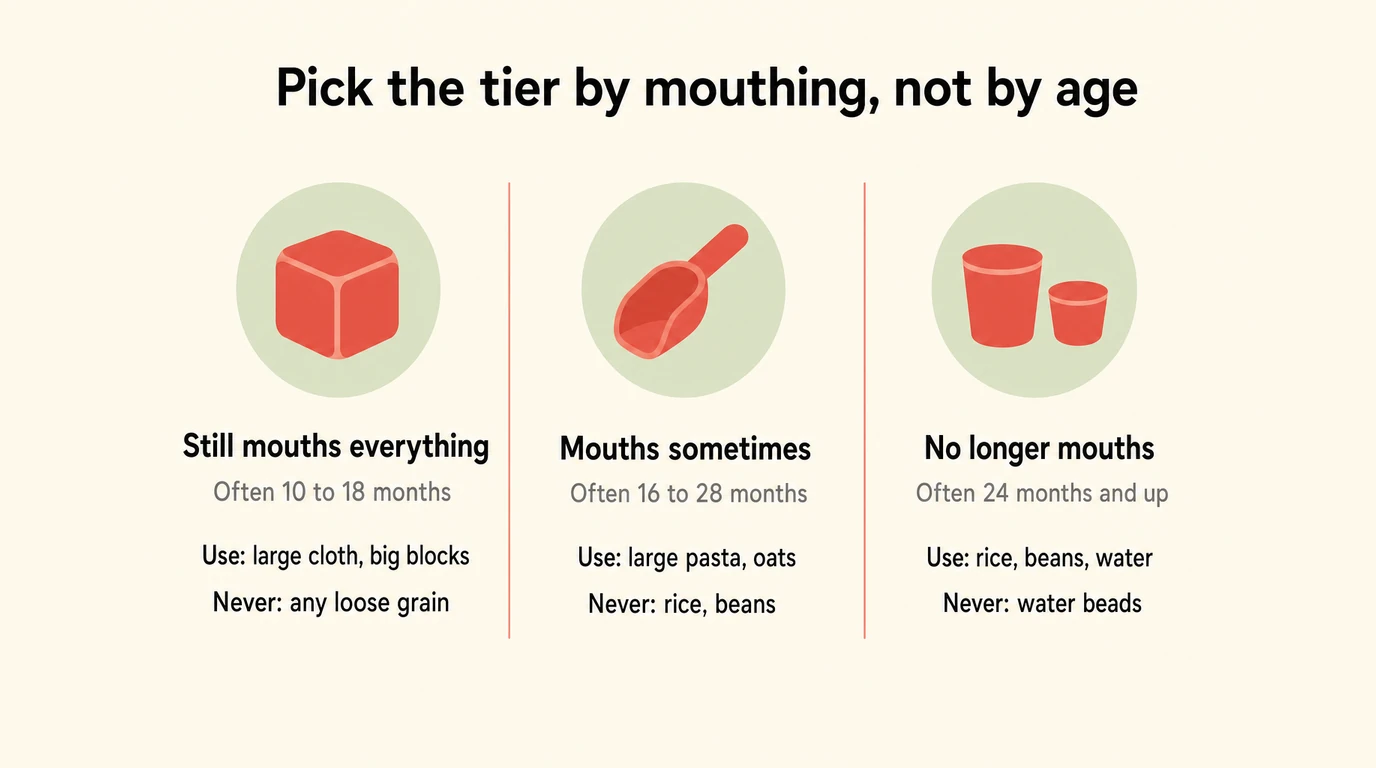
If the mouthing check showed immediate, repeated mouthing, stay in Tier 1. Everything in the bin must be larger than your child’s fist and either genuinely food-safe or a single solid piece with nothing to pull apart. No loose grains, no exceptions. This is where most sensory bins for 1 year olds belong, along with any 2 year old whose check came back Tier 1. Stay within arm’s reach the whole time; this is not a tier for stepping away to load the dishwasher.
Safe fill: large wooden or silicone kitchen tools (big cups, bowls, spoons); fabric squares in different textures; a single large ice block, removed once it melts small enough to fit a fist; large, soft foam shapes or balls. Tools: hands only, or one oversized scoop too big to enter the mouth. Never in this tier: any loose grain, water beads, buttons, pom poms, small toys, or anything that fits through a toilet paper tube.
Textures without pieces
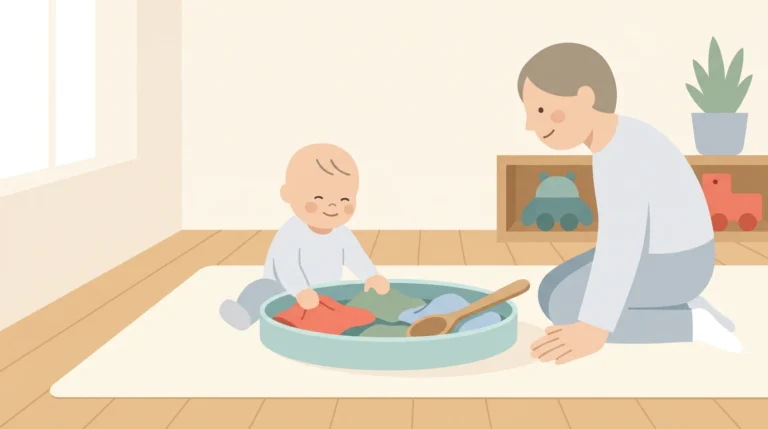
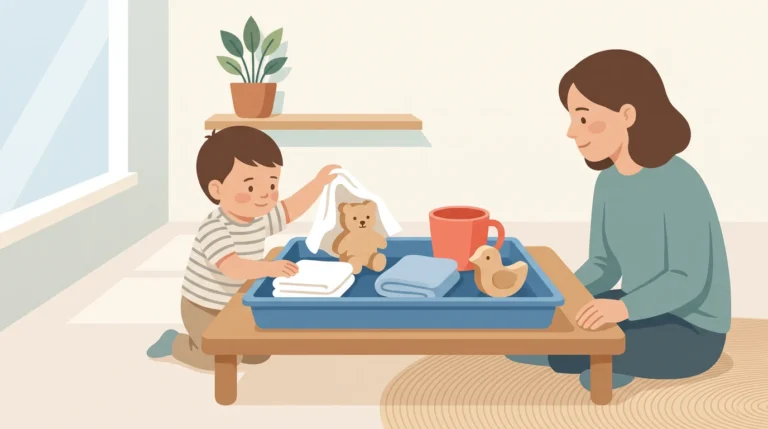
Fill a shallow bin with fabric squares in four or five textures: terry cloth, silk, corduroy, faux fur. Add one big wooden spoon. Your child can mouth the fabric freely, since fabric this size cannot be swallowed or inhaled.
Melt and squeeze
Freeze water in a loaf pan to make one large ice block. Set it in a shallow tray with a big silicone cup for scooping the melt. Take it out once a broken piece would fit inside your child’s fist.
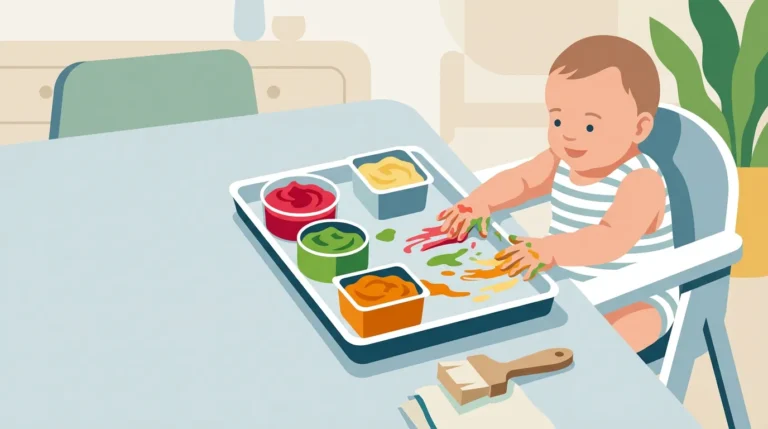
For messier hands-on play at this same mouthing stage, taste-safe paint is a good option to add into the rotation.
Tier 2 bins for a child who mouths sometimes
If your child explored with their hands first and only mouthed the item when bored or tired, Tier 2 fits: sensory bin ideas for 1 year olds who are further along, and a sensory bin for 2 year old children who mouth occasionally rather than constantly. It introduces the first loose, edible fill and a first tool, but supervision stays at arm’s reach, not across the room, since occasional mouthing can happen without warning.
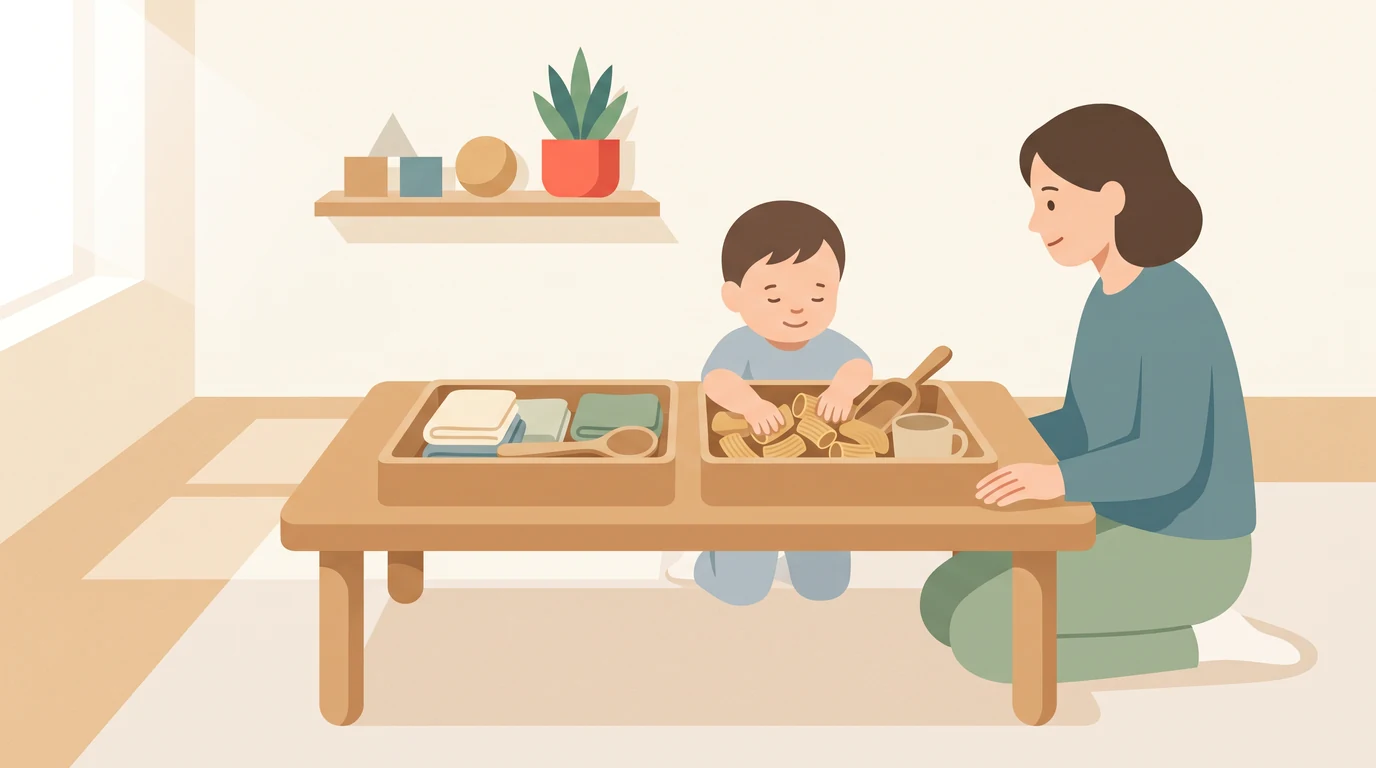
Safe fill: large dry pasta such as rigatoni, farfalle, or jumbo shells, straight from the box; rolled oats, measured a cup or two at a time; cooked and cooled pasta for a softer version. Tools: a big spoon or scoop, plus one first tool such as a small sieve or large, blunt tongs. Never in this tier: rice, dry beans, corn kernels, popcorn, small pasta like orzo or stars, glitter, fine powders such as flour or cornstarch (inhaled as dust in a single breath, a different hazard again from grains), and water beads.
Big pasta scoop and pour
Fill a shallow bin halfway with dry rigatoni or farfalle. Add two bowls and one big scoop, and show your child how to move the pasta between them. Stay close, and stop if it goes in the mouth more than once.
Oat cloud
Pour two cups of rolled oats into a shallow tray with a wooden spoon and small cups. Oats are soft enough that an accidental mouthful breaks down easily, a good bridge fill while you watch for mouthing habits to fade.
Tier 3 bins for a child who no longer mouths
If your child explored the test item with hands the whole two minutes and never mouthed it, Tier 3 opens up: dry rice, dry beans, small scoops, sorting, and water at real depth. No longer mouthing does not mean choke-proof; the automatic hand-to-mouth reflex has faded, not the need for supervision. Stay within arm’s reach, since a child who does not habitually mouth objects can still put one in their mouth on purpose, mid-game, in seconds.
Safe fill: dry rice, plain or dyed; dry beans or chickpeas; small dry pasta; dried corn kernels or split peas; water a few inches deep. Tools: small scoops, tongs, sieves, funnels. Never in this tier: water beads, fine powders, or anything small enough to lodge in a nostril or ear, since a no-longer-mouthing 2 year old will sometimes push objects somewhere other than the mouth.
Rice and scoop sorting
Dye a batch of rice (our guide to making a sensory bin covers the method) and split it across small bowls by color. Give your child small cups and a funnel to sort and pour. Dry rice is small, hard, and light enough to be breathed in rather than swallowed, so stay close rather than stepping away.
Water table with cups and sieves
A few inches of water in a low bin, with cups, sieves, and a funnel, belongs at Tier 3, not Tier 1 or 2, because it takes real coordination to pour without dumping water over their own face. Never leave a child alone with even a shallow bin, and empty it the moment play ends.
Sensory bins for 2 year olds vs 1 year olds: comparing the three tiers at a glance
The age ranges below overlap on purpose. A cautious 15-month-old can sit in the Tier 1 column next to a determined 22-month-old, and a mouthy 28-month-old can still belong in Tier 2. The overlap is the point: use the mouthing check to place your child, and the age range only as a sanity check.
| Tier | Safe fill | Tools | Never in this tier | Typical age range |
|---|---|---|---|---|
| Tier 1: still mouths everything | Fist-size or larger solid and food-safe items only, no loose grain | Hands, or one oversized scoop | Any loose grain, water beads, small parts, buttons, pom poms | 9 to 22 months |
| Tier 2: mouths sometimes | Large dry pasta, rolled oats, in limited amounts | Big spoon or scoop, plus one first tool (sieve or tongs) | Rice, dry beans, corn kernels, small pasta, fine powders, water beads | 15 to 30 months |
| Tier 3: no longer mouths | Dry rice, dry beans, small pasta, water a few inches deep | Small scoops, tongs, sieves, funnels | Water beads, fine powders, anything nostril or ear size | 22 to 36 months |
Moving a bin up a tier without buying anything
You do not need new equipment to move a child up a tier. You need one changed variable at a time, so that if mouthing shows up again, you know exactly what caused it.
- Keep the same container and tool. Change only the fill, mixing a small handful of the next tier’s fill into the current one rather than swapping it outright.
- Watch two or three sessions. If the new fill goes in the mouth, remove it and stay at the current tier a few more weeks.
- If it goes unmouthed across those sessions, increase the amount, then introduce the next tool. Change one thing at a time, never all three at once.
Going back down a tier after a regression is normal, not a setback. Teething, illness, or a new daycare room can bring mouthing back in a child who had stopped for months. Dropping to Tier 1 for two weeks is not undoing progress; it is responding to the child you actually have that week. Once a bin is at the right tier, our sensory bin ideas hub has themed variations to keep it interesting without changing the risk.
When the bin gets dumped, thrown, or eaten
Tipping the whole bin over is usually the deliberate dumping stage from earlier, not aggression. Say the fill stays in the bin in a calm, flat voice, guide it back in together, and keep going. Throwing individual pieces is different, and usually means the fill is tempting to launch or the setup is not holding attention. Pause, restate the boundary once, and reduce the fill or swap the tool. If it happens every session, the bin may be the wrong activity for now.
What a mouthful means depends on what is in the bin. Fabric or oats in the mouth is rarely an emergency, since those fills were chosen precisely because a mouthful is not dangerous. Large dry pasta is harder and worth watching for, due to size and hardness rather than toxicity.
A mouthful of dry rice or dry beans is a bigger deal, and the reason matters more than the rule. Choking is a blocked airway from something too big to swallow. Aspiration is different: something small, hard, and light, like a grain of rice, gets breathed in rather than swallowed and travels toward the airway or lungs, often with no gagging or dramatic moment at all. It can then irritate the airway in a way that shows up hours or days later as a new cough, wheeze, or fever with no cold to explain it. That is why Tier 3 fill waits for children who no longer mouth: grains are not more toxic than oats, but their size and hardness make them the shape most likely to slip into an airway instead of a throat.
If a child ever cannot cry, cough, or breathe after something goes in their mouth, that is choking, and it is a call to 911, not a wait and see situation. If a bin session involved rice, beans, or any small dry fill and your child develops a new cough, wheeze, or fever in the following days with no cold to explain it, tell your pediatrician what was in the bin.
Setting up so cleanup is not the reason you stop
A bin that takes fifteen minutes to clean up gets used once.
- Put a flat sheet or shower curtain under the bin. Loose fill gathers into a corner in one shake instead of scattering.
- Do dry-fill bins in an empty bathtub, where spills collect near the drain and wipe up in under a minute.
- Take wet or messy bins outside onto a patio or driveway, where a hose finishes the job.
- Pick a container that is wide and shallow, small enough that your child can reach the bottom without climbing in. A large under-bed storage lid beats a tall toy bin here.
Frequently asked questions
Is dry rice safe for a 1 year old sensory bin?
Not usually. Most 1 year olds are still mouthing, which puts them in Tier 1, and dry rice is a Tier 3 fill. Run the mouthing check first, since some children move past mouthing earlier or later than most.
What age can toddlers use rice or bean sensory bins?
There is no fixed age. Tier 3 typically fits between 22 and 36 months, but the mouthing check decides it, not a birthday.
Are water beads ever appropriate for a toddler sensory bin?
No, at any tier. The Consumer Product Safety Commission has linked water beads to serious ingestion injuries in young children, including at least one reported death, and approved a new federal safety standard for water bead toys because of the ingestion, aspiration, and choking risks they pose. Skip them entirely.
My 2 year old still mouths toys. Is that a problem?
It is common, not a sign something is wrong. Mouthing typically fades between 18 and 24 months, but plenty of 2 year olds still do it. Use the mouthing check and stay at the tier it points to.
What is a good first sensory bin for a 1 year old?
Start at Tier 1 regardless of exact age: fabric squares, big silicone cups, or a large ice block, with you within arm’s reach throughout. See our list of activities for 1 year olds for more first ideas.
Sources and notes
This article was checked against publicly available guidance from the Consumer Product Safety Commission and the American Academy of Pediatrics, including the AAP’s HealthyChildren.org resource on choking prevention. The CPSC’s small parts standard, which defines a choking hazard for children under 3 using a test cylinder roughly the size of a young child’s throat, informed the fist-size threshold used across all three tiers. CPSC’s recent warnings and federal safety standard for water bead toys informed the recommendation against water beads at every tier. The developmental points referenced reflect the CDC’s Learn the Signs, Act Early milestone checklists. None of this replaces individual medical advice; if you have specific concerns, talk to your pediatrician.
Sources checked on October 25, 2026. Primary references: